LOOKPORT / TICKETING & EVENT BUDGETING
Concert budget breakdown: UK PRS, break even model and calculators
Budget first checklist for UK promoters. Model gross potential, include PRS licence costs, and use calculators with a copyable budget template to find...

A concert budget breakdown lists every cost and revenue line tied to a show, then reduces them to one number: the break-even point. Your first task is to calculate gross potential, capacity multiplied by average ticket price across all tiers, and work out the ticket price or sell-through rate needed to cover costs. Artist guarantees and PRS/PPL licensing fees are often among the largest lines, so get those figures early.
TL;DR:
- Sales pace and historical demand patterns should be monitored two to three weeks before the event to adjust marketing efforts accordingly.
- Licensing fees, especially PRS tariffs, depend on application timing and must be accounted for early to avoid higher late fees or higher rate bands.
- Costs related to artist guarantees, venue charges, production, and licensing are the largest expenses, requiring detailed itemization before negotiations.
- Revenue streams beyond ticket sales, such as sponsorship, merchandise, and concessions, must be estimated separately to accurately gauge gross potential.
- Using scenario modeling with fixed, target, and stretch forecasts helps identify the financial risk and the minimum sell-through needed to break even.
- ✓Model concert costs and ticket prices
- ✓Estimate revenue and break-even
- ✓Compare fixed, target and stretch forecasts
Table of Contents
- Full expense breakdown: every cost line to include
- Revenue streams, gross potential and ticket pricing explained
- Scenario modelling and a copyable budget template
- Practical cost-control tactics and negotiation levers
- Licences, reporting and mandatory costs that affect budgets and timing
- Recommended tools and Lookport calculators: what inputs they need and what they return
- Post-event financial reconciliation and reporting processes
- Audience capacity impact on budget planning and scalability
- Common pitfalls in concert budgeting and how to avoid them
- Next step: try Lookport ticketing or the break-even calculator
- Sources
- FAQ
Full expense breakdown: every cost line to include
A concert budget only works when every cost is itemised before you start negotiating. Missing a single category, particularly licensing or contingency, skews your break-even calculation and leaves you exposed on the night.
Start with the artist. Fees are usually the single largest expense and are paid as a guarantee, sometimes with a percentage override once ticket sales pass an agreed threshold. Riders add cost beyond the headline fee: hospitality requirements, technical specifications and travel clauses all carry a price, and deposits (commonly a percentage of the fee) are due on signing, well before doors open.
Venue costs go beyond the hire fee itself. Ancillary charges, including cleaning, security deposits, restoration levies for historic buildings and facility fees for box office or bar services, can add a meaningful percentage on top of the headline rental figure. Ask for a full schedule of venue charges before you commit.
Production is where budgets swell fastest. Sound, lighting, staging and rigging are usually quoted separately, and crew are paid per day rather than per show, so a longer build or get-out adds cost even if the performance itself is unchanged.
Transport, freight and accommodation apply to both artist and crew. Tour buses, flight cases, hotel rooms and per diems all belong on the same line group, since they move together as the show moves between venues.
Marketing, ticketing commissions and payment processing eat into revenue rather than sitting as a standalone expense. Ticketing platforms typically charge a commission per ticket, and card payment processing adds a further percentage on top, so these figures need to be modelled against gross potential, not treated as a fixed cost.
Licences and royalties are frequently underestimated. PRS applies tariffs to gross ticket receipts for events featuring copyrighted music, with published tariff documents setting out percentage bands, reduced rates for qualifying festivals, and minimum charges that apply regardless of turnout. Applying late can mean paying a higher rate.
Insurance, stewarding and health and safety compliance are non-negotiable cost lines rather than optional extras. Public liability cover, event insurance and a stewarding plan sized to capacity all need pricing before you set your ticket price, since regulators and venues will require proof of cover before granting a licence.
Catering and hospitality cover both audience-facing concessions and artist rider requirements, which are contractually fixed and must be budgeted as such rather than estimated loosely.
Merchandise has its own cost structure: production, fulfilment and any revenue split with the artist or their merchandise company need separate lines, since gross merchandise sales rarely reflect net income to the promoter.
Finally, contingency and tax treatment close the list. A contingency line protects against overruns; VAT treatment of ticket sales and expenses needs to be confirmed with an accountant, since treatment varies by event type and organiser status.
The full checklist, in the order most promoters build it:
- Artist fees and rider costs: guarantee, deposit schedule, technical and hospitality rider items.
- Venue hire and ancillary charges: rental, cleaning, restoration levy, facility fees.
- Production: sound, lighting, staging, rigging and per-day crew rates.
- Transport and accommodation: freight, travel, hotels and per diems for artist and crew.
- Marketing and ticketing costs: advertising spend, platform commission, card processing fees.
- Licences and royalties: PRS and PPL tariffs, application deadlines, minimum charges.
- Insurance and security: public liability, event cover, stewarding and health and safety compliance.
- Catering and hospitality: audience concessions and artist rider catering.
- Merchandise: production, fulfilment and any revenue split.
- Contingency and tax: an overrun buffer and confirmed VAT treatment.
Revenue streams, gross potential and ticket pricing explained
Gross potential is the ceiling your budget works against: it is the total revenue possible if every ticket across every tier sold at full price. Calculating it early tells you, before a single ticket is sold, whether the show can plausibly cover its costs.
- Calculate gross potential: multiply each tier’s capacity by its ticket price, then add the tiers together. A venue with 800 standard tickets at £35 and 200 VIP tickets at £75 has a gross potential of £43,000.
- Add secondary revenue: sponsorship, merchandise splits and concessions sit alongside ticket income and should be estimated separately, since they depend on different assumptions (sponsorship on contract value, merchandise on historical per-head spend, concessions on capacity and dwell time).
- Deduct fees to reach net receipts: platform commission and card processing reduce what actually lands in the organiser’s account, so the budget should show gross ticket price, fees deducted, and net receipts as three distinct rows rather than one blended figure. A ticket revenue calculator can do this arithmetic automatically once fee rates are entered.
- Divide total costs by gross potential to find required sell-through: if total costs are £30,000 against a £43,000 gross potential, you need roughly 70% of tickets sold to break even, before accounting for fees.
- Revisit forecasts against pacing: ticket sales rarely arrive evenly. Early sales pace against historical patterns for similar shows should tell you, two to three weeks out, whether you are tracking toward your target sell-through or need to intervene with marketing spend.
VAT treatment on ticket sales varies depending on the organiser’s status and the nature of the event, so net receipts should always be shown after an assumed VAT treatment confirmed with an accountant rather than left as a gross figure. Concert ticket prices and gross takings have risen markedly over recent years as touring economics have shifted toward live revenue, which makes an accurate gross potential calculation more important than ever when comparing a show against past benchmarks.
Scenario modelling and a copyable budget template
Modelling three scenarios, rather than a single forecast, shows you the range of outcomes a show can realistically produce and where the financial floor sits. A conservative scenario should still cover fixed costs even at low sell-through; a target scenario reflects your realistic marketing-backed forecast; a stretch scenario shows the upside if the show sells out or trades up to higher tiers.
The figures below are a hypothetical example only, built to illustrate the template rather than represent typical costs for any real show.
This hypothetical example assumes fees at 6% of gross ticket revenue and a flat £30,000 cost base that does not vary with attendance. In practice, some costs (stewarding numbers, bar staff, box office temps) do flex with expected turnout, so a real template should split each cost line into fixed and variable columns rather than a single total.
A usable template needs five sections: income (by tier and secondary stream), detailed expenses (grouped as in the checklist above), a net profit and loss summary, a cashflow timeline showing when deposits and settlements fall due, and a contingency row sized as a percentage of total costs. Running the same structure through the Concert Profit & Tour Budget Calculator lets you swap sell-through assumptions without rebuilding the spreadsheet each time.
Pro Tip: Build your fixed costs first and check they can be covered by conservative-scenario net revenue alone; if they cannot, the show needs a higher guarantee ceiling or a smaller venue before you book anything.
Practical cost-control tactics and negotiation levers
Cutting costs without cutting quality means knowing which levers actually move the budget and which just shift risk elsewhere.
- Bundle venue and production: some venues offer in-house production packages at a discount versus bringing an external supplier, in exchange for exclusivity on catering or bar rights.
- Budget marketing against gross potential, not total cost: spending a fixed percentage of gross potential on marketing, rather than an arbitrary share of the overall budget, keeps selling pressure proportional to what the show can actually earn.
- Use limited early-bird tiers: releasing a capped number of discounted tickets first creates urgency and gives you an early read on demand before committing to full marketing spend.
- Show fees transparently at checkout: buyers who see the ticket price and the fee separately, rather than one inflated final figure, are less likely to abandon at checkout, and a ticketing fee calculator helps you model that split before pricing.
- Monetise per-head extras: VIP packages, sponsorship activations and merchandise all add revenue without changing the core ticket price, which protects your headline pricing strategy.
- Stage payments to protect cashflow: sizing deposits and settlement terms so major outgoings (artist balance, production settlement) fall after ticket revenue has started arriving reduces the risk of a liquidity gap mid-planning.
Pro Tip: Negotiate crew day rates and get-in/get-out timing together, since a shorter build often reduces both the crew bill and the venue overtime charge in one move.
Licences, reporting and mandatory costs that affect budgets and timing
PRS licensing is a mandatory cost for concerts featuring copyrighted music, and the rate you pay depends partly on when you apply. Published PRS tariff guidance sets out percentage bands applied to gross ticket receipts, with reduced bands available for qualifying festivals and explicit minimum charges that apply even to low-turnout events.
PRS applies its licence fee as a percentage of gross ticket receipts, with minimum charges set out in its published tariff, and applying within the required timing window affects which rate applies. Missing the deadline can move an event into a higher percentage band, which changes the budget after the fact rather than before it.
PRS’s definition of gross receipts typically includes the full ticket price before deductions, which promoters sometimes overlook when reporting net rather than gross figures. Insurance and stewarding requirements often carry their own minimums set by the venue or local licensing authority, and these minimums should shape how large a contingency line you carry rather than being treated as fixed costs with no flex. Licensing, insurance and tax treatment are areas where a qualified entertainment lawyer or insurance broker should review your specific event rather than relying on general guidance.
Recommended tools and Lookport calculators: what inputs they need and what they return
Any budgeting tool needs the same core inputs to be useful: venue capacity, ticket tier prices, platform and card fees, the artist guarantee, a fixed versus variable cost split, and a contingency percentage. Feed those in accurately and the tool returns your break-even point, the sell-through rate required to hit it, how sensitive profit is to small changes in ticket price, and when cash actually lands against when bills fall due.
- Concert Profit & Tour Budget Calculator: models break-even and ticket-price sensitivity across a single show or a full tour.
- Ticket revenue calculator: calculates net revenue per ticket after platform and card fees are deducted.
- Sales pacing calculator: tracks sell-through velocity against target and flags when marketing spend needs to increase.
Export the results to a spreadsheet once you are comparing more than two scenarios side by side, since a spreadsheet makes it easier to line up conservative, target and stretch outcomes against your cashflow calendar.
Post-event financial reconciliation and reporting processes
Once the show is over, reconciliation means matching every budgeted line against what was actually spent and earned. Start with ticket revenue: confirm the final sell-through figure against the platform’s settlement report, then check that fees deducted match the rate you were quoted.
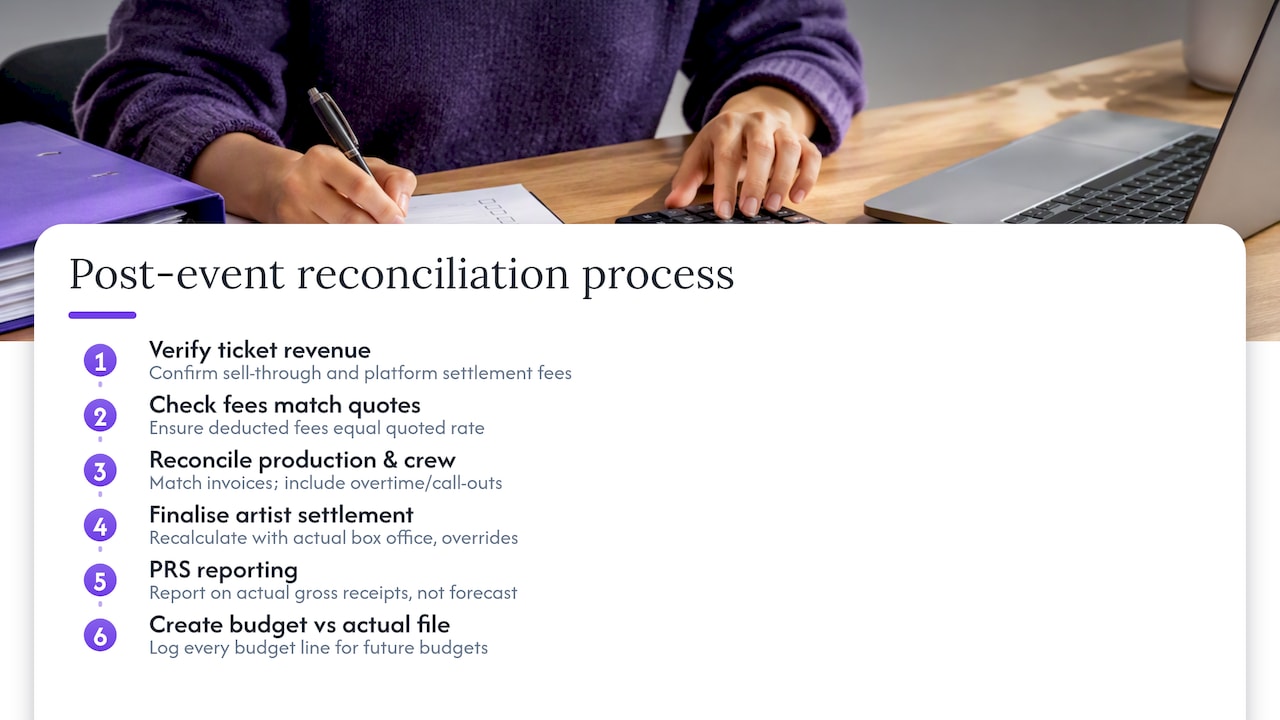
Next, reconcile production and crew costs against invoices, since day-rate crew and hired equipment often generate variations from the original quote once overtime or additional call-outs are included. Artist settlement, including any percentage override once a guarantee threshold was passed, needs a final calculation against actual box office, not the forecast used when booking.
PRS reporting is typically due after the event, based on actual gross receipts rather than the forecast used at the budgeting stage, so your final licence payment may differ from the figure held in your working budget. Keep a reconciliation file that lists budgeted versus actual for every line, since patterns across multiple events, a category that consistently overruns, for example, are the most useful input into your next budget.
Audience capacity impact on budget planning and scalability
Capacity sets the ceiling on gross potential, but it also changes which costs are fixed and which scale with attendance. A 500-capacity venue and a 5,000-capacity venue do not just differ in ticket volume: production scale, stewarding numbers, insurance minimums and even artist fee expectations typically shift together as capacity rises.
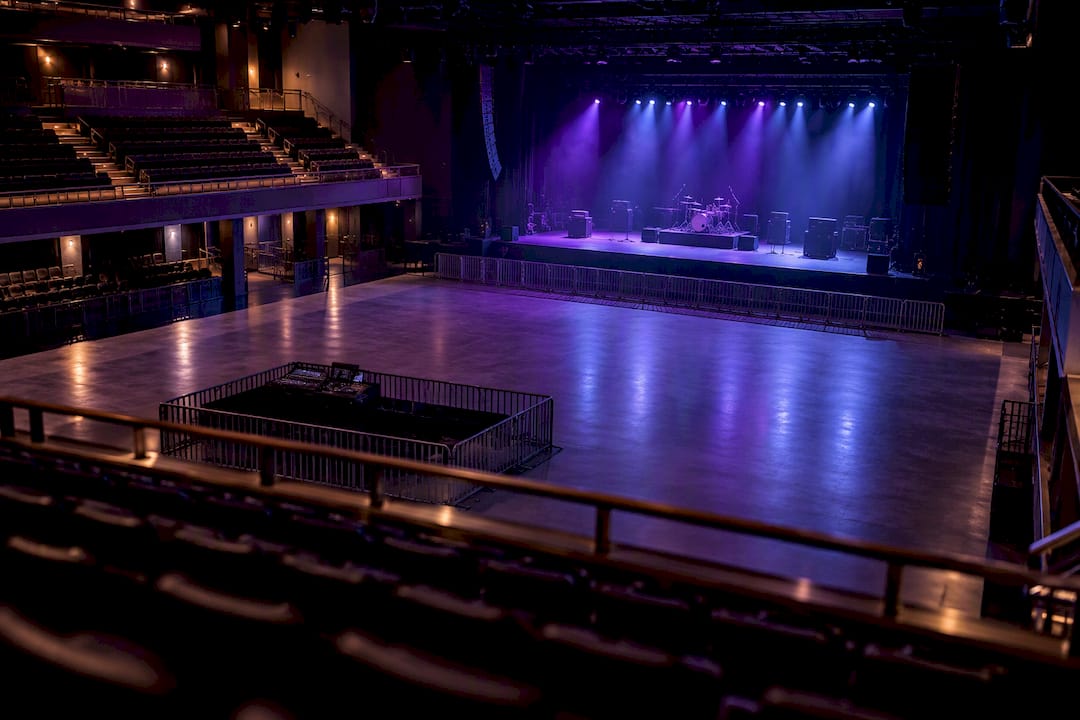
Smaller shows carry a higher proportion of fixed costs relative to gross potential, which means the break-even sell-through percentage is often higher even though the absolute cost figure is lower. Larger shows benefit from economies of scale on production and marketing per head, but they also carry a higher absolute cost base, so a shortfall in sell-through has a bigger cash impact.
Before committing to a venue size, check that your budget’s fixed costs can be covered at a conservative sell-through for that specific capacity, rather than assuming a bigger room automatically means a safer margin.
Common pitfalls in concert budgeting and how to avoid them
The most frequent budgeting mistake is treating ticketing and card fees as an afterthought rather than modelling them against gross potential from the start. Build net receipts into the budget from the first draft, not as a deduction applied after the show.
A second common error is underestimating licence costs by applying late or by reporting net rather than gross receipts to PRS, which can shift you into a higher rate band unexpectedly. Apply as early as the tariff timing rules allow.
Promoters also frequently skip contingency altogether, or set it too low to cover a genuine equipment failure or a weather-related delay for an outdoor show. Size contingency against the specific risks of the venue and event type, not a flat percentage copied from a previous, unrelated show.
Finally, cashflow timing gets overlooked in favour of the headline profit figure. A show can be profitable on paper and still run into a liquidity gap if artist deposits and production payments are due before ticket revenue starts arriving in volume, so the cashflow timeline deserves as much attention as the profit and loss summary.
Next step: try Lookport ticketing or the break-even calculator
A ticketing platform that already returns break-even, sell-through and cashflow figures saves you from rebuilding those calculations by hand every time a booking changes.
Lookport Ticketing charges a 6% commission with no other platform charges, and ticket proceeds go directly into the organiser’s own Stripe account rather than sitting with a third party before payout. Run your numbers through the Concert Profit & Tour Budget Calculator to see your break-even point before you commit to a venue or guarantee.
Sources
For licence rates and application timing, consult the PRS tariff documentation directly. For context on how ticket revenue is distributed across the live music industry, see this analysis of concert ticket economics.
- CT130/17 Performing Right Society Ltd and PACE Rights Management LLP - Tariff LP
- Where concert ticket money goes: who’s getting rich off live music’s golden age? | The Guardian
FAQ
How much does Taylor Swift charge per concert?
Specific artist fees for named touring acts are not publicly listed and vary enormously by market, venue and tour, so no single figure applies generally. Any concert budget should treat the headline artist fee as a negotiated, confidential line rather than a benchmarked figure.
What are the five components of a budget?
Definitions vary, but a concert budget commonly splits into income, fixed costs, variable costs, contingency and net profit and loss. Some templates separate cashflow timing as a sixth component, since when money moves matters as much as how much moves.
Is £300 a lot for a concert?
Whether a ticket price feels high depends entirely on the artist, venue tier and market, so there is no fixed threshold that defines “a lot”. Concert ticket prices have risen substantially over recent years as touring has become a larger share of artist income, which shifts what counts as typical for top-tier shows.
Is £200 a lot for a concert?
As with any ticket price, £200 sits within or above typical ranges depending on the artist’s profile and the venue tier rather than against any universal benchmark. Promoters setting prices at this level should model sell-through carefully against gross potential, since higher price points usually require a lower sell-through percentage to break even but carry more risk if demand falls short.
How do I calculate break-even for a concert?
Break-even is found by dividing total costs by gross potential to get the required sell-through percentage, or by dividing total costs by capacity to get the required average ticket price. Tools such as the Concert Profit & Tour Budget Calculator automate this once capacity, pricing and cost inputs are entered.
Recommended
Ticketing & event budgeting
 2026-10-22
Ticketing Analytics for UK Promoters: What to Track and Why
Ticketing analytics for UK concert promoters: the metrics that drive decisions, how to set up tracking, and how to tie sales data back to your show budget.
 2026-10-21
Concert Break-Even Calculator: How Many Tickets You Must Sell
Work out how many tickets a UK concert needs to break even. Costs, PRS, ticket commission, a worked example and a free calculator for promoters and venues.
 2026-10-19
Ticket Sales Break-Even Analysis for UK Shows
Work out how many tickets you must sell to cover a UK show: VAT, PRS, fees, fixed costs and a worked example, plus a free break-even calculator.
 2026-10-18
Refund Policy for Concerts: What UK Promoters Must Offer
What UK law and industry rules require when a concert is cancelled, moved or the buyer changes their mind, plus how to write a clear refund policy.
 2026-10-15
Facebook Ads for UK Promoters: Track Ticket Sales Before Spend
UK promoters can set up Meta pixel and Conversions API tracking, choose audiences, estimate ticket costs, and link Facebook ad spend to ticket revenue.
 2026-10-14
Profit Margins: Test 10 P&L Lines for UK Concert Promoters
See how UK concert promoters can model profit per show with 10 P&L inputs, test sell through and costs, and check break even before committing a deposit.