LOOKPORT / TICKETING & EVENT BUDGETING
Secondary Ticketing Law in the UK: A Promoter's Guide
What UK secondary ticketing law requires today, what the planned resale price cap means, and how promoters should set resale terms and budget for the change.

Resale of concert and event tickets is legal in the UK for most events, but it is regulated. Resale platforms must give buyers specific information under the Consumer Rights Act 2015. Using bots to buy past an event’s ticket limit is a criminal offence. Football tickets follow stricter rules. The government has announced a ban on reselling above face value, but that ban had not become law at the time of writing.
This guide is for promoters, venues and organisers. It sets out what the law says now, what is planned, what your own terms can and cannot do, and how to budget when resale rules are in flux. It is general information, not legal advice. For your own terms and conditions, take advice from a solicitor who works in consumer law.
TL;DR
- Online resale of live-event tickets is governed by consumer law, with specific secondary ticketing rules and an anti-bot offence, according to the House of Commons Library.
- The government announced a no-profit resale rule on 19 November 2025. Legislation will follow when parliamentary time allows, so the current rules still apply.
- You can restrict resale in your terms only if the restriction is clear before purchase and is not unfair. You cannot simply void a resold ticket.
- Publish a clear resale policy, offer a way for fans to return or resell tickets, and model a no-mark-up market in your break-even budget.
Table of Contents
- Is ticket resale legal in the UK?
- What the Consumer Rights Act 2015 requires
- Bots and buying above event limits
- Football and other live events
- What the planned resale ban means
- What your terms can and cannot do
- What a resale policy should cover
- Budgeting for a no-mark-up resale market
- Selling primary tickets with Lookport
- A short checklist before your next on-sale
- FAQ
- Next step
- Sources
Is ticket resale legal in the UK?
For most events, yes. The House of Commons Library briefing explains that online resale of live-event tickets is regulated by general consumer protection law, plus specific secondary ticketing rules in the Digital Economy Act 2017. The government has said it will legislate for further measures when parliamentary time allows.
The terms matter here. The primary market is where tickets are sold for the first time at their original price. The secondary market is where tickets are resold, often at a different price. Dynamic pricing, where a seller adjusts prices according to demand, time and availability, is a primary market practice. It is a separate issue from touting, though fans often confuse the two.
So the law today does not ban resale as such. It controls how resale is presented, how tickets are bought in bulk, and which terms an organiser can enforce.
What the Consumer Rights Act 2015 requires
The key provision for resale is section 90 of the Consumer Rights Act 2015. It applies to online secondary ticketing facilities, meaning the marketplaces and platforms where tickets are listed for resale. It requires a buyer to be given certain information:
- the seat or standing area, where applicable;
- any restriction that limits use of the ticket to people of a particular description;
- the ticket’s face value;
- a unique ticket number, where applicable.
The information must be clear and comprehensible, and it must be given before the buyer is bound by the contract. The enacted text of Part 3, Chapter 5 sets out the same duty.
As a primary seller you are not the facility in most cases. But your ticket data feeds what resale buyers see. Clear seat or area details, a visible face value and legible restrictions on the ticket help any resale buyer, and help you when a dispute lands on your desk.
Bots and buying above event limits
The Digital Economy Act 2017 created an offence for using automated software to buy more tickets than an event’s maximum permitted number. The offence is set out in The Breaching of Limits on Ticket Sales Regulations 2018. It applies to someone who uses purpose-designed software to buy tickets electronically above the limit, with intent to make a financial gain. The regulations cover events in England, Wales and Scotland, with provision to extend to Northern Ireland.
Two practical points follow for you:
- You set the limit. The offence is tied to the maximum number you set for the event. A clearly stated per-customer limit gives you something to enforce.
- Report attacks. The government’s response to Professor Waterson’s review encourages primary sellers to consider anti-bot measures, including confirmed-identity technologies. It also agrees that sellers should routinely report bot attacks to the police. The same review said CAPTCHA-type tools are not sufficient in most cases.
Whatever platform you sell through, ask how it handles purchase limits and suspicious bulk buying before you put a show on sale.
Football and other live events
Football is the exception that catches people out. Under section 166 of the Criminal Justice and Public Order Act 1994, unauthorised selling of tickets for designated football matches is an offence. That is a separate regime from the one covering concerts, theatre and comedy, which relies on consumer law and the bot offence.
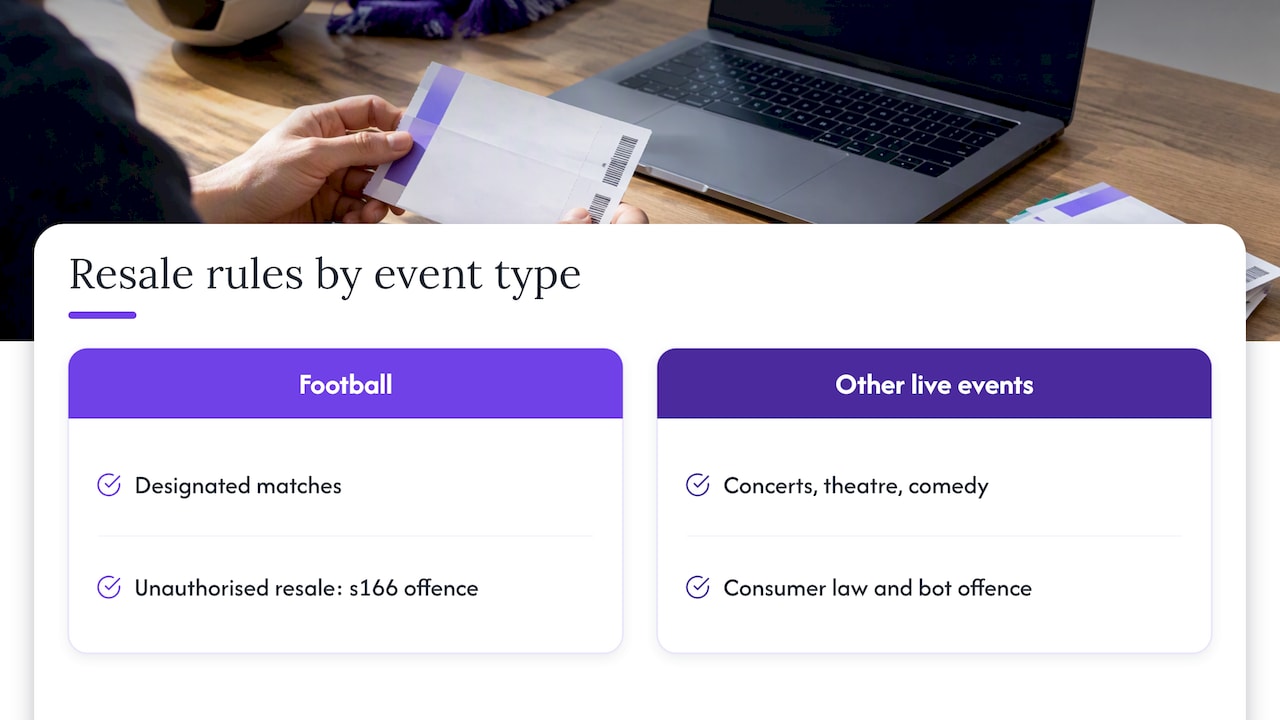
If you run a multi-use venue, keep the two regimes apart in your policies. A concert resale policy should not be copied across to a football fixture, and the reverse is also true. For football, check the current designation and requirements with the relevant authorities and your legal adviser.
What the planned resale ban means
On 19 November 2025 the government announced it would ban reselling live-event tickets above their original cost. The intended rule allows no mark-up above the original price, including unavoidable fees and delivery charges. The same response says legislation will be brought forward when parliamentary time allows. It has not yet become law.
The government’s announcement adds three details:
- Service fees charged by resale platforms are to be capped, so that the price cap is not undermined.
- Resale platforms will have a legal duty to monitor and enforce compliance.
- Businesses that break the rules could face penalties of up to 10% of global turnover under the DMCC Act 2024.
Treat this as direction of travel, not current law. Until legislation passes, the Consumer Rights Act, the bot offence and the football rules above are what apply. Check gov.uk for the current position before you finalise terms for any new on-sale.
What your terms can and cannot do
Many promoters write “tickets resold will be cancelled” into their terms. The law is narrower than that. The CMA-backed guidance for business says an organiser may cancel a ticket, or blacklist a seller, merely because it was resold only if two conditions are met:
- the original contract clearly provided for that consequence before purchase;
- the term is not unfair under Part 2 of the Consumer Rights Act 2015.
Unfair terms cannot be enforced against a consumer. The CMA’s update on unfair terms work adds that it is for the courts, not the CMA, to decide whether a term is fair.
That update also lists what reduces the risk of enforcement action:
- disclosing resale restrictions clearly and upfront;
- giving consumers a way to exchange, return or resell tickets, so they can recoup or limit their losses;
- issuing full refunds when tickets are voided;
- making sure buyers of resold tickets who were not told about restrictions do not lose out.
What a resale policy should cover
A short, plain-English policy beats a clause buried in the terms. Based on the sources above, cover these points:
| Policy point | What to state |
|---|---|
| Per-customer limit | The maximum number of tickets per order or person |
| Resale restrictions | Whether resale is restricted, where it is allowed, and the exact consequence of breach |
| Fan options | How a fan who cannot attend can return, exchange or resell at no profit |
| Voided tickets | When you may void a ticket and that a full refund follows |
| Buyers of resold tickets | How you treat a buyer who was not told about a restriction |
| Contact route | Who to email and what proof you need |
Put it where fans see it before they pay: the event page and the checkout, not only the footer. If you can only offer one fan-friendly mechanism, make it an official way to return or pass on a ticket at face value. It answers the loss-recovery point regulators raise, and it takes demand away from the touts.
Budgeting for a no-mark-up resale market
A resale ban affects your numbers in three ways. These are planning assumptions, not forecasts.
- Face value becomes the ceiling for the secondary market. Fans who now pay a premium on resale may come to you instead, or may not buy at all. Do not bake resale-driven demand into your sell-out assumption.
- Pricing pressure moves to the primary market. If you under-price to be safe, you leave margin on the table. If you over-price, you carry unsold stock. Test several price points rather than one.
- Compliance has a cost. Staff time for limits, refunds and fan queries should sit in your budget as a line, not an afterthought.
Here is a hypothetical example, for illustration only. A 1,000-capacity room sells at £30 face value. Your fixed costs are £14,000 and your variable cost is £1.50 a head. Ticketing commission is a further cost per ticket sold. At 700 tickets sold, revenue is £21,000. Costs are £14,000 plus £1,050 variable, so £15,050, before commission. That leaves £5,950 before commission and other costs. At 500 tickets sold, revenue is £15,000 against £14,750 of costs. The margin is almost gone. Run your own figures with different sell-through rates and prices to see where the line sits.
The tour break-even calculator lets you model costs, ticket prices, revenue and break-even for a show or tour. Use it to compare scenarios: a lower sell-through, a lower ticket price, an extra fee line for compliance.
Selling primary tickets with Lookport
Once your resale policy is set, you need a primary sales channel that fits your budget. Lookport Ticketing is built for concert promoters, event organisers and venues. We charge a 6% commission with no other Lookport charges, as shown on our pricing page. Ticket proceeds go directly into your own Stripe account, and availability follows Stripe-supported countries.
That flat commission makes it simple to put a clear figure into your break-even model. Our features are those described on lookport.live. We make no claim that any platform removes the need for your own resale terms, so keep that policy in place whichever platform you use.
A short checklist before your next on-sale
- Set and publish a per-customer ticket limit.
- Write your resale terms in plain English and show them before checkout.
- Offer a way to return, exchange or pass on a ticket at face value.
- Commit to full refunds for any ticket you void.
- Ask your ticketing provider how it handles limits and suspicious bulk purchases.
- Model your show at a lower sell-through and at a no-mark-up resale market.
- Check gov.uk for the status of the resale legislation before you finalise terms.
FAQ
Is it illegal to resell concert tickets above face value in the UK?
Not yet, in general. Reselling is regulated rather than banned for most events, and the government has announced a ban on resale above cost that still needs legislation. Football tickets are different, because unauthorised selling for designated matches is already an offence. Check gov.uk for the current position.
Can I cancel a ticket if the buyer resold it?
Only if your original contract clearly said so before purchase and the term is not unfair under the Consumer Rights Act 2015. Unfair terms cannot be enforced against a consumer. If you void a ticket, issue a full refund. Ask a solicitor to review your wording.
Are bots banned from buying tickets in the UK?
Using purpose-designed software to buy more tickets than the event’s maximum, with intent to make a financial gain, is a criminal offence in England, Wales and Scotland. The limit is the one you set for the event. Sellers are encouraged to report bot attacks to the police.
What must a resale platform tell buyers?
Under section 90 of the Consumer Rights Act 2015, it must give clear information before the contract is made. That includes the seat or standing area, restrictions on who can use the ticket, the face value and a unique ticket number where applicable.
Who will enforce the planned price cap?
The government has said resale platforms will have a legal duty to monitor and enforce compliance. Businesses that break the rules could face penalties of up to 10% of global turnover under the DMCC Act 2024. The exact detail depends on the legislation when it is passed.
Next step
Model your next show in the tour break-even calculator first. Then, if the numbers work, look at Lookport Ticketing for your on-sale.
Sources
- Ticket resales, House of Commons Library
- Consumer Rights Act 2015, section 90
- Consumer Rights Act 2015, Part 3 Chapter 5 as enacted
- The Breaching of Limits on Ticket Sales Regulations 2018
- Government response to Professor Waterson’s review
- Secondary ticketing: guidance for business
- Update on unfair terms work
- Government response to the consultation on the resale of live events tickets
- Government bans ticket touting to protect fans from rip-off prices
- The ins and the outs of the ticket touts
Ticketing & event budgeting
 2026-11-04
Accessible Tickets Policy for UK Events: What to Include
How to write an accessible tickets policy for UK shows: legal duties, companion tickets, pricing, evidence checks and booking information, with sources.
 2026-11-03
Abandoned Cart Recovery for Events: A UK Promoter's Guide
How UK promoters can cut ticket checkout drop-off and win back buyers: fixing fees, timing reminders, staying within PECR and measuring recovered revenue.
 2026-11-02
AI Ticket Sales Forecasting for UK Concerts: A Practical Guide
How UK promoters can forecast concert ticket sales with AI: the data to gather, a simple workflow, how to check the forecast and how to turn it into a budget.
 2026-11-01
Pricing by Venue Size: How to Set Ticket Prices for Any Capacity
Set ticket prices by venue size: break-even price per capacity, tier splits, a price floor and UK all-in pricing rules, with worked examples in pounds.
 2026-10-31
Group Ticket Strategy: Offers and Waitlists That Fill Seats
How UK promoters can design group ticket offers and run an event waitlist that fills seats without cutting full-price sales, with worked numbers and legal checks.
 2026-10-29
Stripe Payouts in the UK: Timing, Instant Payouts and Cash Flow for Promoters
How Stripe payouts work for UK event organisers: first payout wait, schedules, Instant Payout fees and limits, and how to plan show cash flow around them.