LOOKPORT / TICKETING & EVENT BUDGETING
Group Ticket Strategy: Offers and Waitlists That Fill Seats
How UK promoters can design group ticket offers and run an event waitlist that fills seats without cutting full-price sales, with worked numbers and legal checks.

A good group ticket strategy does three things. It sets a clear minimum group size, it gives a discount or perk that the venue can afford at the margin, and it keeps full-price buyers from switching to the cheaper route. A waitlist is the other half: it captures demand you cannot serve yet and turns it into sales when capacity or tickets are released. This guide shows how to build both, with a worked hypothetical example, the UK rules to check, and the numbers to track.
TL;DR
- Set group offers by size band (for example 6+ or 10+), and fix the discount from your break-even, not from what a competitor’s page shows.
- Offer a perk or a flexible-name ticket before a deeper discount. It protects your average ticket price.
- A waitlist works when people know what they are joining, how releases happen and how long they have to buy.
- Show the full price, including unavoidable charges, and never advertise a group price you cannot supply in volume.
- Model it first in the tour break-even calculator, then sell through Lookport Ticketing.
Table of Contents
- What a group ticket strategy is for
- Structuring the offer
- A worked example (hypothetical)
- Protecting full-price revenue
- Group offers and UK pricing rules
- Setting up an event waitlist
- Turning a waitlist into sales
- Promoting group offers and measuring them
- Selling group tickets with Lookport
- FAQ
- Sources
What a group ticket strategy is for
Group tickets answer one question: which seats are you willing to sell for less, to whom, and in return for what? The answer should be “seats that would otherwise go empty, to buyers who bring other buyers with them.”
That gives you three jobs for a group offer:
- Fill the unsold tail. Most shows have a stretch of inventory that sells slowly. Groups move it in blocks of 6, 10 or 20 at a time.
- Reach new audiences. One organiser, such as a club captain, a teacher, an office social lead or a fan community admin, brings in people who were not on your mailing list.
- Reduce the work. One booking and one payment replaces many separate ones, which is easier for you and for them.
Group offers do not suit every show. If a concert is selling out at full price, a group discount only gives money away. Use them when your sales curve says you need help, and use a waitlist when it says the opposite.
Structuring the offer
Choose group size bands
Keep the bands simple. A public programme from a major UK orchestra shows how a large organisation does it: its group booking page offers groups of 10 or more a discount of up to 30%, with further savings for booking more than one concert at once, no booking fees, and no payment due until four weeks before the concert (London Symphony Orchestra group bookings). The same page also gives the group organiser free tickets at larger sizes. Those terms are the LSO’s own and may change, but the pattern is worth copying: a threshold, a clear saving, a reward for the organiser and a relaxed payment schedule.
For most club, theatre and mid-size concert shows, two bands are enough:
| Band | Typical use | What to offer |
|---|---|---|
| 6 to 9 tickets | Friends, families, small teams | Modest discount or a perk |
| 10 or more | Societies, workplaces, coach parties | Larger discount, free organiser place at a size you choose |
The thresholds above are examples, not benchmarks. Set yours from capacity and typical party size at your venue.
Lead with perks, then price
A deep discount resets what people think a ticket is worth. A perk does not. Options that cost you little:
- Priority entry or a reserved block of seats or standing area.
- A welcome drink or a programme included, if your bar margin allows it.
- Flexible names: the organiser buys 10 and assigns names later, so a late drop-out does not mean a lost ticket.
- A single payment point with one confirmation email.
The top-ranking guides on ticket sales tactics list bundles, scarcity and group discounts together. The useful point behind them is that bundles and perks can do the work of a discount. If you do discount, tiered ticket pricing gives you a structure for doing it in steps rather than in one cut.
Decide on name assignment and flexibility
A group booking tends to change after it is made. Two people drop out, one joins. Decide before you launch:
- Can the organiser change names, and until when?
- Can they reduce numbers, and does the group fall below the minimum if they do?
- What is the refund position if the show is cancelled or rescheduled? Read the refund policy guide for UK promoters and write your group terms to match.
Put these answers on the booking page in plain sentences. Surprise restrictions are the fastest way to create complaints, and they are also a legal risk, covered below.
A worked example (hypothetical)
The figures below are invented to show the method. They are not results from any promoter or from Lookport.
A promoter runs a 500-capacity concert at £30 per ticket. Three weeks out, 350 tickets have sold and 150 are unsold. The promoter offers 15% off for groups of six or more, so the group ticket price is £25.50.
- Suppose 12 groups of six buy: 72 tickets.
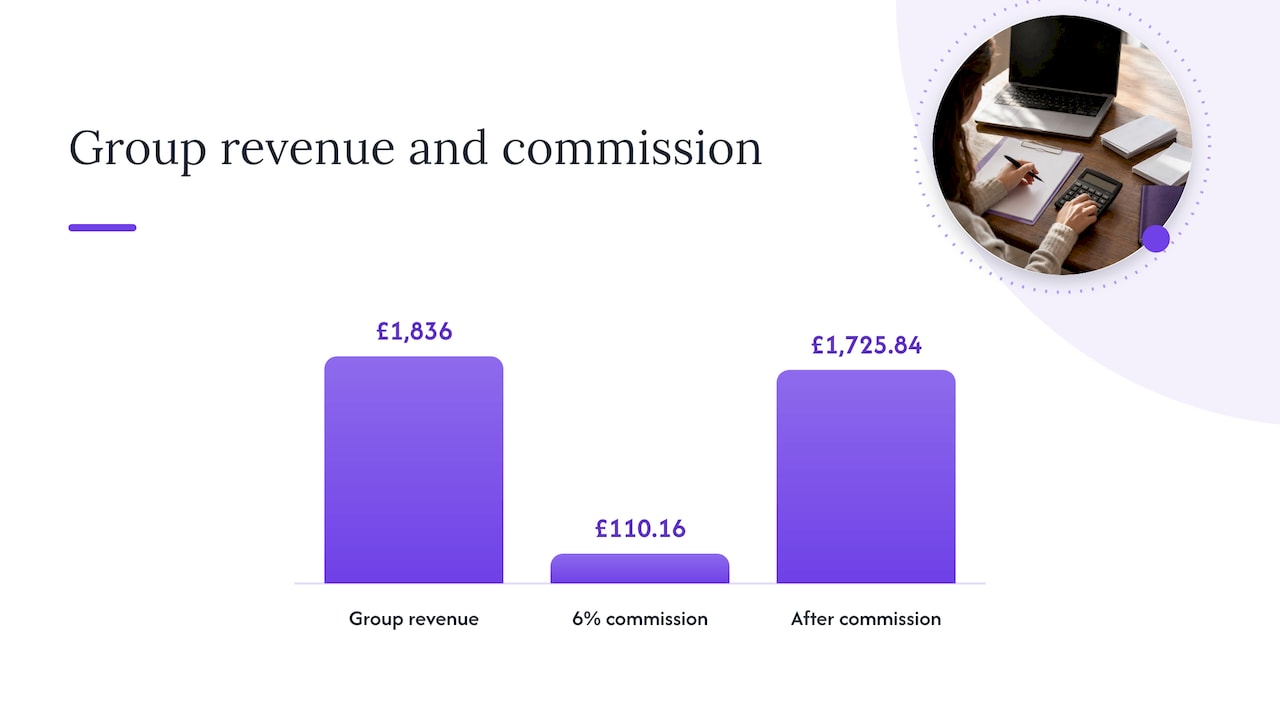
- Group revenue: 72 × £25.50 = £1,836.
- Commission at Lookport’s published 6%: £110.16, leaving £1,725.84 before the promoter’s other costs.
- Cannibalisation check: suppose 20 of those 72 buyers would have paid £30 anyway. The cost is 20 × £4.50 = £90.
The net gain is large compared with the leak, because the seats would otherwise have been empty. Now change one assumption. If 60 of the 72 would have bought at full price, the leak is 60 × £4.50 = £270, and the gain shrinks to the 12 truly incremental tickets. The decision depends on that single number: how many group buyers are new.
This is why you model before you launch. Enter your capacity, ticket price, fixed costs and expected sell-through into the tour break-even calculator, then run a base case, a group-offer case and a pessimistic case. Lookport’s ticketing fee explainer shows how the 6% commission sits in that picture. The commission is Lookport’s only charge, so you can model it as a single line. Payment processing and any VAT treatment are separate matters to check for your own event (VAT on ticket sales).
Protecting full-price revenue
A group offer should attract buyers you would not otherwise have. Four controls help:
- Make the group price conditional. The minimum size, a single transaction and a single named organiser keep casual buyers from splitting a party to claim a discount.
- Cap the inventory. Allocate a block, for example the rear tier or a set number of seats, and close the offer when it is gone.
- Time the release. Open group sales after your first on-sale and early-bird phases, not alongside them. Full-price buyers have had their chance.
- Keep it off the front page. Put the offer on a dedicated group booking page and share it with target organisers, rather than advertising it beside every standard ticket.
Regular programming also builds repeat groups. If your venue runs a steady calendar, guidance on hosting live music regularly is useful for planning a run of dates that group organisers can book against.
Group offers and UK pricing rules
A group price is still a price, and UK rules on how you present it apply.
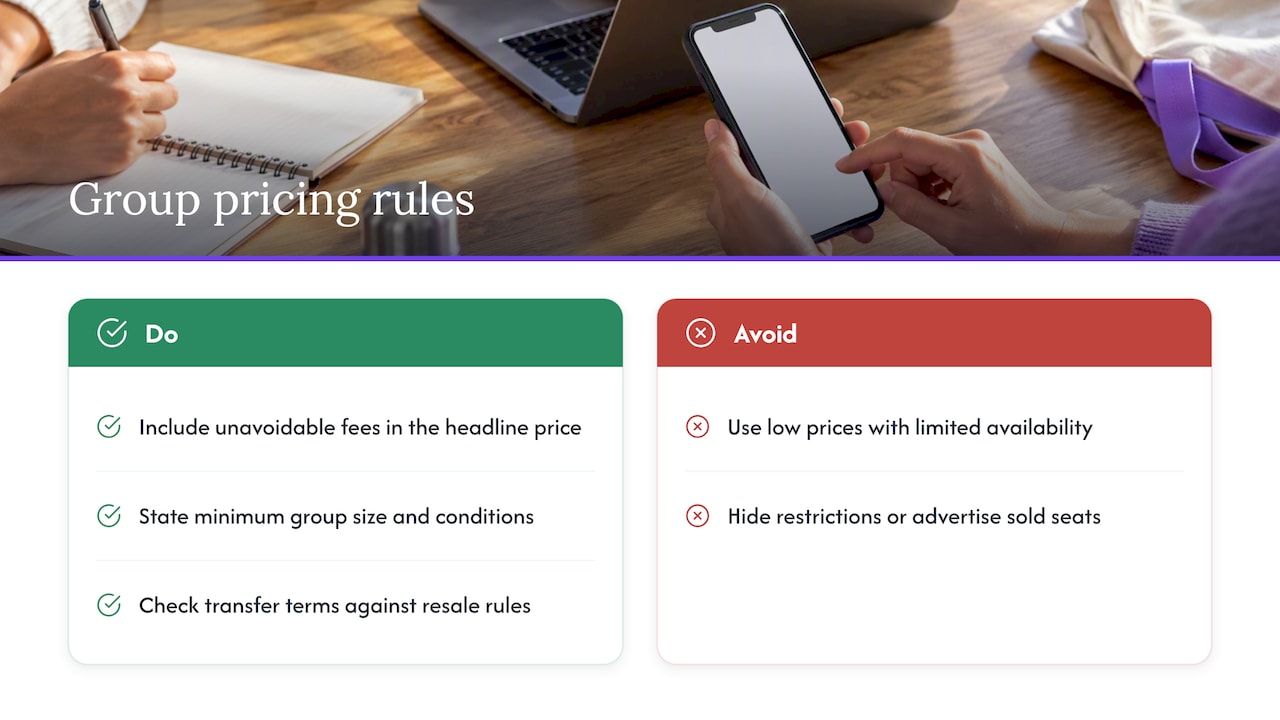
Show the total. STAR reports that the key consumer provisions of the Digital Markets, Competition and Consumers Act 2024 took effect on 6 April 2025, and that refreshed ASA guidance requires headline ticket prices to include all unavoidable charges (STAR AGM and Seminar 2025). If your group price has a booking fee that cannot be avoided, it belongs in the headline figure. See the Lookport guides on all-in ticket pricing and ticket fee strategy.
Do not bait. The Business Companion guide on ticket sales states that bait marketing is illegal: attracting consumers with a lower price that has low or limited availability, or undisclosed restrictions (Business Companion, sale and resale of tickets). For group offers this means two things. State the minimum group size and conditions next to the price. And do not advertise a discount for a block of seats you have already sold or will not release.
Mind resale. If your group terms allow name changes or transfers, check them against the rules on resale in the secondary ticketing law guide.
This article is general information, not legal advice. For a specific offer, check the wording with Trading Standards guidance or a solicitor who knows consumer law.
Setting up an event waitlist
A waitlist is for demand you cannot yet meet: a sold-out show, a capacity that may rise, or tickets that return from cancellations. It also helps when you are deciding whether to add a second date.
What the sign-up should say
Keep the form short and honest. It should state:
- Which event and which ticket type the person is waiting for.
- How many tickets they want (a group may need six together).
- How you will contact them, and how quickly they must act once you do.
- That joining does not guarantee a ticket.
- How releases will work: first come, first served, or in order of sign-up.
Collect an email address and a number of tickets. Anything more adds friction and data you must then look after.
Data protection
A waitlist is personal data, so treat it that way. The ICO explains that a message someone has specifically asked for, such as an alert when tickets return, can be sent without their marketing consent. You must still not hide your identity and must give a valid address for opting out (ICO, PECR electronic mail marketing rules). Sending the same people promotions for other shows is different. That needs its own consent, so use a separate, unticked box and keep the two lists apart.
Turning a waitlist into sales
The risk with a waitlist is not low demand but a messy release. Overselling happens when you tell more people than you have tickets, or when you hold seats indefinitely.
A simple release process:
- Count what is actually free. Cancelled orders, unclaimed holds and any released production seats.
- Release in batches. If 30 seats come back, notify roughly that number of people, in sign-up order, rather than the whole list. Notify a few more only if the first batch does not respond.
- Give a fixed window. Many promoters use 24 to 48 hours for a personal link. Choose a window that suits the time left before the show, and state it in the email.
- Link straight to checkout for the right quantity, so a party of six does not discover only four seats remain after clicking.
- Roll unclaimed seats forward to the next batch, then to general sale.
- Tell people when the list closes, so nobody waits beyond the show date.
A waitlist also tells you something. If 400 people join for a show with 80 seats left, you have evidence for a second date, which you can test in the budget model before committing. Keep in mind that a waitlist count overstates demand, because joining costs nothing. Treat a sensible share as intent, and verify it with the conversion rate from earlier waitlists at your own venue.
Promoting group offers and measuring them
Where to find group organisers
The buyer is the organiser, so write for them. Likely sources:
- Local societies, clubs and supporter groups related to the artist or genre.
- Employers and student unions looking for social events.
- Fan communities, who can run one booking for a whole trip.
- Past group buyers, who are your best second-time prospects.
Give organisers a ready-made page or short email they can forward, with the date, the group price, the minimum size and how to book. Tools such as marketing integrations and event sales notifications on Lookport help you track the response to each campaign and watch the pace of sales as it happens.
Numbers to track
| Measure | How to calculate | What it tells you |
|---|---|---|
| Group share of sales | Group tickets ÷ all tickets | Whether the offer is a niche or a main channel |
| Average revenue per ticket | Total ticket revenue ÷ tickets sold | Whether discounts are diluting the average |
| Incremental share | New buyers ÷ group buyers | Whether you are filling seats or discounting existing buyers |
| Waitlist conversion | Waitlist buyers ÷ people notified | How well your release process works |
| Time to fill | Days from release to sold out | When to release the next batch |
The incremental share is the hardest to measure. A reasonable proxy is whether group buyers’ emails already exist in your customer list before the offer launched. It is imperfect, so record the method you used and keep it consistent between events.
On the AI side, general forecasting methods can use your sales history to estimate how many seats a given offer might fill. The quality depends on how many past events you have, and a forecast built on three shows is a rough guide only. Lookport’s published ticketing page is the place to check which tools are currently live. This article does not rely on them.
Selling group tickets with Lookport
Lookport Ticketing charges a 6% commission with no other Lookport charges, and ticket proceeds go directly into your own Stripe account. Availability follows Stripe-supported countries. That makes group pricing easy to model, because there is one commission figure to put in the budget. See the pricing page for the published fee and the online and hybrid ticketing page for the current feature set.
For a touring show, tour management is where you can look at several dates together. Start with the numbers: open the tour break-even calculator, enter a standard case and a group-offer case, and compare the break-even points. Then set up the offer in Lookport Ticketing.
FAQ
What is a good minimum size for a group ticket?
There is no universal number. Many venues start at 6 to 10 tickets. Choose the size by looking at the typical party that books with you and set the minimum slightly above it, so the discount rewards a larger booking than usual.
How big should a group discount be?
Only as big as your margin on those seats allows. Work it out from your break-even: the discount can never push the net ticket below the cost of serving it. Test a 10% and a 20% case in a budget model before choosing, and consider perks first.
Do I need consent to email a waitlist?
People who ask to be told when tickets are available have requested that message, and the ICO says solicited electronic mail marketing does not need consent. You must still identify yourself and give an opt-out address. Ask for separate consent before sending promotional emails about other events.
How do I stop a waitlist causing overselling?
Notify people in batches matched to the seats actually free, give each a time-limited link for a set quantity, and roll unclaimed seats to the next batch. Never notify the whole list at once.
Can I advertise a group price lower than the standard price?
Yes, if the conditions are clear and the seats are really available. Bait marketing, meaning a low price with limited availability or hidden restrictions, is illegal, and headline prices must include unavoidable charges.
Sources
- London Symphony Orchestra: group bookings
- STAR AGM and Seminar 2025
- Business Companion: sale and resale of tickets
- ICO: PECR electronic mail marketing rules
Recommended
Ticketing & event budgeting
 2026-11-04
Accessible Tickets Policy for UK Events: What to Include
How to write an accessible tickets policy for UK shows: legal duties, companion tickets, pricing, evidence checks and booking information, with sources.
 2026-11-03
Abandoned Cart Recovery for Events: A UK Promoter's Guide
How UK promoters can cut ticket checkout drop-off and win back buyers: fixing fees, timing reminders, staying within PECR and measuring recovered revenue.
 2026-11-02
AI Ticket Sales Forecasting for UK Concerts: A Practical Guide
How UK promoters can forecast concert ticket sales with AI: the data to gather, a simple workflow, how to check the forecast and how to turn it into a budget.
 2026-11-01
Pricing by Venue Size: How to Set Ticket Prices for Any Capacity
Set ticket prices by venue size: break-even price per capacity, tier splits, a price floor and UK all-in pricing rules, with worked examples in pounds.
 2026-10-29
Stripe Payouts in the UK: Timing, Instant Payouts and Cash Flow for Promoters
How Stripe payouts work for UK event organisers: first payout wait, schedules, Instant Payout fees and limits, and how to plan show cash flow around them.
 2026-10-29
Post-Event Marketing for Promoters: A 30-Day Plan
A practical post-event marketing plan for UK concert promoters: what to send in the first 48 hours, which KPIs to track and how to link follow-up to sales.