LOOKPORT / TICKETING & EVENT BUDGETING
Pricing by Venue Size: How to Set Ticket Prices for Any Capacity
Set ticket prices by venue size: break-even price per capacity, tier splits, a price floor and UK all-in pricing rules, with worked examples in pounds.

Venue size does not set your ticket price. Your costs, your realistic sell-through and the fees you pay set it, and capacity decides how much room you have to make those numbers work. A 300-capacity room needs a higher price per head to cover the same fixed costs than a 1,500-capacity hall, but only if both fill to the same level. This guide shows you how to work out a minimum viable price for each venue size, how to split a room into tiers, and how to set a price floor you will not discount below.
All worked examples below are hypothetical and use round figures. Replace them with your own quotes.
TL;DR
- Start from break-even, not from what similar shows charge: price = (fixed costs + per-head costs × attendance) ÷ (attendance × (1 − fee rate)).
- Calculate it at three sell-through levels (for example 60%, 80% and 100% of saleable capacity) so you see how much price depends on filling the room.
- Use saleable seats, not headline capacity. Production, house and sightline-restricted seats do not sell.
- Your price floor is the break-even price at a cautious sell-through. Keep discounts small and set them in advance.
- In the UK, show the full price including mandatory fees from the first screen.
Table of Contents
- Why capacity changes the price you need
- The break-even price formula
- Worked examples at three venue sizes
- Check break-even against market reality
- Split the room into tiers
- What pricing floor protection means in practice
- Price transparency rules for UK organisers
- Fees change the answer at every size
- Sell and track with Lookport Ticketing
- A short workflow you can repeat for every show
- FAQ
- Sources
Why capacity changes the price you need
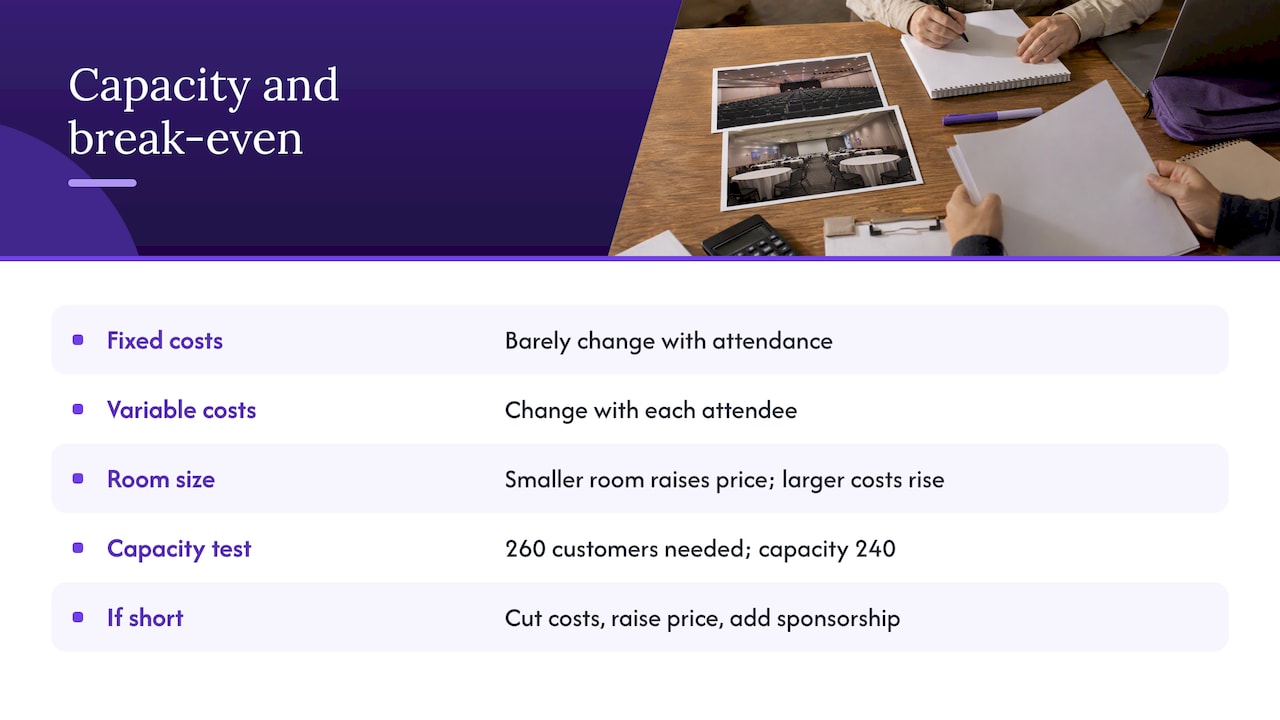
Ticket revenue is price multiplied by tickets sold, and tickets sold can never exceed what the room holds. Costs such as artist fee, venue hire, production, insurance, marketing and PRS licensing barely move with attendance. Those are your fixed costs. Costs such as per-head staffing, printed materials or catering move with each attendee. Those are your variable costs.
Because fixed costs are spread across fewer people in a small room, the break-even price per ticket rises as capacity falls. The reverse holds in a larger room, but a larger room also usually has higher fixed costs, so the price does not simply fall as the venue grows.
The real question is whether the break-even attendance fits inside the room. If you need 260 paying customers to cover costs and the saleable capacity is 240, no amount of marketing fixes it. You must cut costs, raise the price, add sponsorship or add other revenue.
Count saleable seats, not capacity
Headline capacity overstates what you can sell. Cadogan Hall, for example, publishes that 915 seats are available for public sale, excluding house, technical and sightline-restricted seats. Its gross potential calculator also separates gross, VAT and net potential and lets you forecast sales by tier. Ask every venue for its saleable figure and the number of kills (seats removed for desks, sound or cameras) before you model anything.
The break-even price formula
Use one formula for every venue size:
Break-even price = (fixed costs + variable cost per head × attendance) ÷ (attendance × (1 − fee rate))
The fee rate matters because a price that covers costs before fees can fall short after them. With a 6% commission, the fee rate is 0.06, so each £1 of ticket price leaves you £0.94. Add any payment-processing charges that apply to your own Stripe account to the fee rate if you want a fully loaded figure. VAT, if you are registered and it applies to your tickets, also needs to come out of the price before you compare it with costs. Check your treatment with your accountant.
If you also want the profit you need, add your target profit to the top line of the formula.
Worked examples at three venue sizes
These examples are hypothetical. They use a 6% commission, ignore VAT and assume no other fees.
A 300-capacity club or small theatre
Fixed costs: £2,400 (artist fee, room hire, sound engineer, marketing, licences). Variable costs: £1.50 per head.
| Sell-through | Tickets | Break-even price |
|---|---|---|
| 60% | 180 | £15.78 |
| 80% | 240 | £12.23 |
| 100% | 300 | £10.11 |
The gap between £10.11 and £15.78 is the risk in this show. If similar nights in your town sell at £12, the show only works if you fill at least four-fifths of the room.
A 1,500-capacity hall
Fixed costs: £28,000. Variable costs: £2 per head.
| Sell-through | Tickets | Break-even price |
|---|---|---|
| 50% | 750 | £41.84 |
| 70% | 1,050 | £30.50 |
| 100% | 1,500 | £21.99 |
Here the price is more sensitive to demand than in the small room. A half-full hall needs a ticket almost double the price of a sell-out. That is why a mid-size show needs a demand check before you announce a price.
Reading the two together
The small room needs a higher price at full capacity (£10.11 against £21.99 is lower for the hall, but the hall’s cost base is more than ten times bigger). What matters is the spread between your best and worst case. Price from the cautious column, not the sell-out column.
You can run these numbers for your own costs in the concert profit and tour budget calculator, which models costs, ticket prices, revenue and break-even in one place. For a step-by-step version of the maths, see our guide to ticket sales break-even analysis for UK shows.
Check break-even against market reality
Break-even gives you a minimum. It does not tell you whether your audience will pay it. Compare your result with three things.
- Local prices for similar acts. Look at what comparable artists charge in rooms of the same size in your region.
- What your own past shows sold at. Your own sales history is the best demand evidence you have.
- Cash-flow timing. When do you pay the artist deposit and venue hire relative to when ticket money arrives?
The grassroots end of the market is tight. The Music Venue Trust’s latest annual report, as reported by Now Then, puts the average grassroots ticket price at £11.56 for 2025, up just eight pence, with average profit margins of 2.5% and 53% of venues making no profit. If your 300-capacity break-even sits at £15.78 on a cautious sell-through, you know the show carries real risk and needs either lower costs or a stronger draw.
Other factors besides venue size
Live & Local’s promoter handbook lists the factors to weigh alongside size: show costs, target income, local economics, similar local events, artist quality, target audience and concessions. It also notes that a lower price does not automatically bring a bigger audience and that price can signal quality. For its own funded programme it gives guide minimums of £13.50 standard and £10.50 adult concession for October 2025 to May 2026, and says these are guides, not mandatory prices.
Split the room into tiers
One price for every seat leaves money on the table in a larger room, because seats are not equal. Cadogan Hall’s calculator shows the approach: it lets hirers price all seats uniformly or divide them into up to four tiers across the Stalls and Gallery, based on proximity, aisles, acoustic balance and sightlines.
A simple way to do this for any seated or mixed venue:
- Divide the saleable seats into two to four zones by view and sound.
- Set your average target price from the break-even table.
- Price the best zone above that average, the worst below it, so the weighted average still reaches your target.
- Forecast sell-through per zone. Back zones often sell last, so use a lower percentage there.
- Recalculate total net revenue and compare it with costs.
Hypothetical tier example
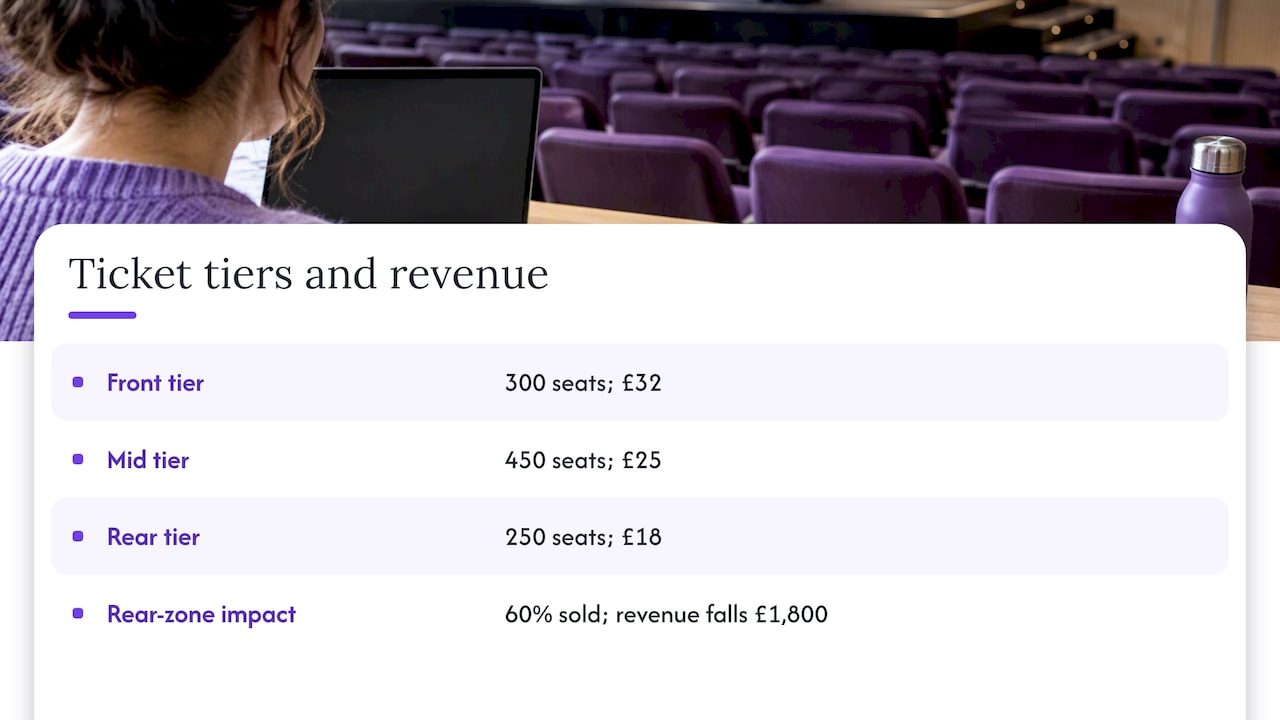
A 1,000-seat venue needs an average net ticket of £25 at the cautious level. You set 300 front seats at £32, 450 mid seats at £25 and 250 rear seats at £18. Weighted gross if all sell: £9,600 + £11,250 + £4,500 = £25,350, an average of £25.35. If the rear zone sells only 60%, revenue drops by £1,800, so you check whether the cautious scenario still clears costs. For more on structure and compliance, read our guide to tiered ticket pricing for UK organisers.
For standing shows, tiers work through release phases (early, standard, late) and add-ons rather than seat location. UCL’s theatre guide, for example, requires full-price, concession and community prices and allows early-bird prices as an option, with prices agreed before production and written into the contract.
What pricing floor protection means in practice
A price floor is the lowest price at which you will sell a ticket, set before the on-sale. It protects you from discounting your way below break-even when sales are slow. To set one:
- Take the break-even price at your cautious sell-through (for the 300-capacity example, 60% gives £15.78).
- Decide the lowest average net price you will accept across all tiers, not for every single ticket.
- Write down the maximum discount, who can authorise it and when.
- Review at fixed points, such as four weeks and one week before the show, using actual sales.
Keep discounts modest. Live & Local advises concessions no greater than 10% and says they should target genuine affordability barriers rather than act as blanket cuts.
If sales fall short at the review point, a floor tells you to act on costs, marketing or the show itself, not on price alone.
Price transparency rules for UK organisers
Whatever price you set, the customer must see the full amount. The Government’s call for evidence on live events pricing states that UK ticket sellers must disclose the total price including additional charges upfront, and that the Digital Markets, Competition and Consumers Act 2024 prohibits drip pricing of mandatory fees. Law firm Reed Smith’s summary of the CMA’s final guidance says it requires all mandatory charges in the upfront price and notes fines of up to 10% of global turnover for the most serious breaches.
In practice, set your break-even price as the all-in price, and work out your face value backwards if you add a booking fee. Our guides on all-in ticket pricing and ticket fee strategy cover how to do this. Read the CMA’s own guidance for the current wording before you publish prices.
Fees change the answer at every size
Fee impact is easy to underestimate. At a £12 ticket, 6% is £0.72. At a £30 ticket it is £1.80. Across 1,050 tickets at £30.50, commission is around £1,900. Model it in, because your break-even price rises by roughly 6.4% over the fee-free figure.
Lookport’s commission is 6%, with no other Lookport charges, and ticket proceeds are paid directly into your own Stripe account. Check the pricing page for the current terms, and use the ticketing fee calculator to see the effect on your own price. For a deeper look, see ticketing fees explained.
Sell and track with Lookport Ticketing
Once your price and tiers are set, you need a ticketing page that shows the all-in price and sends the money to you. Lookport Ticketing is built for concert promoters, event organisers and venues: 6% commission, no other Lookport charges, and proceeds paid directly into your own Stripe account. Availability follows Stripe-supported countries.
Before you launch, build your cost base in the tour budget template guide and the concert budget breakdown, so the figures you feed the formula are complete.
A short workflow you can repeat for every show
- Get the saleable capacity and any kills from the venue.
- List fixed costs and per-head costs, plus a contingency line.
- Choose your fee rate, including commission and any processing charges.
- Calculate break-even price at 60%, 80% and 100% sell-through.
- Compare with local prices and your own sales history.
- Split into tiers if the room has clearly different seats or phases.
- Set the price floor and the maximum discount.
- Publish an all-in price and review at set points.
The contingency line matters. Build in a buffer for overruns so the cautious scenario is genuinely cautious.
FAQ
Does a bigger venue mean a lower ticket price?
Not automatically. A bigger venue spreads fixed costs over more people, but its fixed costs are usually much higher too. Calculate break-even for your own costs at several sell-through levels and compare it with what your audience will pay.
How do I work out the minimum ticket price for a show?
Divide your total costs at expected attendance by attendance after fees. In formula terms: (fixed costs + per-head costs × attendance) ÷ (attendance × (1 − fee rate)). Our concert break-even calculator guide walks through it.
What is a price floor for event tickets?
It is the lowest price or average price you will accept, set in advance from break-even at a cautious sell-through. It stops late discounting from pushing a show below cost.
Do I have to show booking fees in the ticket price?
In the UK, mandatory fees must be included in the upfront price under the DMCCA 2024 and CMA guidance. Check the CMA’s current guidance and take advice if your fee structure is unusual.
Sources
- Gross Potential Calculator, Cadogan Hall
- Setting ticket prices, Live & Local promoter handbook
- Putting fans first: call for evidence on pricing practices in the live events sector, GOV.UK
- CMA’s final price transparency guidance, Reed Smith
- Has recovery now plateaued for the UK’s live music sector? Now Then
- A Guide for Students’ Union UCL Producers, UCL Bloomsbury Theatre
Next step: enter your own costs and capacity in the concert profit and tour budget calculator to see your break-even price at each sell-through level.
Recommended
Ticketing & event budgeting
 2026-11-04
Accessible Tickets Policy for UK Events: What to Include
How to write an accessible tickets policy for UK shows: legal duties, companion tickets, pricing, evidence checks and booking information, with sources.
 2026-11-03
Abandoned Cart Recovery for Events: A UK Promoter's Guide
How UK promoters can cut ticket checkout drop-off and win back buyers: fixing fees, timing reminders, staying within PECR and measuring recovered revenue.
 2026-11-02
AI Ticket Sales Forecasting for UK Concerts: A Practical Guide
How UK promoters can forecast concert ticket sales with AI: the data to gather, a simple workflow, how to check the forecast and how to turn it into a budget.
 2026-10-31
Group Ticket Strategy: Offers and Waitlists That Fill Seats
How UK promoters can design group ticket offers and run an event waitlist that fills seats without cutting full-price sales, with worked numbers and legal checks.
 2026-10-29
Stripe Payouts in the UK: Timing, Instant Payouts and Cash Flow for Promoters
How Stripe payouts work for UK event organisers: first payout wait, schedules, Instant Payout fees and limits, and how to plan show cash flow around them.
 2026-10-29
Post-Event Marketing for Promoters: A 30-Day Plan
A practical post-event marketing plan for UK concert promoters: what to send in the first 48 hours, which KPIs to track and how to link follow-up to sales.