LOOKPORT / TICKETING & EVENT BUDGETING
Accessible Tickets Policy for UK Events: What to Include
How to write an accessible tickets policy for UK shows: legal duties, companion tickets, pricing, evidence checks and booking information, with sources.
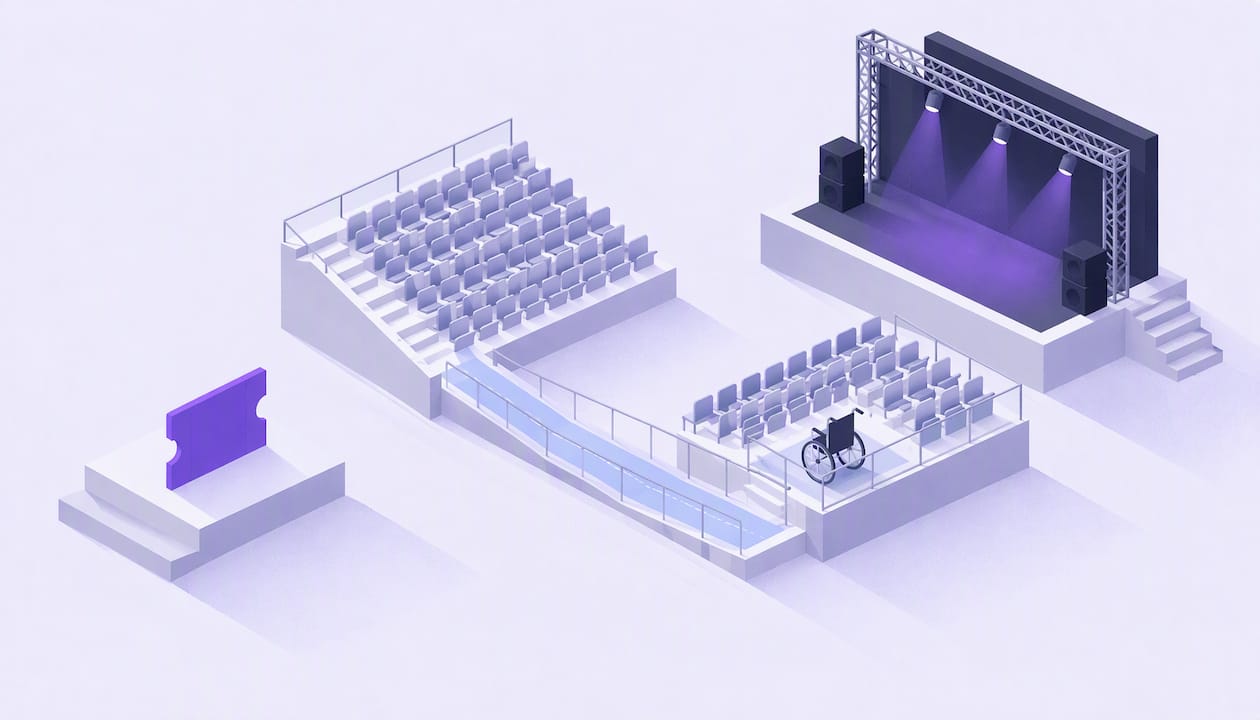
An accessible tickets policy is a short public document that tells disabled customers how to book, what you ask for, what it costs and who to contact. In the UK it sits on top of a legal duty: the Equality Act 2010 requires you to make reasonable adjustments so disabled people can use your service. This guide shows promoters and venues what the policy should say, how to allocate spaces, how to price them fairly and how to keep checks light.
TL;DR
- The Equality Act 2010 bars refusing service or offering worse terms because of disability, and it expects adjustments to be planned in advance.
- Publish your policy before tickets go on sale: evidence you accept, why you ask, how to book, who to contact, and what happens if a request cannot be met.
- Disabled customers should be able to book by the same channels as everyone else, and an essential companion should get a free ticket under a clear policy.
- Do not make disabled customers pay for adjustments: an access booking line should cost no more than the cheapest alternative, and a needed higher-priced seat should be sold at the lowest available price.
- Budget for access from the start. Model it in the concert profit and tour budget calculator before you set prices.
Table of Contents
- What UK law requires when you sell tickets
- What your accessible ticketing policy should say
- Allocating accessible spaces
- Companion and personal assistant tickets
- Pricing accessible and companion tickets
- Evidence and eligibility: keep checks light
- Booking channels and access information
- Resale, exchanges and sold-out shows
- Common problems and the fixes
- Budgeting for access
- Selling tickets with Lookport
- FAQ
- Sources
What UK law requires when you sell tickets
The Equality Act 2010 applies to businesses providing services, and entertainment venues and promoters are covered. The Equality and Human Rights Commission (EHRC) guidance says service providers must make anticipatory reasonable adjustments, so disabled people can use the service as far as is reasonable to the same standard as non-disabled people. That means thinking ahead, not waiting for a complaint.
Three points matter most when you build a ticketing policy:
- No refusal and no worse terms. Refusing service, or offering less favourable terms because someone is disabled, is direct discrimination. VisitBritain’s business guidance states it cannot be justified.
- Adjustments take several forms. The EHRC lists removing or altering physical barriers, changing policies or practices that cause disadvantage, and providing auxiliary aids or services.
- Online booking counts. The industry guide from the Society of Ticket Agents and Retailers (STAR) says ticket agents must take reasonable steps so disabled customers can buy tickets online in the same way as everyone else.
This article is practical guidance, not legal advice. If you are unsure whether a specific adjustment is reasonable for your venue, ask a solicitor who handles equality law, or contact the EHRC.
What your accessible ticketing policy should say
Publish the policy where customers can find it before they reach the checkout. A good one answers the questions a customer would otherwise have to phone you about. Use this structure:
- Who the policy is for. Wheelchair users, ambulant disabled customers, people with sensory or cognitive impairments, people with non-visible conditions, and their companions.
- How to book. Online, by phone, by email or text. Name each channel and what it costs.
- What evidence you accept, and why you ask. The STAR guide says a policy should state what evidence, if any, is accepted, explain why the information is requested, and say that applications without the recommended evidence will be reviewed case by case.
- Companion and personal assistant (PA) tickets. Who qualifies and how to claim.
- Prices. What accessible and companion tickets cost, stated plainly.
- Exchanges and refunds. How a customer changes or cancels if their access needs change.
- A named contact. A person or role, with a phone number and an email address.
- What happens if you cannot meet a request. Explain why and explore alternatives with the customer. Haringey Council’s accessibility policy for its venue uses this approach: explain, then explore options.
Keep the language plain. A customer should be able to read the whole policy in two minutes.
Allocating accessible spaces
Start with capacity. The STAR guide suggests that wheelchair-accessible bays and ambulant seating should typically each account for 1% of overall capacity. On a 2,000-capacity room, that is a starting point of 20 wheelchair bays and 20 ambulant seats. Treat the figure as a baseline and adjust it for your audience and the layout your licence allows. Your venue capacity calculation should already account for how many guests fit safely, so confirm that accessible bays, their sightlines and routes to exits are counted inside that total, not added on top.
A few allocation habits help:
- Spread positions and price bands. If every wheelchair bay sits at the back, disabled customers have no choice of price or view. Offer bays in more than one area where the venue allows.
- Keep groups together. Which? found disabled customers reporting being seated apart from friends. Release companion seats beside the accessible space, and allow a small group to book adjacent seats.
- Hold stock back sensibly. Do not release all accessible spaces to the general public in the first minute, and do not hold so many back that they stay empty. Review the split after each on-sale.
- Show it on a map. If you sell reserved seating, a visual layout lets customers see where bays are. Lookport’s seat maps and reserved seating page describes how reserved layouts work on the platform.
Companion and personal assistant tickets
The STAR guide says that whenever tickets are generally available online, disabled people should also be able to book by that method. It also says free tickets should be available for essential companions with a paid ticket, under a clear, proportionate policy that may include evidence of need.
Write the rule in a way a customer can apply to themselves:
- State that a customer who needs a companion or PA to attend can book one free companion ticket with their own paid ticket.
- Say where the companion sits, usually next to the accessible space.
- Say how the companion’s name is recorded, if at all, for entry.
- Say what happens if the PA is not needed on the day, so the customer does not feel they have to explain.
The Attitude is Everything venue guide notes that a venue accepting PA ticket requests at face value, without evidence, is best practice and says so openly. If you do that, state it in the policy. It removes a barrier and reduces admin.
Pricing accessible and companion tickets
This is where promoters most often get it wrong. The principle in the STAR guide is that disabled customers should not bear the cost of necessary adjustments, so an access booking line should not cost more than the cheapest alternative booking method. If your general booking line is a free online checkout, a premium-rate access phone number is a problem.
Seat price is the second issue. Disability Arts Cymru’s concessionary pricing guidance says that if a disabled person needs a more expensive seat to access the performance, the lowest available ticket price should apply to that seat. The same body says concessions should apply when the choice of accessible seating or route is restricted. This is professional guidance from Wales, not a statute, but it is a sound standard for UK venues.
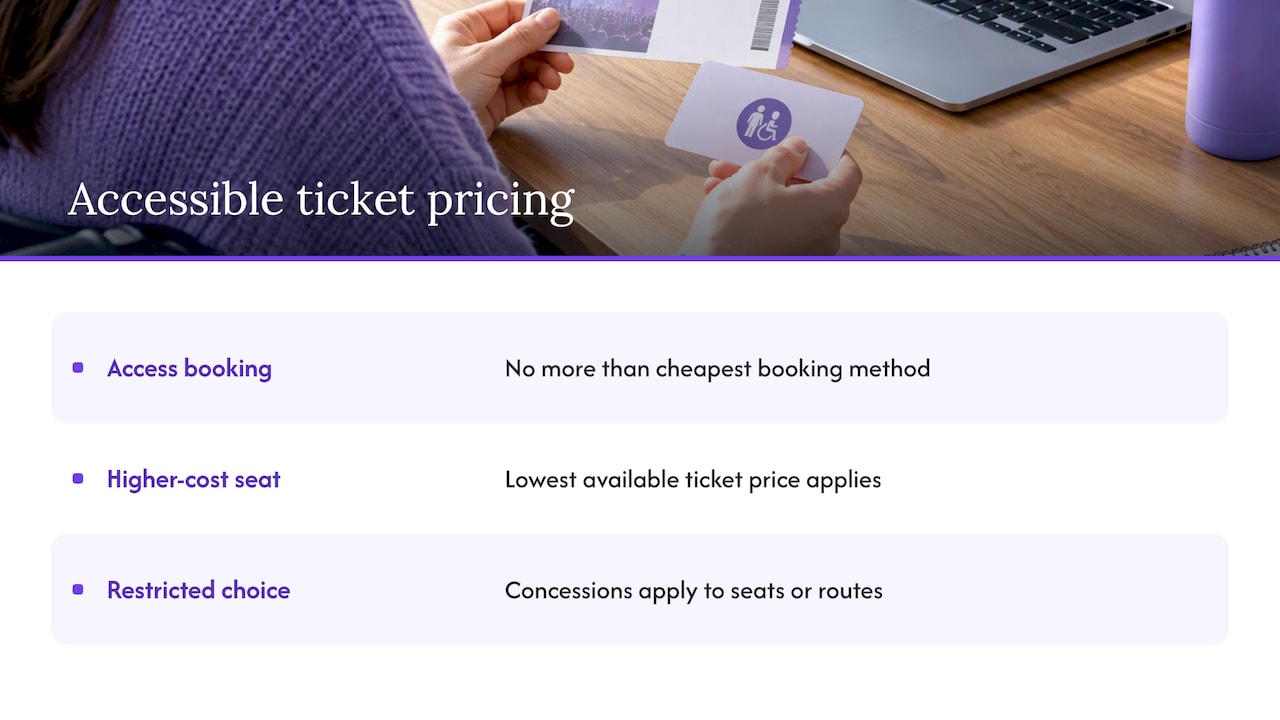
Apply it with a simple test: would a non-disabled customer be able to choose a cheaper area with the same view? If the only accessible position is in the premium block, price it at the cheapest ticket available.
Fees on accessible tickets
Booking fees must be clear too. Show the full price early, as you would for any ticket, and keep the accessible price consistent with it. Our guides on all-in ticket pricing and ticket fee strategy explain how to show one clear price. If you use price tiers, read tiered ticket pricing and decide in advance which tier an accessible space belongs to, so the rule is set before the on-sale and not improvised during it.
Evidence and eligibility: keep checks light
Many venues ask for proof of Personal Independence Payment (PIP) or a Nimbus Access Card when a customer books PA seats, according to Which?. The same research recorded complaints about repeated requests for eligibility documents. Some customers book several times a year, and each request is another hurdle.
A workable approach:
- Ask once. Alexandra Palace lets customers whose eligibility has been confirmed book accessible tickets without sending further documentation. Store the confirmation against the customer record and say so.
- Accept a range of evidence. Name several types and say that applications without them will be reviewed case by case.
- Explain why you ask. Say it is to protect limited accessible spaces, not to doubt the customer.
- Limit who sees it. Share evidence only with the staff who need it, and handle it under your data protection obligations. The Information Commissioner’s Office is the place to check your duties for health-related data.
- Offer an alternative route. A customer without a card or letter should still be able to talk to a person.
Booking channels and access information
Selling the ticket is only half the job. A disabled customer decides whether to buy based on what you tell them about the venue. The Attitude is Everything guide recommends a named access contact and clear information on step-free access, bookable facilities and arrival arrangements, including early entrance options and ticket collection. It also advises putting access information on a dedicated page that is easy to find from the front page, and notes that a downloadable Word file can help screen-reader users.
Publish at least:
- Whether there is step-free access from the street to the box office, the toilets and the performance space. If not, give the number of steps and describe any temporary ramp or alternative entrance, as the same guide recommends.
- Where accessible toilets, quiet spaces and assistance-dog areas are.
- How entry and ticket collection work for accessible customers.
- The contact details of your access lead.
For festivals and multi-day events, repeat the information for each site and each day. Our page on ticketing for special events covers how organisers set up event types beyond a standard single show.
Resale, exchanges and sold-out shows
Accessible customers are more likely to need to change plans at short notice, so build the exchange rule into the policy. State how to exchange an accessible ticket, who handles it, and whether the space returns to the accessible pool for resale.
If tickets can be resold through a secondary ticketing facility, the Consumer Rights Act 2015 requires the seller and the facility operator to give applicable seat or standing-area information, restrictions and face value clearly before the buyer is bound by the contract. That includes information about access features tied to the seat. Our secondary ticketing law guide sets out the promoter’s side, and the refund policy guide covers what you must offer when a show changes or is cancelled.
For sold-out events, publish a clear way to ask about access:
- Keep a waiting list for accessible spaces and say how it works.
- Return unused accessible spaces to the list promptly.
- Tell customers when you release extra spaces, for example after a layout change.
If you cannot meet a request, say why and offer alternatives such as a different date, a different area or a refund.
Common problems and the fixes
Which? reported that disabled consumers experienced inaccessible online booking for accessible seats, long phone queues, repeated requests for eligibility documents, difficulty booking PA tickets, being seated apart from friends, and a lack of clear venue-access information. It says venues and ticket sellers should review their processes, software and training. Here is how each maps to a fix:
| Problem reported | Practical change |
|---|---|
| Accessible seats cannot be booked online | Add an online route, or a clear request form with a response time |
| Long phone queues | Offer email and text booking, and staff the line at on-sale |
| Repeated eligibility requests | Record approval once and reuse it |
| PA tickets hard to book | Link the companion ticket to the main booking |
| Seated apart from friends | Allow adjacent seat blocks next to accessible bays |
| Unclear venue information | Publish a dedicated access page and a named contact |
Training matters as much as software. The STAR guide says staff should be trained in accessible ticketing policies and procedures, disability equality and awareness, the law, etiquette and terminology.
Large events are being held to the same standard. In an EHRC agreement with a major festival promoter, accessibility was to be embedded at every stage of the fan journey, with websites and apps audited against the Web Content Accessibility Guidelines, and a mystery shopper scheme using disabled participants to assess facilities at selected festivals. The detail is on the EHRC festivals page. Smaller promoters can borrow the idea: ask a disabled friend or access consultant to try your booking journey before you go on sale.
Budgeting for access
Access costs are easy to forget until late. Include them in the show budget from the first draft:
- Platforms, ramps and viewing areas, including hire and set-up.
- Staff time on the access line and at entry.
- Training for box office and door staff.
- Free companion tickets, which reduce sellable capacity or revenue.
- Any BSL interpreter, captioning or audio description you plan to offer.
Free companion tickets and bays that replace standard seats change your break-even point. Enter your capacity, ticket prices and costs into the concert profit and tour budget calculator, then run a second scenario with accessible bays and companion tickets removed from paid sales. For the wider method, see the guides on ticket sales break-even analysis, concert budget breakdown and pricing by venue size. Any figures you enter are your own assumptions, so check them against your venue’s actual layout and licence.
Selling tickets with Lookport
Lookport Ticketing is built for concert promoters, event organisers and venues. We charge 6% commission with no other Lookport charges, and ticket proceeds are paid directly into your own Stripe account. Availability follows Stripe-supported countries. You write and publish your accessible tickets policy, and you decide which spaces, prices and evidence rules apply to your show. See Lookport Ticketing for the features currently described on our site and our pricing page for the commission.
If you are still working out what accessible bays and companion tickets do to your numbers, start with the calculator, then move to setting up your event.
FAQ
Is an accessible tickets policy a legal requirement in the UK?
The Equality Act 2010 does not name a ticket policy, but it requires reasonable adjustments and bars worse treatment because of disability. A written policy is how you show those duties are met in practice. Without one, customers and staff are left guessing.
Can I charge more for accessible seats or companion tickets?
You should not make disabled customers pay for adjustments. Industry guidance says an access booking line should cost no more than the cheapest alternative, and that a needed higher-priced seat should be sold at the lowest available price. Essential companions should get a free ticket under a clear policy.
Can I ask for proof of disability?
Yes, under a clear, proportionate policy that explains why you ask and what you accept. Say that requests without the usual evidence will be reviewed case by case. Keep it to a single check where you can.
How many accessible spaces should a venue offer?
STAR guidance typically suggests 1% of overall capacity for wheelchair-accessible bays and 1% for ambulant seating. Treat that as a starting point and adjust it for your layout, audience and licence.
Sources
- EHRC: Your rights to equality from businesses providing goods, facilities and services
- VisitBritain: Disabled customers
- STAR: Making Ticket Sales Accessible For Disabled Customers
- Disability Arts Cymru: Concessionary Pricing Policy
- Haringey Council: Accessibility Policy
- Which? and RiDC: Disabled consumers are missing out on live events
- Attitude is Everything: Access Starts Online venue guide
- EHRC: Improving access for disabled people at festivals
- Consumer Rights Act 2015, Part 3, Chapter 5 (legislation.gov.uk)
- Venue capacity guide
Recommended
Ticketing & event budgeting
 2026-11-03
Abandoned Cart Recovery for Events: A UK Promoter's Guide
How UK promoters can cut ticket checkout drop-off and win back buyers: fixing fees, timing reminders, staying within PECR and measuring recovered revenue.
 2026-11-02
AI Ticket Sales Forecasting for UK Concerts: A Practical Guide
How UK promoters can forecast concert ticket sales with AI: the data to gather, a simple workflow, how to check the forecast and how to turn it into a budget.
 2026-11-01
Pricing by Venue Size: How to Set Ticket Prices for Any Capacity
Set ticket prices by venue size: break-even price per capacity, tier splits, a price floor and UK all-in pricing rules, with worked examples in pounds.
 2026-10-31
Group Ticket Strategy: Offers and Waitlists That Fill Seats
How UK promoters can design group ticket offers and run an event waitlist that fills seats without cutting full-price sales, with worked numbers and legal checks.
 2026-10-29
Stripe Payouts in the UK: Timing, Instant Payouts and Cash Flow for Promoters
How Stripe payouts work for UK event organisers: first payout wait, schedules, Instant Payout fees and limits, and how to plan show cash flow around them.
 2026-10-29
Post-Event Marketing for Promoters: A 30-Day Plan
A practical post-event marketing plan for UK concert promoters: what to send in the first 48 hours, which KPIs to track and how to link follow-up to sales.