LOOKPORT / TICKETING & EVENT BUDGETING
AI Audience Analytics: UK Promoters Use the First 72 Hours of Sales
Use the first 72 hours of ticket sales to spot likely return buyers, test consented campaigns, and plan an 8 to 12 week AI analytics rollout for UK promoters.
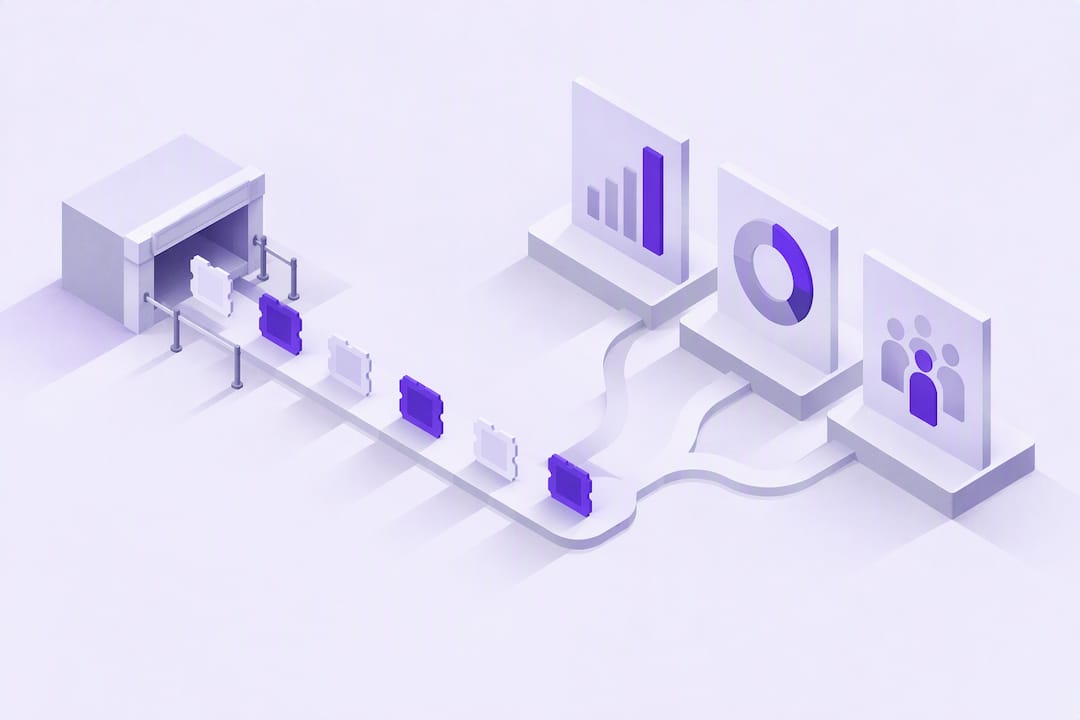
AI audience analytics can help you identify who may be most likely to come back and target offers to those fans by understanding the ROI of playlist promotion. The approach works when you capture first-party purchase and scan data, watch the first 72 hours of sales as an early signal, and act through consented channels like email and SMS. Start by fixing your data capture, running a simple propensity test, and launching one small targeted campaign within your next sales cycle.
TL;DR:
- Link ticket, attendance, merchandise, and engagement records to one persistent fan ID, and capture sales at five minute intervals rather than daily totals.
- Hold back an untreated control group, test uplift using the same offer, and set minimum sample sizes per segment before trusting propensity scores.
- Match early access to likely buyers, win back discounts to lapsed fans, and VIP bundles to top lifetime value segments; test one offer first.
- UK GDPR requires a DPIA when profiling is likely to create high risk; document model logic, explain data use, and provide contact options.
Table of Contents
- What AI audience analytics actually does for repeat ticket sales
- Data inputs: what to capture and how to link transactions to fans
- Predictive models and timing: spotting who will return and when to act
- From insight to action: campaign patterns that boost repeat attendance
- Measurement: the KPIs and attribution you need to prove uplift in repeat sales
- UK GDPR and ICO checklist for profiling and automated decisions
- An 8 to 12 week roadmap to implement AI audience analytics
- How to segment high-value repeat customers vs occasional buyers
- How Lookport Ticketing and the tour break-even calculator speed up tests and revenue modelling
- FAQ
- Sources
What AI audience analytics actually does for repeat ticket sales
AI audience analytics takes your transaction history and turns it into three practical outputs: segmentation, propensity scoring and lifetime value (LTV) prediction. Segmentation groups fans by behaviour rather than guesswork. Propensity scoring ranks fans by how likely they are to buy your next show. LTV prediction estimates how much a fan is worth across multiple events, not just one transaction.
For promoters, audience analytics can help identify likely buyers and tailor presale offers. Whether that improves conversion, sell-outs or repeat purchases depends on the audience, campaign and offer.
The segments worth building first are straightforward:
- Superfans: fans who have attended three or more of your events.
- High-spend fans: fans whose combined ticket and merchandise spend sits well above average.
- Lapsed buyers: fans who bought previously but have not returned since.
Each segment needs a different message and a different offer, which only becomes possible once you can see the data clearly enough to separate them.
Data inputs: what to capture and how to link transactions to fans
The quality of any predictive model depends entirely on what you feed it. Treat data capture as the foundation, not an afterthought.
- Ticket purchase history, including show, date, price paid and channel.
- Scan and attendance records, confirming who actually showed up rather than just who bought.
- Merchandise transactions, linked to the same fan wherever possible.
- Campaign engagement data, such as email opens, clicks and ad interactions.
- CRM contact fields, including consent status and preferred channel.
Linking these data points to a single, persistent fan identifier is the part most promoters skip, and it is the part that matters most. Industry guidance on event data stresses capturing timestamps at interval-level granularity, since five-minute sales intervals support meaningful predictive features, while daily totals do not (Mixmag). Practitioner reporting on fan identification also points to linking merch and ticket purchases to one fan ID as the method that produces precise segments such as superfans (Ukmusic).
Before you build anything predictive, run basic quality checks: de-duplicate fan records, confirm timestamp resolution is fine enough to be useful, make sure your first-party data is exportable, and avoid counting the same sale twice across different ticketing or marketing tools.
Pro Tip: Build your fan ID before you build your model. A clean identifier is worth more than a sophisticated algorithm running on messy data.
Predictive models and timing: spotting who will return and when to act
You do not need a data science team to get useful predictions. Lightweight models built on recency, frequency and monetary value (RFM) data, combined with transaction cadence, can produce workable propensity, churn risk and LTV buckets.
Timing matters as much as the model itself. The first 72 hours of on-sale activity act as the strongest early indicator of how a show will ultimately perform, and promoters who adjust creative, targeting or pricing quickly in response to that window tend to outperform those who wait for the full sales curve to play out (Hunton). The same early-signal principle holds across granular sales-interval data, where sharp drop-offs or spikes in the opening hours tend to predict the trajectory of the rest of the campaign (mixmag.net).
Before trusting any prediction, validate it:
- Hold back a control cohort that does not receive the targeted treatment.
- Run uplift tests comparing treated and untreated groups on the same offer.
- Set a minimum sample size per segment so the signal is not just noise.
Skipping validation is how promoters end up acting on patterns that were never really there.
From insight to action: campaign patterns that boost repeat attendance
Prediction only pays off once it drives a specific campaign. Three recipes cover most repeat-sales situations: early-access presales offered to your highest-propensity fans before general release, limited-time win-back discounts aimed squarely at lapsed segments, and VIP bundles reserved for your highest-LTV fans.
Lead with owned channels. Email and SMS are consented, resilient to platform algorithm changes, and directly attributable to a specific fan. Once you have tested an offer there and seen what converts, you can extend reach with paid lookalike audiences built from your best-performing segment (Plan direct marketing | ICO).
- Wire propensity scores directly into your campaign triggers so high-scoring fans get the early-access offer automatically.
- A/B test the offer itself, not just the subject line or creative.
- Measure lift by cohort rather than in aggregate, so you can see which segment actually moved.
Pro Tip: Test one offer on one segment before rolling it out across your full list. A small, clean test beats a large, noisy one.
Measurement: the KPIs and attribution you need to prove uplift in repeat sales
Without the right KPIs, you cannot tell whether your campaign worked or whether the show would have sold anyway. Track repeat purchase rate, cohort retention across events, conversion rate by propensity segment, average revenue per fan, and campaign return on investment.
- Repeat purchase rate: the share of past buyers who bought again.
- Cohort retention: how a specific group of fans behaves across multiple shows over time.
- Conversion by segment: whether your high-propensity group actually converts at a higher rate than the rest of your list.
Cohort-based attribution, comparing a treated group against a genuine control group, is the only reliable way to isolate uplift from a campaign rather than from seasonal demand or artist momentum. Watch for double-counting the same sale across email, SMS and paid channels, since that inflates ROI figures. During the critical early window, check sales pacing daily; once the campaign has run its course, move to weekly cohort reporting.
UK GDPR and ICO checklist for profiling and automated decisions
Profiling fans for marketing purposes falls under UK GDPR, and the Information Commissioner’s Office sets out clear expectations for how it should be done. The ICO describes profiling as automated processing of personal data used to evaluate personal aspects of someone. Its guidance discusses providing meaningful information about the logic and likely consequences of automated decisions with significant effects, and says a Data Protection Impact Assessment (DPIA) is mandatory where processing is likely to result in high risk (Automated decision making and profiling).
The ICO requires a DPIA for any profiling likely to result in high risk to individuals, which covers most large-scale fan scoring work (Automated decision making and profiling).
- Check what data you use and why.
- Explain your data use clearly to fans.
- Check whether consent or another lawful basis applies to each activity.
- Provide a way for fans to contact you about their data and preferences.
- Review data-sharing arrangements with ticketing or marketing platforms.
Beyond the checklist, set appropriate retention periods, document your model logic, and assess whether a DPIA is needed when introducing a new segment or scoring model.
An 8 to 12 week roadmap to implement AI audience analytics
A practical rollout fits comfortably into three stages.
- Audit your current data. Check the quality and exportability of ticketing records, see whether scan and merchandise data can be linked to a fan ID, and review how contact preferences are recorded.
- Build or configure a simple propensity model using RFM features. Connect its output to campaign workflows and run a small test on a show or cohort.
- Measure the results against a control group, refine your features and offers, and consider expanding the approach if the results hold up.
Pro Tip: Model the revenue impact of your test before scaling it. The tour break-even calculator lets you check pricing and break-even assumptions against a realistic scenario before you commit budget to a wider rollout.
How to segment high-value repeat customers vs occasional buyers
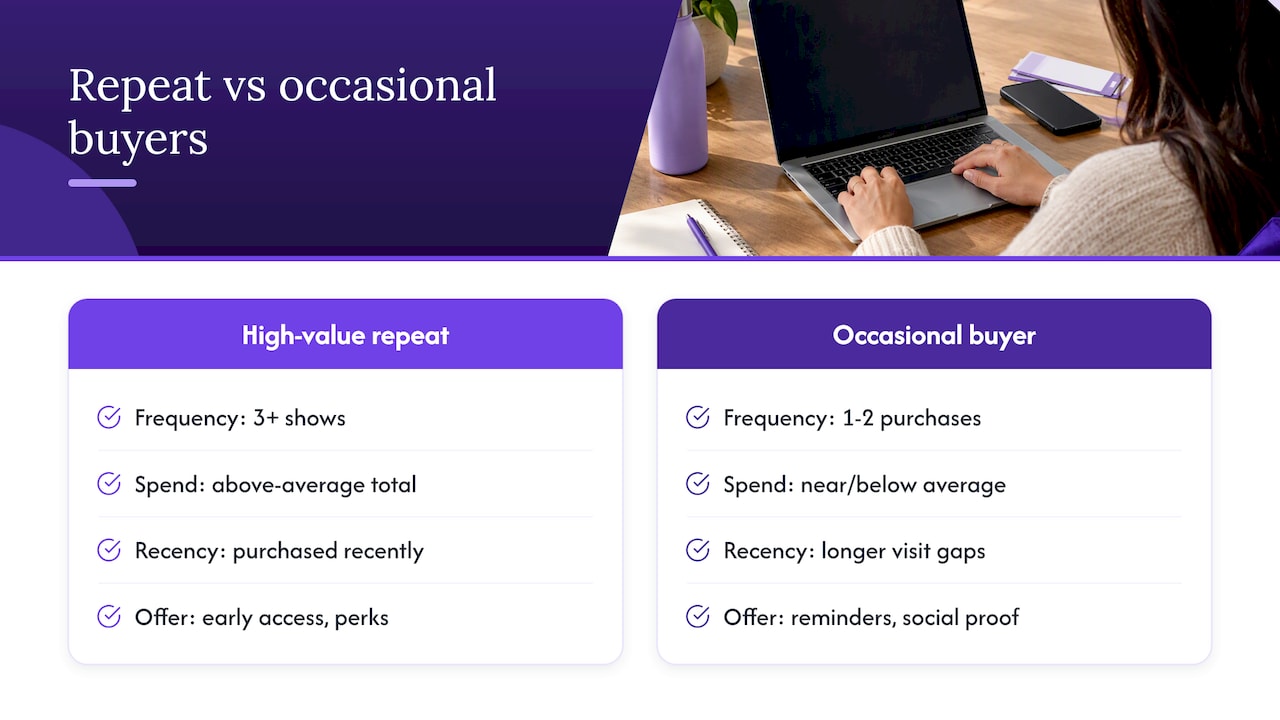
The split between a high-value repeat customer and an occasional buyer usually comes down to three variables: frequency, spend and recency. A fan who has attended three or more shows, spent above your average ticket and merchandise total, and purchased recently could fit your superfan segment. An occasional buyer typically shows one or two purchases, spend close to or below average, and longer gaps between visits.
Build the split directly from your RFM data rather than from assumptions about genre or demographics, since purchase behaviour is a far stronger predictor of future attendance than who a fan appears to be on paper. Once segmented, treat the two groups differently: high-value repeat fans respond well to early access and recognition, such as presale windows or small perks tied to their history with you, while occasional buyers respond better to reminders, social proof and time-limited offers that nudge a decision they were already close to making.
Review the thresholds regularly. A fan who was previously occasional may have moved into your high-value segment, and a former superfan may be drifting towards lapsed status. Treating segmentation as a one-off exercise rather than a living model is one of the most common reasons promoters lose track of their best fans.
How Lookport Ticketing and the tour break-even calculator speed up tests and revenue modelling
We built Lookport Ticketing for promoters. Proceeds go directly into your own Stripe account, and Lookport charges a flat 6% commission with no other Lookport charges.
- Review the live Lookport Ticketing features to see what ticketing data and sales information are available.
- Proceeds go directly into your own Stripe account.
- The tour break-even calculator, which lets you model pricing, revenue and break-even scenarios before you commit to a specific campaign or offer.
If you are planning a test for an upcoming show, start with Ticketing to get your data flowing, or run the numbers through the break-even calculator first to see what a successful win-back or early-access campaign would need to deliver.
FAQ
What’s AI ticket reselling?
AI ticket reselling generally refers to automated tools used on secondary marketplaces to detect demand, adjust resale pricing or flag suspicious bulk purchases. It sits outside primary ticketing and audience analytics, which focus on identifying genuine fans and encouraging them to buy directly from the promoter.
Who has the most audience in a concert?
Audience size at any single concert depends entirely on the venue capacity and the artist, so there is no fixed answer. What matters more for repeat-sales planning is tracking your own audience across multiple shows rather than comparing absolute attendance figures between different events.
What are the best strategies for marketing a concert?
Effective concert marketing combines owned channels like email and SMS with targeted paid campaigns built from your best-converting segments. Industry practice treats email and SMS as resilient, consented assets separate from any single platform’s algorithm, which keeps your reach stable even when ad costs or reach on social platforms shift (Oasis, Beyoncé and Dua Lipa).
How to measure ticket sales?
Measure ticket sales through sales pacing against time to the event, repeat purchase rate across your fan base, and conversion by audience segment rather than looking at total sales alone. Comparing a treated cohort against a genuine control group is the most reliable way to confirm whether a specific campaign actually drove the result.
Sources
The claims above draw on Information Commissioner’s Office guidance for profiling and automated decision-making, alongside industry reporting on UK music tourism and repeat attendance figures. We link only the sources that directly support the facts stated in this article, so you can verify the regulatory and commercial points for yourself.
Recommended
Ticketing & event budgeting
 2026-10-22
Ticketing Analytics for UK Promoters: What to Track and Why
Ticketing analytics for UK concert promoters: the metrics that drive decisions, how to set up tracking, and how to tie sales data back to your show budget.
 2026-10-21
Concert Break-Even Calculator: How Many Tickets You Must Sell
Work out how many tickets a UK concert needs to break even. Costs, PRS, ticket commission, a worked example and a free calculator for promoters and venues.
 2026-10-19
Ticket Sales Break-Even Analysis for UK Shows
Work out how many tickets you must sell to cover a UK show: VAT, PRS, fees, fixed costs and a worked example, plus a free break-even calculator.
 2026-10-18
Refund Policy for Concerts: What UK Promoters Must Offer
What UK law and industry rules require when a concert is cancelled, moved or the buyer changes their mind, plus how to write a clear refund policy.
 2026-10-15
Facebook Ads for UK Promoters: Track Ticket Sales Before Spend
UK promoters can set up Meta pixel and Conversions API tracking, choose audiences, estimate ticket costs, and link Facebook ad spend to ticket revenue.
 2026-10-14
Profit Margins: Test 10 P&L Lines for UK Concert Promoters
See how UK concert promoters can model profit per show with 10 P&L inputs, test sell through and costs, and check break even before committing a deposit.