LOOKPORT / TICKETING & EVENT BUDGETING
Model 5–15% contingency for UK event budgets with a copyable template
Practical contingency planning for UK event budgets: when to set 5–15%, four calculation methods and a copyable template to model spend.

The right figure depends on how exposed the event is to weather, supplier reliability and complex production. Once you have set a figure, model it against ticket revenue using a budgeting calculator before you commit to final supplier quotes.
TL;DR:
- Combine flat percentage contingency with line-item buffers for volatile costs like AV hire, outdoor staging, or urgent supplier repairs to improve accuracy.
- Use scenario modeling and risk-weighted scoring before signing major contracts to ensure contingency reflects undeveloped or uncertain costs properly.
- Reserve contingency funds for unforeseeable events such as weather disruptions, technical failures, or last-minute safety requirements, not avoidable planning errors.
- Track contingency spending with detailed, versioned budgets and approval processes, aligning ongoing reviews with ticket sales and risk register updates.
- ✓Model event and tour costs
- ✓Test different ticket prices
- ✓Estimate revenue and break-even
Table of Contents
- How much contingency should you allocate?
- How do you calculate contingency for an event?
- What should contingency cover, and what should it not?
- How do you track and control contingency spend?
- How does insurance complement contingency planning?
- How does contingency link to your risk register?
- Templates and tools to model contingency in practice
- Model your contingency with Lookport’s budgeting tools
- FAQ
- Sources
How much contingency should you allocate?
A straightforward one-day event with fixed-price suppliers can often work with a low single-digit contingency, since most costs are already confirmed. A multi-day event, or one with several moving production elements, usually requires a moderate contingency reserve. Outdoor events, those with complex AV or broadcast requirements, or events booked on tight lead times with provisional quotes, often justify a higher contingency within that general upper range.
Several factors push a budget toward the higher end of that range:
- Outdoor settings exposed to weather disruption or ground conditions.
- Multi-day running orders with cumulative staffing and logistics costs.
- Complex AV, lighting or broadcast setups with technical failure risk.
- Tight lead times that leave little room to renegotiate supplier terms.
- Provisional or verbal quotes that have not been formally confirmed.
When supplier quotes are still provisional, treat the contingency figure as a working estimate and revisit it once contracts are signed. A budget built entirely on estimates deserves contingency nearer the top of the band until those numbers firm up.
How do you calculate contingency for an event?
Four methods cover most situations, and combining them often gives a more accurate figure than relying on one alone.
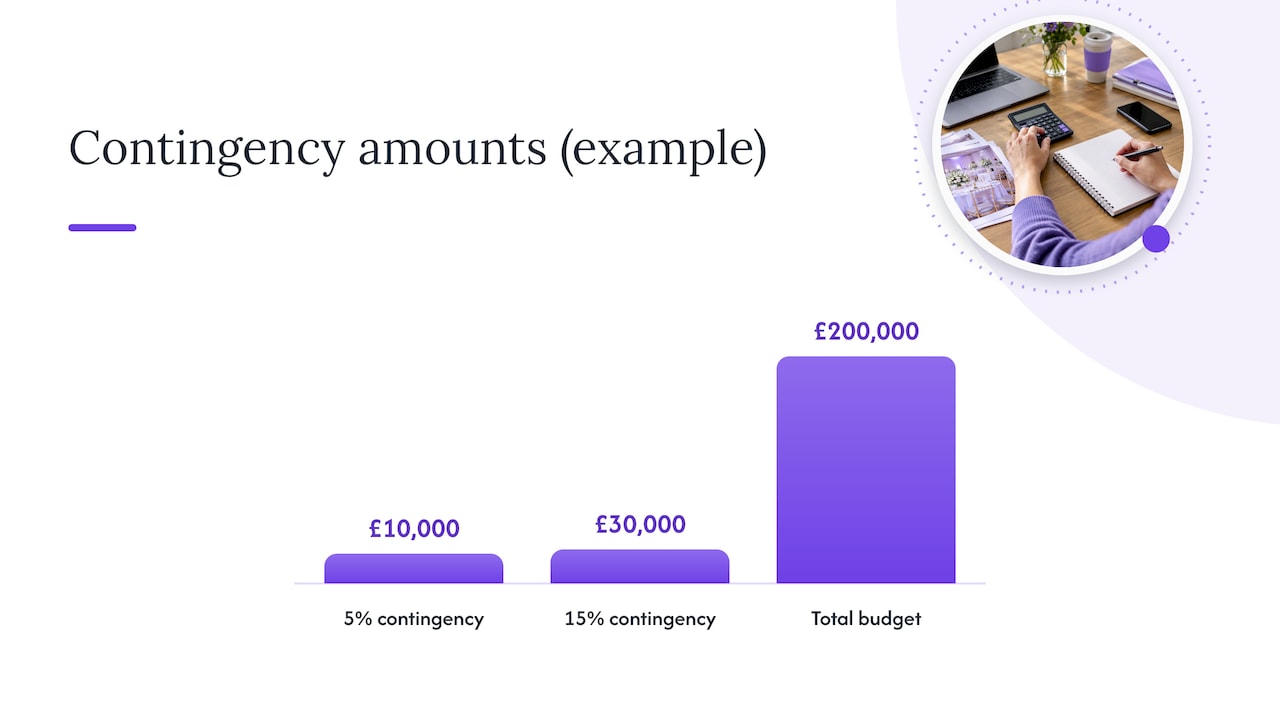
- Simple percentage: apply a flat 5% to 15% to total budget. Quick to use, but it treats every cost line as equally uncertain, which rarely reflects reality.
- Line-item contingency: add a specific buffer to individual volatile costs, such as freight, AV hire or outdoor staging, where price swings are common.
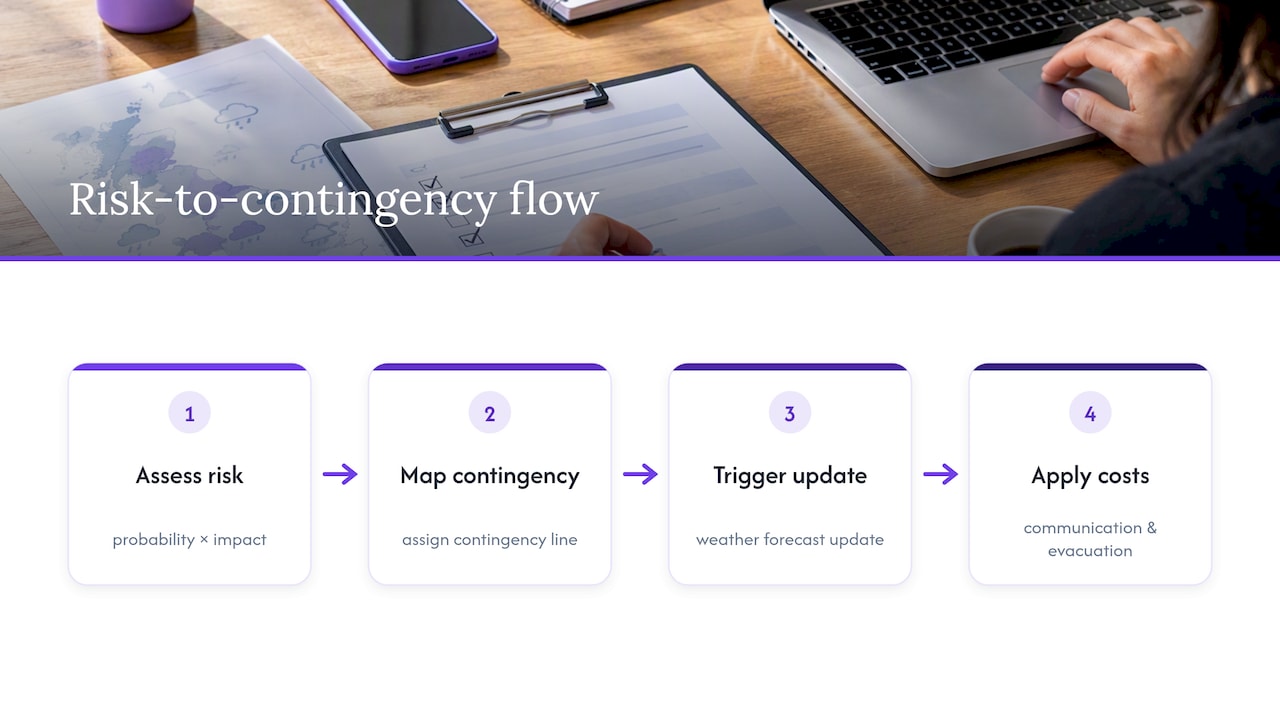
- Risk-weighted contingency: score each item on your risk register by probability and impact, then size contingency against the items with the highest combined score rather than the whole budget.
- Scenario modelling: stress-test the budget against a low, medium and high cost scenario, checking where break-even sits in each case.
Combining a flat percentage for residual, unpredictable costs with line-item buffers for known volatile items tends to produce a tighter, more defensible figure than either method alone.
Take a hypothetical outdoor festival with a total budget of £200,000.
Pro Tip: Run the scenario model before you sign your largest supplier contract, not after, so the contingency figure still reflects a decision you can act on.
What should contingency cover, and what should it not?
Contingency exists for costs you could not reasonably have priced in advance, not for errors in the original plan.
- AV or technical equipment failure requiring emergency hire or repair.
- Weather mitigation, such as emergency covering, drainage or heating.
- Extra stewarding or security called in on the day for crowd or safety reasons.
- Travel delays affecting artists, crew or equipment that require rebooking.
- Last-minute hire to replace a supplier that falls through.
Contingency should not absorb costs caused by avoidable planning errors, such as underquoting a supplier at the outset or forgetting a line item entirely. Those belong in a lessons-learned review, not the contingency draw. Set a simple authorisation rule: anything under a fixed threshold can be approved by the budget holder directly, anything above it needs sign-off from a second person, and every draw gets a short written reason attached.
How do you track and control contingency spend?
Contingency only works as protection if it is visible throughout planning, not just at the final reconciliation.
- Keep a versioned budget, reforecasting weekly as the event date approaches and more quotes are confirmed.
- Record every contingency transaction on its own line with a receipt and a one-line rationale, separate from planned costs.
- Set an approval threshold so small draws move quickly and larger ones get a second sign-off.
- Review contingency release against ticket-sales pacing, since slower sales may mean less headroom to spend than originally planned.
Pro Tip: Reforecast contingency at the same cadence you review ticket sales, so a slow sales week triggers a budget conversation before the money is already spent.
How does insurance complement contingency planning?
Contingency and insurance protect against different kinds of risk. Contingency covers smaller, predictable cost overruns; insurance covers larger, lower-probability events that could otherwise sink the budget entirely. The Purple Guide’s insurance guidance recommends public liability cover as a baseline for event organisers, with the appropriate limit set against the scale and risk profile of the event.
- Public liability insurance, sized to the event’s scale and public exposure.
- Event cancellation cover, worth considering for high-value or weather-exposed events.
- Non-appearance cover, relevant where a single headline act drives most ticket revenue.
- Adverse weather cover, useful for outdoor events with a fixed, non-movable date.
Check that supplier insurance requirements line up with your own contingency allocation. If a supplier’s cover has gaps, that gap becomes a cost your contingency reserve may need to absorb instead.
How does contingency link to your risk register?
Contingency and the risk register should move together, not sit as two separate documents reviewed at different times. The Purple Guide’s planning and risk assessment guidance treats risk assessment as a core part of event planning, with contingency and emergency arrangements built in from the start rather than added afterwards. A council event management plan template typically lists contingency planning and emergency procedures as mandatory sections, which is a useful structure to borrow even for smaller events.
Map your highest-scoring risk register items, ranked by probability multiplied by impact, directly to a contingency line. When a risk rating changes, for instance a weather forecast firming up a week out, revisit the matching contingency figure rather than waiting for the next scheduled review. Communication and evacuation costs belong in this mapping too: the Purple Guide’s lite edition flags continuous contingency review and suggests planning how you would communicate cancellations or emergency information, which carries its own cost if it needs a rapid social media or messaging push.
A fillable risk-assessment template, such as the group event risk assessment used for outdoor and guided group events, is a useful starting structure if you are building a register from scratch.
Templates and tools to model contingency in practice
A minimal contingency template needs three columns beyond the standard budget: a separate contingency line per risk category, an approval column recording who signed off each draw, and a notes column explaining why. That structure alone makes a contingency reserve auditable without extra software.
- Keep contingency as its own budget line, never folded into general costs.
- Record approval and rationale for every draw, however small.
- Reforecast the whole budget, not just contingency, as quotes firm up.
For modelling the numbers themselves, a tour break-even calculator lets you test how ticket price, revenue and expense assumptions affect your break-even point, which helps you judge whether your contingency reserve is realistic against expected sales. Budgeting and cost-tracking tools that separate planned spend from actuals, such as those on an event finances page, make it easier to see contingency drawdown as it happens rather than at reconciliation. Any forecast is only as good as its inputs, so validate ticket price and cost assumptions against signed contracts before relying on the output.
Model your contingency with Lookport’s budgeting tools
Our ticketing platform charges a standard commission with no additional charges, and ticket proceeds go directly into your own Stripe account rather than sitting with a third party. We built our budgeting tools so you can model contingency scenarios and watch revenue pacing against your cost buffers as sales come in, without needing a separate spreadsheet system.
- Model ticket price, revenue and break-even assumptions with the tour break-even calculator.
- Track planned spend against actuals with event budgeting and P&L tools.
- Forecast sales velocity to inform when contingency can be safely released with a sales pacing calculator.
| Tool | What it helps with |
|---|---|
| Tour break-even calculator | Testing ticket price, revenue and expense scenarios against contingency assumptions |
| Event finances (budgets, cost tracking, P&L) | Recording contingency draws against actual spend as the event approaches |
| Sales pacing calculator | Forecasting ticket revenue pace to judge when contingency can be released |
These tools work alongside whatever risk register or planning template you already use. If ticketing and budget modelling are what you need in one place, our ticketing platform is worth a look.
FAQ
What are the 7 types of budgets used in event planning?
Event budgets commonly break into categories such as venue, catering, production and AV, staffing, marketing, travel and logistics, and contingency, though the exact split varies by organiser and event type. Definitions vary across guides, so treat this as a common structure to adapt rather than a fixed standard.
What is a contingency budget in project management?
In event planning, it is tracked as a separate line and tied to specific risks on a risk register rather than spent on general overruns.
What is the 50/30/20 budget rule?
Event contingency planning uses percentage-based or risk-weighted methods instead, sized to the specific costs and risks of the event.
What is an example of a contingency plan?
A contingency plan for an outdoor event might set aside a dedicated budget line for emergency covering or staging repair if weather disrupts the site, with a named approver and a trigger point for when the spend is released. The Purple Guide recommends building this kind of response directly into event risk assessments rather than treating it as a separate afterthought.
Sources
Recommended
Ticketing & event budgeting
 2026-10-22
Ticketing Analytics for UK Promoters: What to Track and Why
Ticketing analytics for UK concert promoters: the metrics that drive decisions, how to set up tracking, and how to tie sales data back to your show budget.
 2026-10-21
Concert Break-Even Calculator: How Many Tickets You Must Sell
Work out how many tickets a UK concert needs to break even. Costs, PRS, ticket commission, a worked example and a free calculator for promoters and venues.
 2026-10-19
Ticket Sales Break-Even Analysis for UK Shows
Work out how many tickets you must sell to cover a UK show: VAT, PRS, fees, fixed costs and a worked example, plus a free break-even calculator.
 2026-10-18
Refund Policy for Concerts: What UK Promoters Must Offer
What UK law and industry rules require when a concert is cancelled, moved or the buyer changes their mind, plus how to write a clear refund policy.
 2026-10-15
Facebook Ads for UK Promoters: Track Ticket Sales Before Spend
UK promoters can set up Meta pixel and Conversions API tracking, choose audiences, estimate ticket costs, and link Facebook ad spend to ticket revenue.
 2026-10-14
Profit Margins: Test 10 P&L Lines for UK Concert Promoters
See how UK concert promoters can model profit per show with 10 P&L inputs, test sell through and costs, and check break even before committing a deposit.