LOOKPORT / TICKETING & EVENT BUDGETING
UK organisers: Avoid VAT fines on ticket sales, 5% relief & checklist
VAT guide for UK organisers: when 20% applies, the temporary 5% relief (25 June–1 Sept 2026), a seven‑point ticketing checklist and a Lookport model to...

In narrow circumstances, a lower rate applies: most notably a temporary 5% reduced rate for qualifying children’s and family admissions running from 25 June to 1 September 2026. The sections below explain how to apply these rules in your ticketing and accounting systems, with HMRC and GOV.UK as the primary authority throughout.
TL;DR:
- The temporary 5% VAT rate applies only to children’s and family admission tickets from June 25 to September 1, 2026, and is based on the event date, not purchase date.
- Only specific cultural, theatrical, or attraction admissions qualify for VAT exemption if the organizer meets strict non-profit and management criteria listed in VAT Notice 701/47.
- Correct VAT treatment depends on whether you sell tickets as the principal or agent, with the latter only accounting for VAT on commissions, not full ticket prices.
- For cross-border events or resale, VAT rules vary depending on the place of supply, the role as principal or agent, and whether resale occurs within your own system or on third-party platforms.
- Ticketing systems must be configured to apply VAT based on event date, support separate categories, and keep detailed records for tax compliance and audit purposes.
Table of Contents
- Standard VAT treatment of ticket sales: when 20% applies
- Temporary reduced rate for children’s and family tickets in summer 2026
- Exemptions and cultural-body eligibility under VAT Notice 701/47
- Registration, place of supply and accounting for VAT on tickets
- A practical checklist for ticketing systems and pricing
- Operational example: modelling VAT impact before you go on sale
- Clarification on VAT invoicing requirements for ticket sales
- Penalties and consequences of incorrect VAT treatment on tickets
- How to handle VAT on resold or secondary market tickets
- Why Lookport makes VAT-aware ticketing straightforward
- FAQ
- Sources
Standard VAT treatment of ticket sales: when 20% applies
Admission to a concert, festival or venue event counts as a taxable supply under UK VAT law.
Most promoters and venues fall into this default category. The exceptions are narrow and depend on who you are and what you’re selling:
- Cultural exemptions: admission charges by eligible bodies to specified cultural events can be exempt, covered separately under VAT Notice 701/47.
- Certain educational activities: some admissions tied to educational provision may fall outside standard VAT treatment, depending on the supplier’s status.
- Betting and gaming exclusions: these sit under different VAT rules entirely and rarely overlap with ticketed live events, but mixed-activity venues should check each revenue stream separately.
Agent versus principal status also changes who accounts for VAT. If you sell tickets as the principal (you’re the one staging the event and taking on the financial risk), you charge VAT on the full ticket price. If you’re acting purely as an agent for another promoter, selling on commission, you only account for VAT on your commission, while the promoter accounts for VAT on the ticket price itself. Getting this distinction wrong is one of the most common sources of VAT errors in ticketing, so confirm your contractual role before you set tax rates in your ticketing system.
Temporary reduced rate for children’s and family tickets in summer 2026
A temporary UK-wide reduced rate of 5% applies to certain children’s meals and qualifying admission tickets between 25 June 2026 and 1 September 2026, introduced through The Value Added Tax (Reduced Rate) (Hospitality and Tourism) Order 2026, which amends Schedule 7A of the Value Added Tax Act 1994 for this specific period.
The relief covers a defined set of admissions, not every ticket a child might buy:
- Children’s admissions to theatres, cinemas, concerts and exhibitions.
- Family admissions, where the ticket is sold and marketed as covering a family group.
- Specified attractions named in the relief guidance.
Pro Tip: Treat how you market and price a ticket as evidence, not just a label: a ticket must actually be sold as a children’s or family admission to qualify, not simply offered at a discount.
The Revenue and Customs brief 5/2026 sets out that the reduced rate applies according to the date of admission, not the date of purchase. That means a ticket bought in April 2026 for a show taking place on 30 June 2026 falls within the relief window and can be charged at 5%. Businesses may also opt to account at the reduced rate for advance payments received before the relief starts, provided the admission date itself falls within the window, as long as they keep clear records of that decision.
One scope point matters for pricing teams: where a family package is held out for sale as a family admission that includes one or more children, the whole package, adults included, takes the reduced rate rather than just the children’s portion.
Exemptions and cultural-body eligibility under VAT Notice 701/47
Separate from the temporary relief, some cultural admissions are exempt from VAT altogether. This exemption is set out in VAT Notice 701/47 on admission charges to cultural events, and it applies only to a specific category of organiser known as an “eligible body”.
- Non-profit distribution: the organisation must not distribute any profit it makes, whether from ticket sales or other activities.
- Reinvestment of profits: any surplus generated must be reinvested into the organisation’s cultural or charitable purpose, not paid out to members or shareholders.
- Voluntary, unpaid management: the body’s management or administration must be run by people who have no direct or indirect financial interest in its activities.
- Public body status: certain public bodies, such as local authority museums or galleries, may also qualify for exemption without meeting the eligible body tests in full.
Where these conditions are met, admission to qualifying museums, galleries, theatrical and musical performances, and similar cultural events can be exempt. A commercial concert promoter running a standard ticketed gig will not normally meet these tests, so exemption under this notice is the exception rather than the rule for most of our readers.
There’s a practical catch for organisations that do qualify. Exempt income affects your ability to recover input VAT on costs connected to that exempt activity. If your organisation has both exempt cultural income and standard-rated ticket sales, you may need to apply partial exemption rules, which restrict how much VAT you can reclaim on shared overheads like venue hire or marketing spend. This is worth checking with an accountant before you assume exemption is automatically the better outcome.
Registration, place of supply and accounting for VAT on tickets
If your taxable turnover exceeds the VAT registration threshold, you must register for VAT, and if you register late, HMRC still requires you to account for VAT from the date you should have registered, not from when you actually complete the paperwork. This catches out seasonal promoters whose turnover climbs quickly during a busy touring period.
Place of supply rules determine which country’s VAT applies to an admission charge. According to HMRC guidance on the place of supply for event admissions, admission is taxed where the event physically takes place. If you’re an intermediary selling tickets for an overseas event, you may need to register and account for VAT in that other country, depending on whether you’re acting as agent or principal.
A few accounting practicalities to settle before you go on sale:
- Decide your agent or principal status in writing, and apply it consistently across all ticket categories.
- Set your ticketing system to apply VAT based on the event date, not the purchase date, for anything that spans a rate change.
- Keep refund and exchange processes linked to the original VAT treatment, so a refunded ticket reverses the correct amount of output tax.
- For cross-border bookings handled through intermediaries, check whether reverse-charge rules apply to the supply between businesses.
Pro Tip: When advance sales straddle a VAT rate change, decide your accounting approach before tickets go on sale and write it down, rather than deciding retrospectively when HMRC asks.
A practical checklist for ticketing systems and pricing
Getting VAT right in practice comes down to a short sequence of system checks, most of which take minutes to configure but save hours of correction later.
- Set your ticketing platform to apply VAT rates by event date, not transaction date, for any event that spans a rate boundary.
- Create distinct ticket categories for children’s, family and adult admissions rather than relying on a single discounted price point, as seen in Booking information | Ocean Theatre Co..
- Record exactly how each category was marketed and priced, since this evidence supports your eligibility if HMRC later queries the rate applied.
- Keep copies of promotional materials, pricing pages and any terms describing what a “family ticket” includes.
- Test your checkout flow end to end, including receipts and accounting exports, before tickets go live.
- Confirm that refunds and exchanges automatically adjust the VAT component, not just the headline price.
- Reconcile the VAT collected against your accounting system each period, and keep a short audit file recording your rate decisions, relevant dates and calculations.
| Checklist item | Why it matters |
|---|---|
| VAT rate tied to event date | Avoids applying the wrong rate to advance sales spanning a rate change |
| Separate child/family/adult categories | Supports eligibility evidence for the temporary reduced rate |
| Retained marketing and pricing records | Backs up your rate decision if HMRC asks for evidence |
| Refund and exchange VAT adjustment | Keeps your VAT return accurate after cancellations |
| Audit file of decisions and dates | Gives you a clear record for HMRC enquiries |
Operational example: modelling VAT impact before you go on sale
A ticketing platform that lets you set VAT by event date, rather than by a single blanket rate, removes a lot of manual correction. Lookport’s ticketing platform supports separate ticket categories, which means you can run a child’s ticket at 5% and an adult ticket at 20% within the same event without manual workarounds, alongside clear product labelling and exportable sales history for your accounts.
Say, purely as a hypothetical example, a family show sells 500 tickets at £20 each. These figures are illustrative only; run your own numbers against your actual pricing and category mix.
To see how a VAT rate change feeds through to overall event profitability, our tour break-even calculator lets you model ticket prices, costs and revenue scenarios before you commit to a pricing structure. Useful functions when you’re setting this up:
- Date-driven VAT settings per ticket category.
- Separate product labelling for child, family and adult admissions.
- Exportable sales history for your VAT return and audit file.
Clarification on VAT invoicing requirements for ticket sales
If you’re VAT-registered and selling to another VAT-registered business, such as a corporate hospitality buyer, you need to issue a proper VAT invoice showing your VAT registration number, the tax point (usually the date of sale or the date the ticket is issued), the rate applied and the VAT amount separately from the net price.
For sales direct to the general public, a full VAT invoice usually isn’t required unless the buyer asks for one, but your receipt should still show the ticket price and make clear whether VAT is included. Many ticketing systems generate this automatically, provided the VAT rate has been set correctly against the right ticket category.
Mixing rates on a single line item without a breakdown makes it harder to defend your treatment if HMRC reviews your return. Keep the rate, the category and the evidential basis (how the ticket was marketed) consistent across your invoice, your accounting export and your audit file, so the three always tell the same story for any given transaction.
Penalties and consequences of incorrect VAT treatment on tickets
Charging the wrong VAT rate, or failing to register when your turnover crosses the threshold, carries real financial consequences.
The severity of any penalty typically depends on whether HMRC views the error as careless, deliberate or deliberate and concealed, and on whether you told them before they found it themselves. Voluntary disclosure of a mistake, corrected promptly, generally results in a lower penalty than an error HMRC uncovers through its own checks.
This is exactly why the record-keeping steps earlier in this guide matter beyond basic good practice. An audit file showing your rate decisions, the dates involved and the evidential basis for any reduced rate or exemption gives you something concrete to show HMRC if your treatment is ever queried. Without that record, you’re relying on memory to explain a decision made months or years earlier, which rarely goes well in a VAT enquiry.
How to handle VAT on resold or secondary market tickets
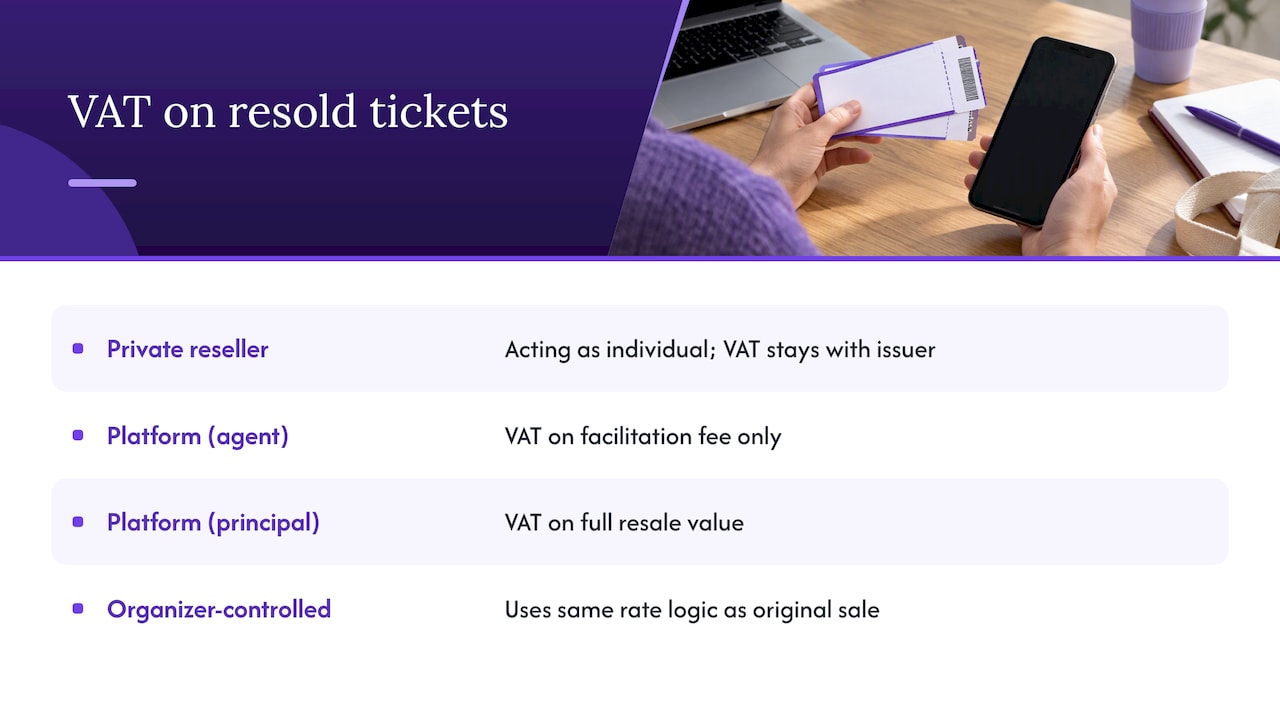
Secondary market or resold tickets raise a different VAT question: who is actually making the supply, and at what price. If you resell a ticket you originally bought for your own use, you’re generally acting as a private individual rather than a business, and VAT questions mostly sit with the original issuer rather than with you.
For a business or platform that facilitates resale, the agent versus principal distinction covered earlier becomes central again. If the resale platform is acting as an agent, matching buyers and sellers for a fee, VAT applies to that facilitation fee, not necessarily to the full resale price. If it’s acting as principal, buying and reselling tickets in its own right, VAT applies to the full resale value it charges.
Organisers who control resale through their own ticketing system, rather than leaving it to third-party platforms, have a clearer line of sight over which VAT treatment applies, since they already know whether the original sale was standard-rated, reduced-rated or exempt. Keeping resale within your own platform, with the same ticket categories and rate logic you used for the original sale, avoids the ambiguity that arises when a ticket changes hands on a separate marketplace with no visibility into how the original admission was taxed.
Why Lookport makes VAT-aware ticketing straightforward
Getting VAT right shouldn’t mean wrestling with your ticketing software every time a rate changes. Our platform charges a flat 6% commission with no other Lookport charges, and ticket proceeds go directly into your own Stripe account rather than sitting with us between sale and payout.

For VAT purposes specifically, our ticketing platform supports the separate ticket categories you need to apply different rates correctly, whether that’s a standard adult admission, a temporary reduced-rate children’s ticket, or a VIP category with its own pricing structure. Features we offer that support this kind of setup include:
- Online and hybrid ticketing with configurable ticket categories per event.
- VIP ticketing tiers alongside standard admissions.
- Sales history exports to feed your VAT reconciliation and audit file.
If you want to see how a rate change affects your overall event economics before you set prices, our tour break-even calculator models ticket revenue, costs and break-even point from your own figures.
This article is general information, not a substitute for advice from a qualified financial advisor. Consult a qualified financial professional about your own circumstances before acting on anything here.
FAQ
Do you have to pay VAT on ticket sales?
Exceptions exist for qualifying cultural admissions under VAT Notice 701/47 and for the temporary reduced rate running from 25 June to 1 September 2026.
Is there VAT on flight tickets in the UK?
Flight tickets follow separate VAT and Air Passenger Duty rules rather than the admission charge rules covered in this guide. We’d point you to HMRC’s dedicated transport VAT guidance rather than this ticketing-focused article for a definitive answer on flights.
Is VAT always 20% in the UK?
No, 20% is the standard rate but it isn’t universal: a reduced 5% rate and a zero rate apply to specific goods and services, and the UK introduced a temporary 5% rate for qualifying children’s meals, tickets and family attractions from 25 June to 1 September 2026. Some cultural admissions can also be exempt entirely under separate rules.
What are the new VAT rules for 2026 in the UK?
The main change for 2026 is the temporary 5% reduced rate for qualifying children’s meals, tickets and family attractions, running from 25 June to 1 September 2026 under The Value Added Tax (Reduced Rate) (Hospitality and Tourism) Order 2026. Outside this narrow window and category, standard VAT rules for ticket sales remain unchanged.
Sources
Recommended
Ticketing & event budgeting
 2026-10-22
Ticketing Analytics for UK Promoters: What to Track and Why
Ticketing analytics for UK concert promoters: the metrics that drive decisions, how to set up tracking, and how to tie sales data back to your show budget.
 2026-10-21
Concert Break-Even Calculator: How Many Tickets You Must Sell
Work out how many tickets a UK concert needs to break even. Costs, PRS, ticket commission, a worked example and a free calculator for promoters and venues.
 2026-10-19
Ticket Sales Break-Even Analysis for UK Shows
Work out how many tickets you must sell to cover a UK show: VAT, PRS, fees, fixed costs and a worked example, plus a free break-even calculator.
 2026-10-18
Refund Policy for Concerts: What UK Promoters Must Offer
What UK law and industry rules require when a concert is cancelled, moved or the buyer changes their mind, plus how to write a clear refund policy.
 2026-10-15
Facebook Ads for UK Promoters: Track Ticket Sales Before Spend
UK promoters can set up Meta pixel and Conversions API tracking, choose audiences, estimate ticket costs, and link Facebook ad spend to ticket revenue.
 2026-10-14
Profit Margins: Test 10 P&L Lines for UK Concert Promoters
See how UK concert promoters can model profit per show with 10 P&L inputs, test sell through and costs, and check break even before committing a deposit.