LOOKPORT / TICKETING & EVENT BUDGETING
UK Promoters: Run ICO Compliant AI Concert Marketing in 8–12 Weeks
UK promoters: an ICO compliant AI playbook to sell more concert tickets. Use audience scoring, rapid tests and an 8–12 week rollout to measure lift.
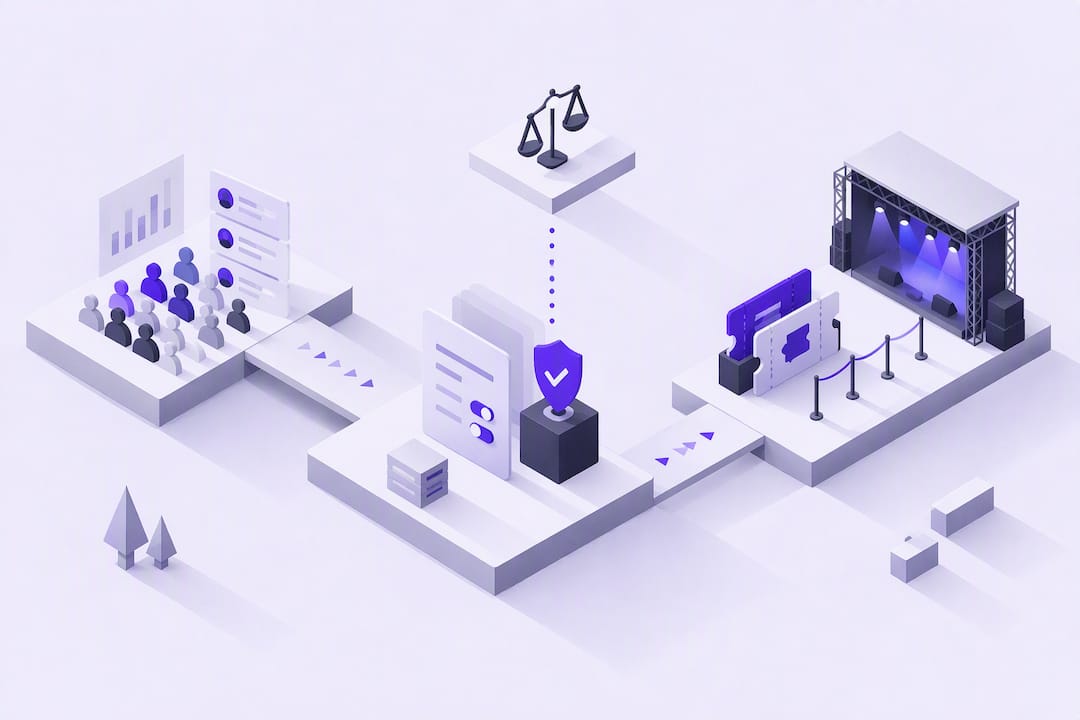
The best AI-driven approach to selling more concert tickets combines accurate audience scoring with platform-native creative and a frictionless, trackable mobile checkout. We built Lookport around this exact workflow, and two sources anchor why it matters: UK Music shows the scale of the opportunity, while the ICO sets the compliance boundaries. Check our ticketing tools or run the break-even calculator before you commit budget.
TL;DR:
- Regularly update audience models with recent ticket sales and engagement data to ensure targeting remains current and effective.
- Measure baseline metrics such as conversion rate, cost per ticket, and cohort lifetime value before scaling AI-driven tactics.
- Use city, venue, and timing context to refine segments, prioritizing recent engagement signals over demographic data alone.
- Implement strict tracking, data hygiene, and lawful processing measures before launching campaigns to minimize legal risks.
- Rely on clean tracking and rapid creative testing to reduce cost per click more than targeting improvements alone.
Table of Contents
- Strategy overview: finding, engaging and converting your audience
- Tactical playbook: AI tactics by channel
- Implementation checklist: tracking, privacy and rollout timing
- Measurement and optimisation: proving lift before you scale
- Segmentation strategies powered by AI for concertgoers
- AI chatbots and conversational marketing for ticket sales
- Managing and integrating AI insights with CRM systems
- How Lookport supports this workflow
- FAQ
- Sources
Strategy overview: finding, engaging and converting your audience
We think about AI-driven ticket sales in three pillars: find, engage, convert. Audience scoring finds the people most likely to buy. Creative-first funnels engage them with content that feels native to the platform they’re scrolling. A frictionless checkout converts that interest into a completed sale before the moment passes.
The market reward for getting this right is substantial. The UK live music sector generated about £11.2 billion in total economic activity in 2025, with £5.7 billion spent directly by music tourists on tickets and related items, drawn from 24.7 million music tourists. That scale means even modest improvements in targeting accuracy or checkout completion translate into meaningful revenue, which justifies the time spent setting up proper tracking and testing frameworks.
Before you touch a campaign, agree on the metrics that tell you whether any of this is working:
- Tickets sold: the baseline volume metric, tracked daily against your on-sale curve.
- Conversion rate: the percentage of engaged users who complete a purchase, measured from ad click through to check out.
- Cost per ticket: total spend divided by tickets sold, the number that tells you whether a channel is sustainable.
- Cohort lifetime value: repeat purchase behaviour from the same buyer across future shows, which shapes how much you can spend to acquire them.
Get these four numbers reporting cleanly before you scale any AI tactic. Without a reliable baseline, you cannot tell whether a new audience model or creative format actually moved the needle.
Tactical playbook: AI tactics by channel
Here is the sequence we recommend, built around how promoters actually run campaigns rather than abstract theory.
- Build behavioural clusters from existing signals. Seed your audience models with past buyers, streaming engagement and social interaction data. Weight recent activity more heavily than older activity, since a fan who streamed an artist last month is a stronger signal than one who streamed two years ago.
- Refresh lookalike and cross-platform audiences regularly. Feed new ticket-sale events back into Meta, Google and TikTok audience tools as each wave of sales completes, so the model keeps learning from your most current buyers rather than a static seed list.
- Run rapid, multivariate creative tests. Test hooks, formats and calls to action against each other simultaneously rather than one change at a time. Favour UGC-style assets over polished studio cuts, since platform-native formats tend to outperform obviously produced content on TikTok and Meta.
- Automate bidding with guardrails. Let automated bidding manage day-to-day allocation, but set frequency caps and review budget rebalancing weekly so spend doesn’t drift toward the easiest, not the best, audience.
- Apply dynamic pricing and VIP segmentation conceptually. Price tiers that respond to demand, paired with clearly differentiated VIP packages, let urgency messaging do real work instead of manufactured scarcity.
- Protect margin with owned channels. Email and SMS presales, released in city-level waves, convert your warmest audience before you spend a pound on paid media.
Practitioner interviews on large-scale ticket operations describe data systems behind the sale of over 75 million concert tickets, and the consistent theme is that clean tracking and rapid creative testing, not targeting alone, drive down effective cost per click. The competitive edge is shifting toward creative quality once the tracking foundation is solid.
Pro Tip: Validate any propensity model against an out-of-time holdout group before trusting it for a new tour, so you catch overfitting to a single artist or city.
Implementation checklist: tracking, privacy and rollout timing
Before launch, work through tracking, data hygiene and legal checks in that order.
- Tracking: install pixel and server-side API events, connect ticket-sale events to your analytics platform, and verify deduplication so a single sale doesn’t count twice across channels.
- Data hygiene: maintain canonical email and phone records, apply consent flags and suppression lists, and sync customer data on a regular cadence so stale records don’t skew your models.
- Lawful basis and DPIA: document the lawful basis for any AI-driven processing, and complete a Data Protection Impact Assessment where profiling or automated decisions could have a significant effect on individuals, following ICO guidance on lawfulness in AI. The ICO also warns that profiling can trigger transparency obligations and a right to object under UK GDPR, with extra care required around vulnerable groups.
- Rollout timeline: a typical wave structure runs announcement and presale across 8 to 12 weeks, paid activation across 4 to 7 weeks, and a final-call urgency push in the last 2 weeks, with A/B tests run continuously through the paid activation window.
- Pre-launch smoke tests: check mobile checkout speed, confirm the payment flow end to end, and verify funnel tagging fires correctly before the first pound of ad spend goes live.
Treat this checklist as sequential. Skipping the lawful basis step to launch faster creates risk that outweighs any speed gained.
Measurement and optimisation: proving lift before you scale
Pick your primary metrics and measurement windows before launch, not after. Concert campaigns typically need a few weeks of stable data before conclusions are reliable, since ticket-buying behaviour clusters around announcement, midpoint and final-call phases rather than spreading evenly.
- Design a holdout group that receives no AI-optimised targeting, so you can measure incremental lift against a true baseline.
- Treat your ticket-platform sales data as the single source of truth for conversion rate and lifetime value calculations, since ad-platform reporting tends to overstate attributed conversions.
- Watch for broken attribution and inconsistent event naming across channels, which silently bias automated bidding toward the wrong audience.
- Avoid premature scaling: wait for a full measurement window before increasing budget on a tactic that looks promising after only a few days.
One of the clearest industry findings is that clean tracking, rather than any single AI technique, determines whether creative testing and automated bidding actually reduce cost per click, based on agency experience drawing on tens of millions of ticket sales. Get the measurement foundation right first.
Segmentation strategies powered by AI for concertgoers
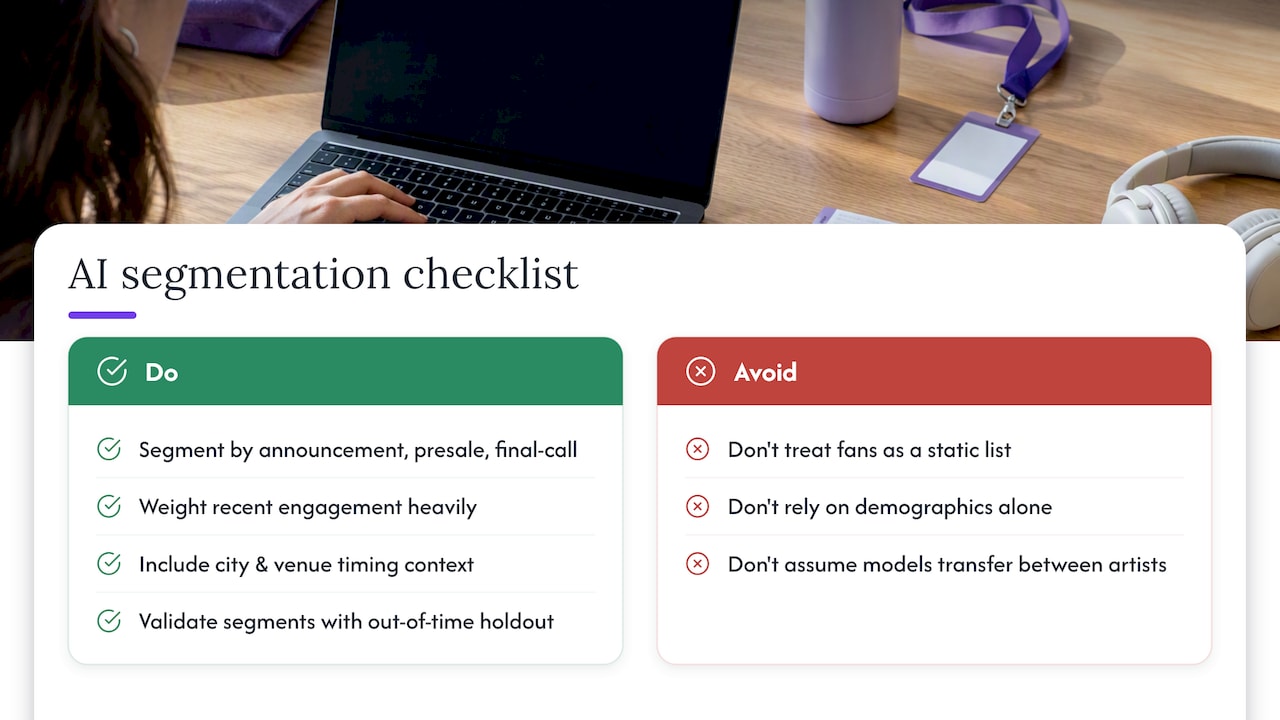
Concertgoers segment differently from general retail shoppers, because buying intent spikes around specific moments: announcement, presale windows and final-call urgency. AI segmentation works best when it reflects that rhythm rather than treating fans as a static list.
Useful segments include recent ticket buyers for the same artist or genre, fans who engaged with streaming or social content in the past 30 days, and past attendees of similar venues or tour stops. Weighting recency heavily matters here: someone who streamed a new single last week is a stronger prospect than someone who last engaged a year ago.
City and venue context also sharpens segmentation. A fan in a tour-stop city with limited remaining inventory behaves differently from one in a city with an early on-sale. Building that geographic and timing context into your models, rather than relying on demographic data alone, tends to produce sharper clusters. Validate any segment against an out-of-time holdout before trusting it across a full tour, since a model trained on one artist’s fanbase doesn’t always transfer cleanly to another.
AI chatbots and conversational marketing for ticket sales
Conversational tools can handle a meaningful share of pre-sale questions automatically: seating options, accessibility details, refund policy and presale codes. Routing these through a chatbot frees your team to focus on campaign strategy rather than repetitive enquiries during a high-traffic on-sale window.
The practical value is in reducing friction at the exact moment a fan is deciding whether to complete a purchase. A chatbot that answers a pricing or seating question instantly, rather than making a fan wait for an email reply, keeps that purchase intent alive. Keep the scope narrow and accurate: a chatbot that confidently gives wrong information about refunds or accessibility causes more damage than no chatbot at all. Pair any conversational tool with a clear handoff to a human for anything outside its documented scope.
Managing and integrating AI insights with CRM systems
AI-driven audience scores and segments only create value when they flow into the systems your team actually uses day to day. A propensity score sitting in a separate analytics dashboard, disconnected from your customer database, rarely changes how a campaign gets run.
The practical fix is a clean data flow: ticket-sale events feed your CRM, your CRM feeds your ad platforms and email tools, and campaign results feed back into the model that generated the original scores. Reconciling platform event names against your ticket-platform sale events on a regular basis catches dropped events or duplicate conversions before they distort automated bidding or inflate conversion numbers.
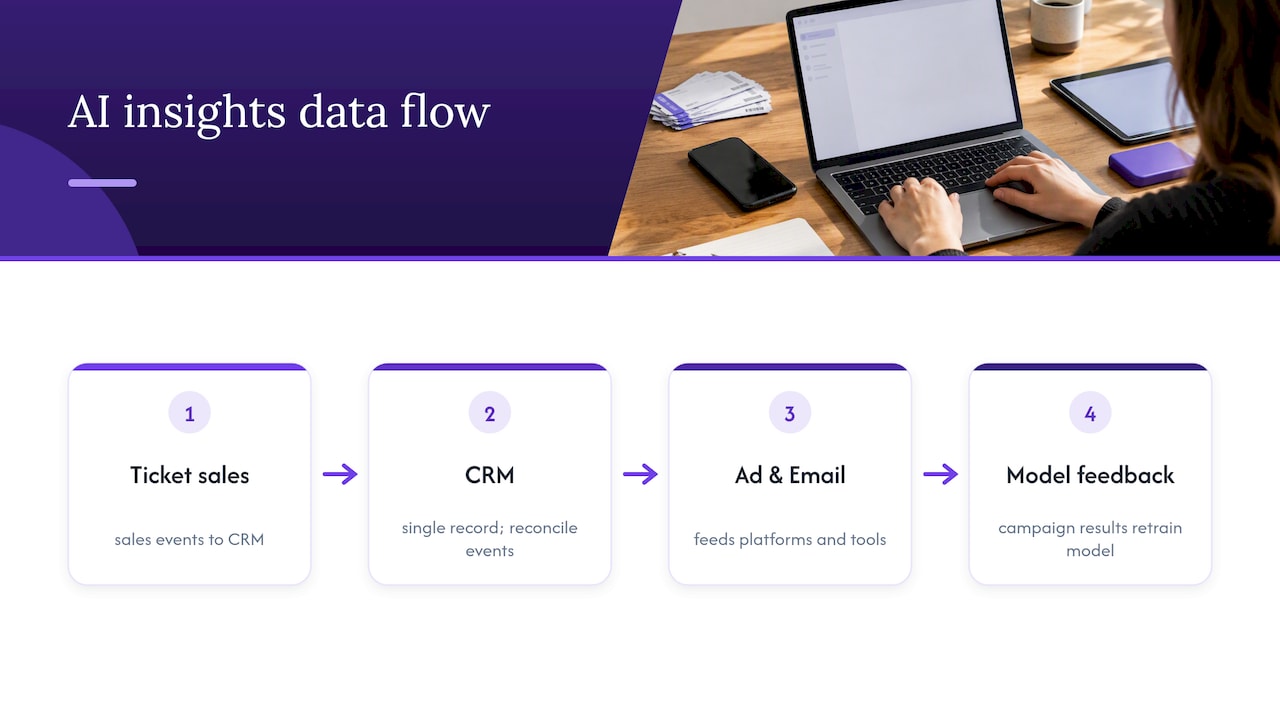
Keep ownership simple: one canonical customer record per fan, with consent flags and suppression lists maintained centrally, rather than separate lists per channel. That consistency is what lets you run presales, retargeting and lifetime value calculations from the same trustworthy base rather than reconciling conflicting numbers after the fact.
How Lookport supports this workflow
We built our platform around the exact workflow described above: audience signals, creative testing and a checkout that doesn’t lose the sale at the final step.
On the technical side, our AI ticketing features surface sales signals promoters can act on, our customer data and CRM tools support presale segmentation and notifications, and our mobile-optimised checkout is built to reduce the drop-off that generic funnels suffer at the payment step. VIP ticketing is available for promoters running tiered pricing strategies.
- See how Ticketing handles sales events, mobile checkout and VIP tiers in one flow.
- Model your costs and pricing with the concert profit and tour break-even calculator before committing ad spend.
If you’re weighing how much headroom an AI tactic genuinely buys you, start with the numbers: check availability on Ticketing or run the break-even calculator against your next show.
FAQ
What are some effective marketing strategies for ticket sales?
Effective ticket-sales marketing combines audience scoring to find high-intent fans, platform-native creative testing, and owned channels like email and SMS presales to protect margin. Pairing these with a frictionless mobile checkout and clean tracking tends to outperform any single tactic used alone.
What are some effective concert marketing strategies?
Wave-based rollout works well for concerts: an announcement and presale period, a paid activation phase, and a final-call urgency push in the last two weeks before the show. City-level presale waves and VIP segmentation help protect margin while paid media builds broader awareness.
What are some effective AI marketing strategies?
The strongest AI marketing strategies for concerts centre on behavioural audience clustering, automated bid management with frequency caps, and rapid multivariate creative testing. None of these work well without clean, deduplicated tracking feeding the models, which should be the first thing any promoter sets up.
What are the 5 main marketing strategies?
For concert ticket sales specifically, the five core strategies are audience scoring and segmentation, platform-native creative testing, automated paid media management, dynamic pricing with VIP tiers, and owned-channel presales through email and SMS. Used together, they cover the full path from discovery to purchase.
Is using AI for concert ticketing compliant with data protection rules?
AI-driven targeting is compliant when you document a lawful basis for processing and complete a Data Protection Impact Assessment where profiling could significantly affect individuals, as set out in ICO guidance. Promoters should also be cautious with granular psychographic targeting, since profiling guidance flags extra protections for vulnerable groups.
Sources
- Music tourism hit record £11.2bn in 2025, says UK Music
- How do we ensure lawfulness in AI? | ICO
- Markus Hetzenegger on How Data Systems Helped Sell 75+ Million Concert Tickets
Recommended
Ticketing & event budgeting
 2026-10-22
Ticketing Analytics for UK Promoters: What to Track and Why
Ticketing analytics for UK concert promoters: the metrics that drive decisions, how to set up tracking, and how to tie sales data back to your show budget.
 2026-10-21
Concert Break-Even Calculator: How Many Tickets You Must Sell
Work out how many tickets a UK concert needs to break even. Costs, PRS, ticket commission, a worked example and a free calculator for promoters and venues.
 2026-10-19
Ticket Sales Break-Even Analysis for UK Shows
Work out how many tickets you must sell to cover a UK show: VAT, PRS, fees, fixed costs and a worked example, plus a free break-even calculator.
 2026-10-18
Refund Policy for Concerts: What UK Promoters Must Offer
What UK law and industry rules require when a concert is cancelled, moved or the buyer changes their mind, plus how to write a clear refund policy.
 2026-10-15
Facebook Ads for UK Promoters: Track Ticket Sales Before Spend
UK promoters can set up Meta pixel and Conversions API tracking, choose audiences, estimate ticket costs, and link Facebook ad spend to ticket revenue.
 2026-10-14
Profit Margins: Test 10 P&L Lines for UK Concert Promoters
See how UK concert promoters can model profit per show with 10 P&L inputs, test sell through and costs, and check break even before committing a deposit.