LOOKPORT / TICKETING & EVENT BUDGETING
Promoters: Fillable Concert Settlement Sheet with Lookport's 6% Option
Field by field, copyable settlement template for promoters and tour managers, plus a night checklist, worked example and Lookport's 6% ticketing option.

A concert settlement sheet is the signed financial record that converts ticket sales and expenses into the final payment the artist receives. It matters because it doubles as your tax and contractual record, not just a handshake on the night. Before you leave the venue, open a prepared template and confirm the box office figures against the door count while staff are still on site.
TL;DR:
- Accurate reconciliation of ticket sales against door counts is essential and should be completed while staff are still present to prevent delays.
- The order of deductions, expenses, and deal terms applied to gross ticket revenue significantly impacts the final artist payment, making pre-show agreement vital.
- Clear written confirmation of guarantees, backend percentages, deductions, and contacts during the advance stage reduces disputes and ensures smoother settlement processes.
- Using a standardized template that includes all key fields and scenario modeling can prevent calculation errors and help identify breakeven points before the show starts.
- Documenting and archiving signed or emailed records of settlement figures ensures a reliable paper trail for future reference and tax purposes.
Table of Contents
- Essential fields every settlement sheet needs
- The vocabulary that decides who owes whom
- Preparing the settlement in advance
- Settling up on the night: reconciliation step by step
- Handling disagreements without derailing the night
- Worked example: a settlement you can adapt
- Templates and tools worth using
- Option: Lookport ticketing and the tour break-even calculator
- Primary sources and templates cited
- Sources
- FAQ
Essential fields every settlement sheet needs
A settlement sheet only works if every field is filled with the right number, pulled from the right source, at the right stage of the calculation. Missing or misplaced fields are where most confusion starts, so build your template around these blocks.
- Header and parties: date, show name, venue, contract reference number and named contacts for both promoter and venue, so everyone signing knows exactly what they are agreeing to.
- Box office: price bands, paid tickets sold, comps issued and gross face value, taken directly from the ticketing export rather than estimated.
- Deductions: taxes, facility fees, per-ticket ticketing fees and any refunds or chargebacks that reduce the gross figure before expenses are applied.
- Expenses: approved show costs such as venue rent, production, security and staffing, split into fixed costs that apply regardless of attendance and variable costs that scale with it.
- Deal terms: the guarantee, the backend percentage, the versus test between the two, and how any deposit already paid gets handled in the final number.
A settlement sheet template built around these fields reconciles gross ticket sales, allowable deductions and approved expenses into a single final artist payment, commonly called the walkout. Miss the header details and you lose the audit trail. Miss the deal terms and you cannot run the maths that decides who gets paid what.
The vocabulary that decides who owes whom
Settlement disputes rarely come down to arithmetic errors. They come down to which line an amount sits in, because that placement changes the base a percentage is calculated against.
- GBOR (gross box office receipts): the full face value of tickets sold before any deductions.
- NBOR (net box office receipts): GBOR minus taxes and ticketing fees, the figure most backend percentages are actually calculated against.
- Net after expenses: NBOR minus the approved show expenses, used when a deal is structured as a straight percentage of profit rather than gross.
- House nut (or breakeven): the total fixed and variable costs the show must clear before any backend payment is triggered.
- Walkout: the final amount physically paid to the artist once every deduction, expense and deal test has been applied.
Whether the advertised gross gets reduced by fees and tax first, then by expenses, changes the base a backend percentage applies to, which is exactly why the order of operations needs to be agreed before the show, not during it. A common flashpoint is ticketing fees: some contracts treat them as a deduction from gross before NBOR is calculated, others bury them inside promoter overhead as an expense. Either approach works, but only one of them should appear in your contract.
Preparing the settlement in advance
Settlement night runs smoothly when almost nothing is decided on the night itself. The advance, the written exchange between promoter and venue before the show, is where the real work happens.
- Confirm the guarantee, backend percentage, full deduction list and breakeven figure in writing with the venue or promoter counterpart.
- Agree the venue contact who will handle settlement, the format of the box office export and when that report will be available after doors close.
- Settle the merch split, any hospitality allowances and the invoice or receipt procedure for expenses claimed on the night.
- Pre-populate a day sheet with every agreed figure and circulate it to the named contact before load-in.
Confirming the deduction list, breakeven and named contact in writing during the advance is the single best way to avoid messy settlements, since most disputes trace back to items that were never clearly agreed beforehand. A pre-agreed deduction list beats arguing about amounts after the show, and any large or unusual expense should get written approval during the advance rather than being raised for the first time at the settlement table.
Settling up on the night: reconciliation step by step
Once the doors close, the sequence you follow determines how quickly and cleanly the numbers agree.
- Reconcile the ticketing export against the physical door count while box office staff are still present, before anyone leaves.
- Apply the agreed deductions first, then the approved expenses, then run the guarantee versus backend test to see which figure applies.
- Show your arithmetic to the venue contact line by line rather than presenting a single final number.
- Confirm the payment method and get a signed or emailed record of the agreed figures before you leave.
Box office count discrepancies are the most frequent cause of settlement delays, and resolving them while staff are still on site is standard professional practice rather than an optional extra.
Pro Tip: Print the day sheet with blank rows next to each figure so the venue contact can write their own numbers alongside yours, which turns a disagreement into a side-by-side comparison instead of a standoff.

Handling disagreements without derailing the night
Most settlement disputes are small and solvable on the spot, provided you bring the right evidence and know when to pause rather than push.
- Bring the ticketing platform export, the physical door list, any deposit report and receipts for expenses claimed.
- When an undocumented deduction appears, ask where it was agreed and by whom, then check it against the advance paperwork.
- Accept a small, clearly minor contested line rather than delay payment over it, but pause final payment on anything material pending written confirmation by email.
- Keep a signed PDF or emailed confirmation of the final settlement for accounting and tax purposes.
A practical workflow exports ticketing reports, pre-populates the day sheet from the advance and archives a signed record once settlement is agreed, so there is always a paper trail if a figure is questioned later.
Worked example: a settlement you can adapt
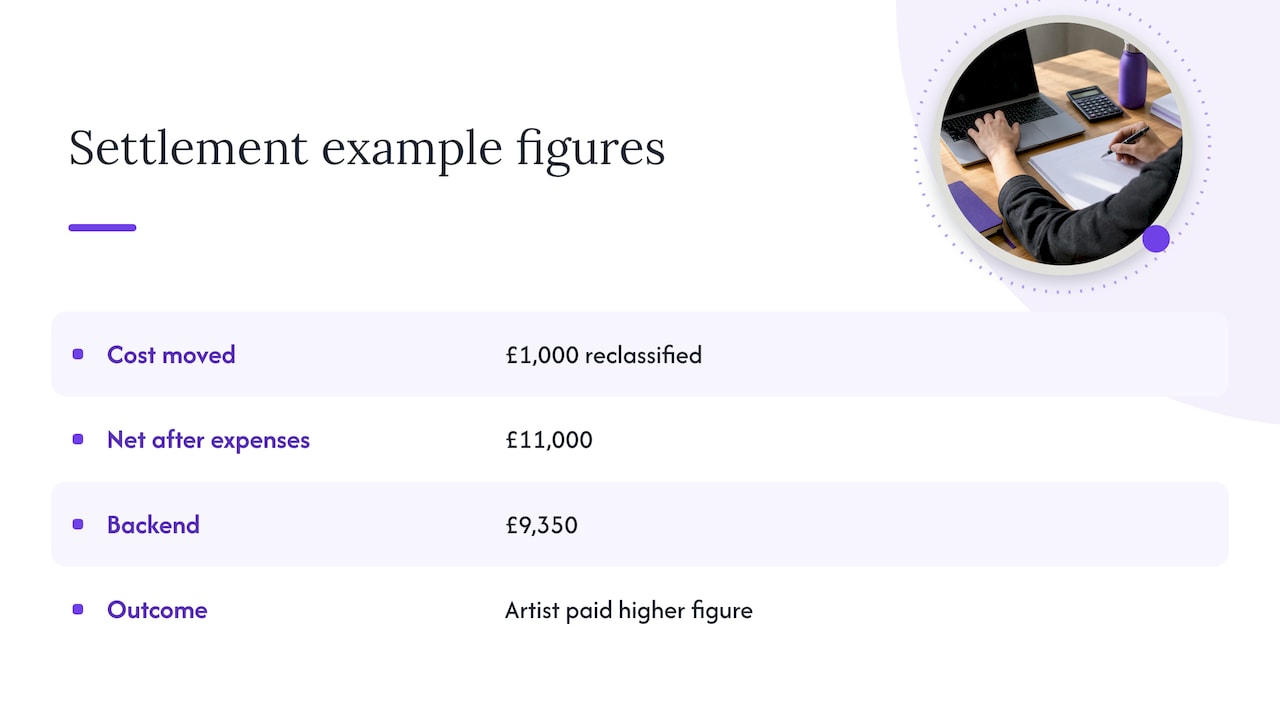
The numbers below are illustrative only, built to show how a gross figure becomes a walkout, not a claim about any real show.
Because the backend figure clears the guarantee, the artist walks out with the higher of the two figures rather than the guarantee floor. Moving a single cost, say a £1,000.00 security invoice, from approved expenses into promoter overhead would raise net after expenses to £11,000.00 and the backend to £9,350.00, which is exactly why labelled scenarios showing where an expense sits are worth running before the show, not during it.
Templates and tools worth using
A reusable template turns settlement from a scramble into a checklist. Copy the header, box office, deductions, expenses and deal terms fields into a spreadsheet or your existing profit and loss system, and you have a working template for every show.
- List every field above as a column heading so the same sheet works across venues, with only the contract-specific numbers changing.
- Feed a break-even calculator with fixed costs (the house nut), variable costs, ticket price tiers, fees and tax assumptions to see where a show clears breakeven.
- Run scenario tests at 70%, 85% and 100% capacity, since modelling multiple capacity scenarios helps identify the breakeven crossover before the show goes on sale.
- Validate every model by reconciling the ticketing export against the venue’s own door count before trusting the numbers it produces.
Option: Lookport ticketing and the tour break-even calculator
If box office exports are the part of settlement that causes friction, Lookport’s ticketing platform gives you a clear sales export and a flat 6% commission with no other Lookport charges, with proceeds paid directly into your own Stripe account. The tour break-even calculator lets you model fixed costs, ticket prices and capacity scenarios before you ever reach the settlement table. Both sit alongside whatever workflow you already use, not in place of it.
Primary sources and templates cited
- Free show settlement sheet template, Callboard: the core field-by-field template referenced throughout.
- How venue settlement works, Booking Agent: the advance checklist and dispute prevention guidance.
- Net box office vs gross box office, Live Index: the settlement waterfall and terminology.
- How does a concert settlement work, Live Index: box office reconciliation practice.
Sources
- Callboard
- How Venue Settlement Works (Getting Paid After the Show) 2026
- Net box office vs. gross box office: The terms behind concert settlement | Live Index
- How does a concert settlement work? | Live Index
FAQ
What is included in a settlement statement?
A settlement statement includes the header and parties, box office figures, deductions, approved expenses, deal terms and the final walkout amount paid to the artist. It is signed or confirmed by email by both the promoter and venue as the agreed financial record of the show.
What is a closing settlement statement?
A closing settlement statement is the final, signed version of the settlement sheet produced once every figure, deduction and expense has been agreed by both parties. It becomes the accounting and tax record for the show once payment is confirmed.
What is the purpose of a concert report?
A concert report reconciles gross ticket sales against deductions and expenses to calculate the final artist payment, and it gives both promoter and venue a shared, verifiable record of the night’s numbers. It also supports future budgeting by showing how a show actually performed against its advance projections.
What counts as a sold out concert?
A sold out concert is generally one where every available ticket in a venue or configuration has been sold, though the exact definition can depend on how comps and holds are counted. Settlement sheets should record paid tickets and comps separately so the gross figure reflects actual revenue rather than total capacity.
Recommended
Ticketing & event budgeting
 2026-10-22
Ticketing Analytics for UK Promoters: What to Track and Why
Ticketing analytics for UK concert promoters: the metrics that drive decisions, how to set up tracking, and how to tie sales data back to your show budget.
 2026-10-21
Concert Break-Even Calculator: How Many Tickets You Must Sell
Work out how many tickets a UK concert needs to break even. Costs, PRS, ticket commission, a worked example and a free calculator for promoters and venues.
 2026-10-19
Ticket Sales Break-Even Analysis for UK Shows
Work out how many tickets you must sell to cover a UK show: VAT, PRS, fees, fixed costs and a worked example, plus a free break-even calculator.
 2026-10-18
Refund Policy for Concerts: What UK Promoters Must Offer
What UK law and industry rules require when a concert is cancelled, moved or the buyer changes their mind, plus how to write a clear refund policy.
 2026-10-15
Facebook Ads for UK Promoters: Track Ticket Sales Before Spend
UK promoters can set up Meta pixel and Conversions API tracking, choose audiences, estimate ticket costs, and link Facebook ad spend to ticket revenue.
 2026-10-14
Profit Margins: Test 10 P&L Lines for UK Concert Promoters
See how UK concert promoters can model profit per show with 10 P&L inputs, test sell through and costs, and check break even before committing a deposit.