LOOKPORT / TICKETING & EVENT BUDGETING
Audience Engagement Technology for Concerts and Festivals
Which audience engagement technology works at UK concerts and festivals, how to test it, measure it, keep it within ICO rules and budget for it.
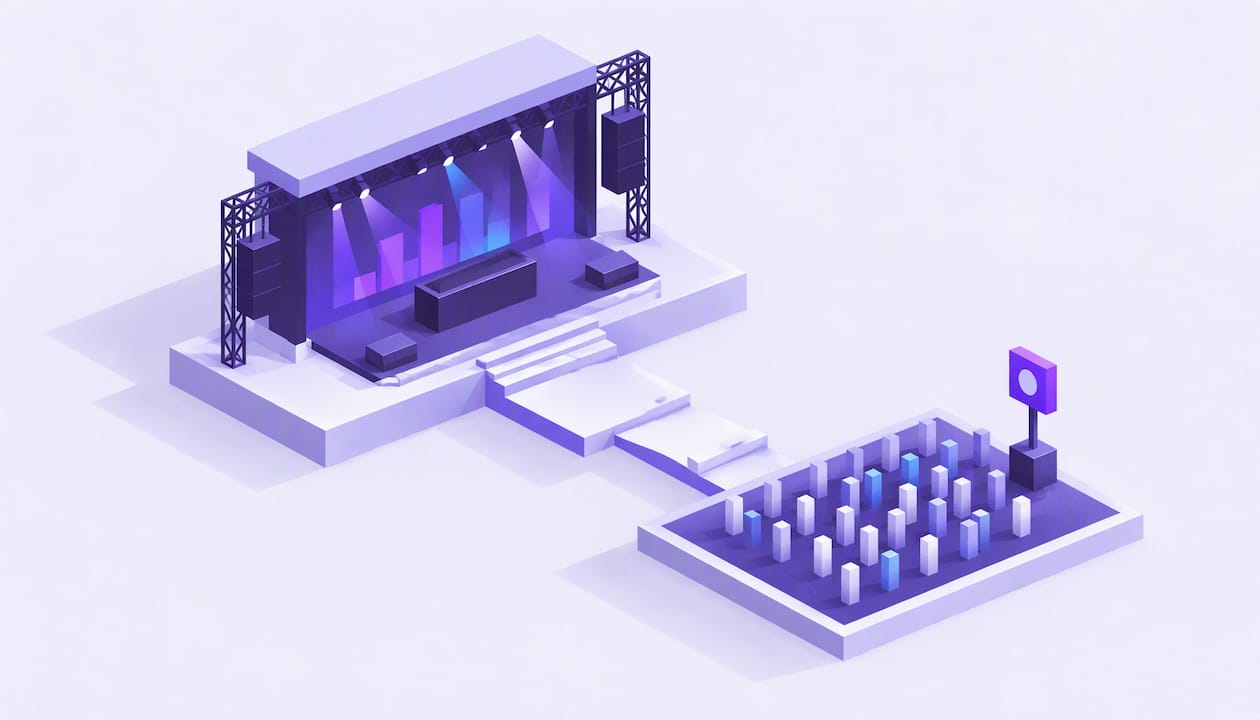
Audience engagement technology is any tool that moves people from watching a show to taking part in it, and that gives you data on what they did. At concerts and festivals that means apps, wristbands, polls, QR codes, voting, competitions and shared content. It only earns its cost when each tool has one job, is tested at the real venue, collects data lawfully and pays for itself in sales, sponsorship or repeat attendance. This guide covers the main types, a workflow for using them, how to measure results and how to budget for them.
TL;DR
- Audience participation technology covers festival apps, RFID and NFC wristbands, live polls, QR codes, voting, games and exclusive content.
- Polls and screens fail when they are treated as activation tricks. Give each tool a clear purpose before, during or after the show.
- Test in the real environment, rehearse the whole experience and keep a manual backup plan.
- Collect only the attendee data you can justify under UK data protection and direct marketing rules.
- Put engagement spend into your budget with a break-even figure, so you know how many extra tickets it must justify.
Table of Contents
- What audience engagement technology means at a live event
- The main types of technology promoters and venues use
- Use the technology before, during and after the show
- A workflow for choosing and running a tool
- Practical considerations: testing, rehearsal and backup
- How to measure whether it is working
- Data protection when you collect attendee information
- Budgeting engagement technology against ticket revenue
- Where Lookport fits
- Common mistakes to avoid
- FAQ
- Sources
What audience engagement technology means at a live event
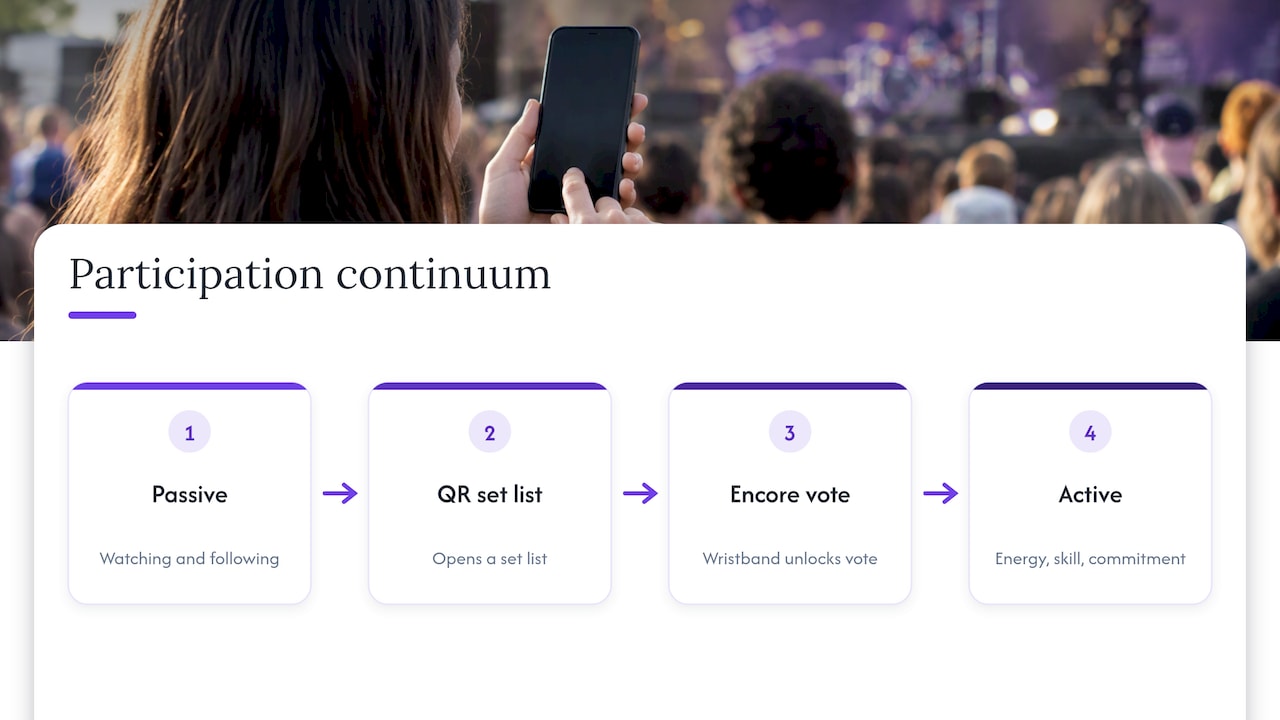
Researchers separate audience participation at live events into two kinds. Active participation needs energy, skill and commitment, while passive participation means watching and following the event. Technology moves people along that scale. A QR code that opens a set list is a small step. A wristband that unlocks a vote on the encore is a bigger one.
The same research points to liveness as a key feature of technological interaction at live events. Liveness is the connection of people experiencing an event in real time, with the potential for shared social realities. For a promoter, that is the useful test. A tool is worth using if it makes people feel they are in the same moment as the room and the performers, not if it simply adds a screen.
“Audience engagement” and “audience participation” are used almost interchangeably in the trade. Engagement is the wider term and includes marketing before and after the show. Participation is what happens in the room. This guide treats participation as one part of engagement.
The main types of technology promoters and venues use
A 2024 academic review of technology in music promotion lists what promoters and venues actually deploy. Festival apps and RFID or NFC wristbands are used for access, raffles, voting, social sharing, games and exclusive content, and some events experiment with AI audience co-creation. The table below turns that into a practical choice.
| Technology | Typical job | Best suited to | Main risk |
|---|---|---|---|
| Festival or venue app | Programme, notifications, exclusive content | Multi-day festivals, tours with repeat audiences | Low downloads if people must install it on site |
| RFID or NFC wristbands | Entry, raffles, tap-to-unlock content | Festivals, larger venues | Hardware cost and on-site scanning logistics |
| QR codes | Links to polls, set lists, signup forms | Any venue | Poor mobile signal in the room |
| Live polling and voting | Encore choice, song requests, Q&A | Club shows, talks, artist sessions | Feels gimmicky if the result is ignored |
| Competitions and games | Sponsor activations, social sharing | Sponsored festivals | Data collected without a clear lawful basis |
| Exclusive content | Reward for ticket holders | Tours, fan clubs | Needs content produced in advance |
Most small and mid-size promoters do not need all of these. A QR code, a short poll and a well-timed follow-up email will cover most needs for a single-night show.
Use the technology before, during and after the show
Engagement does not start at doors. During an event, organisers can use live polling, QR codes, RFID badges, NFC wristbands and mobile interactions to engage attendees and collect interaction data. The same tools can work across three stages.
Before the show
The ticket purchase is your first engagement point, and it is where you get contact details with the right permissions. Use it to ask one or two useful questions, such as how the buyer heard about the show. Then send practical messages: arrival times, what to bring, how to use the app or wristband.
If you want to link ticket buyers to campaigns, you need a ticketing setup where customer data and marketing tools sit together. Our audience CRM and customer data features and marketing integrations are built for that. For the planning side, our guide to ICO-compliant AI concert marketing covers the marketing workflow in more detail.
During the show
Keep it simple. Pick one or two interactions and tell the audience clearly when they will happen. A poll that decides the encore, a QR code on the screen between sets, or a wristband tap to enter a prize draw are all easy to explain from the stage.
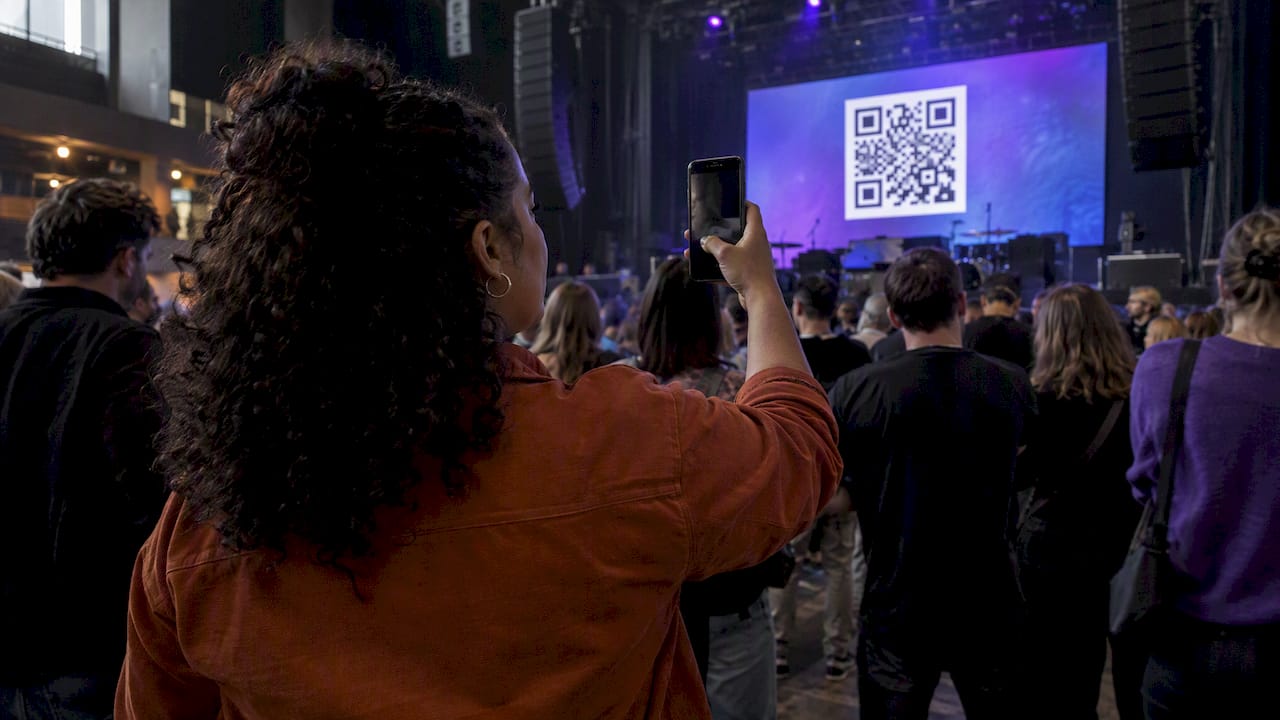
Academic work on professional event productions warns about the obvious trap. Polls and chat screens often fail when treated as mere activation tricks, and successful integration supports the cognitive, affective and behavioural sides of participation. In plain terms, people need to understand what they are doing, care about the outcome and find it easy to act. If the artist ignores the poll result, the audience notices.
After the show
This is where most of the commercial value sits. Send a thank-you message, share content from the night and offer early access to the next date to people who attended. Compare who engaged with who bought again. Our article on AI audience analytics in the first 72 hours of sales shows how to read buyer patterns once data is flowing.
A workflow for choosing and running a tool
Use the same steps for every show, so each engagement tool is a decision and not an impulse.
- Set one goal. Examples: raise the share of attendees who join your mailing list, increase bar spend, or lift early sales of the next date.
- Pick the lowest-friction interaction. One tap or one scan beats an app download.
- Define the data you need. If the goal does not require a name or email address, do not collect one.
- Test in the real environment. Do not rely on a demo in the office.
- Rehearse the whole experience. Include stage cues, screen content and staff scripts.
- Write a manual backup. Decide what happens if the signal drops.
- Measure and review. Compare results with the goal you set in step one.
Practical considerations: testing, rehearsal and backup
The AVIXA framework is direct on this. Its key considerations are testing in different environments, rehearsing the whole experience, building a manual backup plan and choosing interactions that reduce friction. It also warns that systems that work in controlled conditions may fail in outdoor or unpredictable environments, so testing must happen where the event will take place.
For UK promoters, three situations deserve extra attention:
- Outdoor festivals. Mobile networks can be overloaded when thousands of people try to connect at once. Offer an offline route, such as a printed QR code poster with a short URL.
- Older or basement venues. Thick walls can block signal. Check the room itself, not just the foyer.
- Rain and crowds. Wristband scanners and phones in wet conditions need a plan. Staff should know how to run a manual list.
Researchers add that interactive features should be judged by time, environment, audience motivation and the specific qualities of the participation. A tool that works for a seated 400-capacity theatre will not necessarily work for a standing festival crowd.
How to measure whether it is working
AVIXA proposes a four-part framework for evaluating interactive technology: Attention, Participation, Immersion and Insight, used to check that the technology adds value. Here is how you could apply it at a concert. The metrics below are suggestions, not published benchmarks.
| Stage | Question | Example measure |
|---|---|---|
| Attention | Did people notice it? | QR scans per 100 attendees |
| Participation | Did they act? | Poll votes as a share of attendance |
| Immersion | Did it deepen the experience? | Post-show survey rating, social posts |
| Insight | Did you learn something you can use? | Segments identified, next-show conversion |
Set a target for each before the show. Without one, every result looks like a success. Afterwards, ask the commercial question: did people who engaged buy again, spend more or recommend the show? If you cannot link engagement to ticket records, you can only describe activity, not value.
Data protection when you collect attendee information
Engagement tools collect data, and in the UK that brings ICO guidance into play. This is general information, not legal advice. For anything unusual, speak to a data protection adviser or the ICO.
- Marketing messages. The ICO says direct marketing must be fair, lawful and transparent, and consent for electronic mail must be specific to the type of message. A tick-box for “updates” is a weak basis for a text message campaign.
- Sharing with other platforms. If you pass attendee data to a third-party platform for social media targeting, the organiser and platform are often joint controllers, and you need a lawful basis for that processing.
- Retention. Keep poll and Q&A data only as long as you need it. The ICO’s own privacy notice for its events gives three months as an example of a reasonable period for analysing event success before deletion. Set your own period, record it and stick to it.
- Charities. The ICO has announced that, as of 5 February 2026, charities can send electronic direct marketing to people interested in their purpose without prior consent, if strict requirements are met. If you promote a charity gig, check whether this applies before relying on it.
A practical rule: write the privacy wording for each interaction before building it. If you cannot explain in one sentence why you collect a field, remove the field.
Budgeting engagement technology against ticket revenue
Engagement tools are a cost line, and they should sit in your show or tour budget like any other. Begin with the break-even question: how many extra tickets, or how much extra spend, must the tool generate to cover itself?
Hypothetical example, for illustration only. A promoter plans a 1,500-capacity show with a £30 ticket and budgets £2,000 for a poll, QR signage and a post-show email campaign.
- Lookport charges 6% commission on ticket sales, which is £1.80 on a £30 ticket, leaving £28.20.
- £2,000 divided by £28.20 is about 71 tickets.
- So the engagement spend breaks even if it brings in or retains roughly 71 extra buyers, before payment processor fees and other variable costs, which you should add to your own model.
That gives you a testable claim. If you think the campaign can lift next-date sales by 71 tickets, run it. If you cannot see how, cut the scope. The same approach works for a tour: spread the cost across dates and see how the break-even point moves.
Our tour break-even calculator lets you model costs, ticket prices, revenue and break-even in one place, so you can add an engagement line and see its effect. To check what a given ticket price leaves after commission, use the ticketing fee calculator.
Where Lookport fits
Engagement starts with the ticket sale, and that is where we work. Lookport Ticketing charges 6% commission with no other Lookport charges, and ticket proceeds go directly into your own Stripe account. Availability follows Stripe-supported countries. You can see the fee on our pricing page.
For engagement planning, our customer data and campaign features help you keep buyer information and follow-up messages in one place, and custom ticketing and branding lets the ticket page match your event. Check the pages for what is currently live. Wristbands, apps and polling hardware are separate purchases from specialist suppliers and are not part of the Lookport commission.
If you want to see how ticket sales and engagement planning fit together for your next show, start with Lookport Ticketing and set up your event.
Common mistakes to avoid
- Adding tools without a goal. Every interaction needs a reason you can state in one line.
- Asking for too much data. Each extra field lowers completion and raises your compliance burden.
- Skipping the venue test. A system that works in the office may fail in a crowded field.
- Ignoring the result. If you run a vote, act on it visibly.
- Forgetting the follow-up. Engagement data is worth most when it shapes the next sales campaign.
- Leaving it out of the budget. If it is not in the model, you cannot tell whether it paid back.
FAQ
What is the difference between audience engagement and audience participation technology?
Audience engagement is the wider term. It covers every contact with your audience, from the ticket page to the post-show email. Participation technology is the part that lets people take an active role in the show, such as voting, scanning or sharing. Researchers describe participation as active or passive, depending on the energy and commitment it takes.
Which technology should a small venue start with?
Start with a QR code and a short poll, then a follow-up email to people who gave permission. These need little hardware and are easy to explain from the stage. Test them in the room first, and have a manual fallback in case the signal is poor.
Do I need consent to collect data from a poll?
That depends on what you collect and what you do with it. An anonymous poll collects little personal data. If you want to send marketing to people afterwards, the ICO says consent for electronic mail must be specific to the type of message. Write the wording first and take advice from a data protection adviser if you are unsure.
How do I know whether engagement technology paid for itself?
Set a target before the show, then compare results with your ticket records. Work out how many extra tickets or how much extra spend the tool needed to cover its cost, and check whether engaged attendees bought again. A break-even model makes this a simple comparison.
Sources
- Engagement, Participation, and Liveness: Understanding… (SciTePress, 2023)
- Best Practices in Technology Usage for Promotion of Music (Springer, 2024)
- Interactive Technology and Live Events: A Framework for Engagement (AVIXA, 2026)
- Augmenting the Performer–Audience Live Participation in Professional Event Productions (Salovaara, 2021)
- Plan direct marketing (ICO)
- Attend an event, seminar or workshop (ICO privacy notice)
- Charities given new flexibility to contact supporters under data law change (ICO)
Recommended
Ticketing & event budgeting
 2026-11-14
Concert Sales Curve: How UK Tickets Sell and How to Plan for It
Learn what a concert sales curve shows, how UK tickets typically sell from on-sale to show day, and how to check your pace against break-even.
 2026-11-13
Own Your Ticketing Data: A UK Promoter's Guide
What owning your ticketing data means under UK GDPR, which buyer data to keep, and how to set up referral tracking and marketing consent so it works for you.
 2026-11-12
Anti-Bot Ticketing: How UK Promoters Protect an On-Sale
How anti-bot ticketing works, what the UK ban on ticket bots means for promoters, and how to layer defences without blocking genuine fans at your on-sale.
 2026-11-11
GDPR for Event Marketing: A UK Promoter's Guide
How UK GDPR and PECR apply to event marketing: lawful basis, email and SMS consent, ticket-buyer privacy notices, retention and choosing CRM software.
 2026-11-10
Geo-Targeting Concert Ads: A UK Promoter's Guide
How to set up geo-targeted concert ads in the UK: choose radius, split tour dates by city, track ticket sales and stay within PECR consent rules.
 2026-11-09
Drip Pricing Rules in the UK: What Ticket Sellers Must Show
UK drip pricing rules for ticket sellers: which fees go in the headline price, how VAT on booking fees works, fines, and a checklist for promoters.