LOOKPORT / TICKETING & EVENT BUDGETING
Drip Pricing Rules in the UK: What Ticket Sellers Must Show
UK drip pricing rules for ticket sellers: which fees go in the headline price, how VAT on booking fees works, fines, and a checklist for promoters.

Under UK consumer law, the price a fan sees first must be the price they pay. If a booking fee, delivery fee or VAT is unavoidable, it belongs in the headline ticket price from the first page of the journey, not on the last checkout screen. The Competition and Markets Authority (CMA) now enforces this directly, with fines. This guide explains what the rules require, how VAT on booking fees fits in, and how to set up your pricing so it holds up.
TL;DR
- Drip pricing means revealing mandatory fees, taxes or charges late in the purchase process. Under the Digital Markets, Competition and Consumers Act 2024 (DMCCA), it is unlawful.
- Any fee a buyer must pay, including booking fees and VAT, goes into the total price shown from the start. Showing it separately will not normally be enough.
- Optional extras can be shown separately. Fees that truly cannot be calculated in advance need a clear explanation of how they are worked out.
- The CMA can fine up to 10% of global turnover or £300,000, whichever is higher, and has already used these powers on ticketing and other sectors.
- Booking fees charged for card payment on ticket sales have been held to be subject to VAT in the UK, so build VAT into the all-in price.
Table of Contents
- What drip pricing means under UK law
- Which ticket fees must be in the headline price
- VAT on booking fees
- What happens if you get it wrong
- A worked example: building an all-in price
- How to show prices and fees clearly: a checklist
- Ticketing with a single, simple commission
- FAQ
- Sources
What drip pricing means under UK law
Drip pricing is the practice of hiding extra fees, taxes or other charges until later in the purchase process. GOV.UK’s CMA price transparency guidance describes it in exactly those terms and confirms it is illegal under the DMCCA.
The phrase itself does not appear in the Act. According to Penningtons Law, the practice is caught because leaving material information, including the total price, out of an “invitation to purchase” is an unfair commercial practice. Adding the fee only at the final stage is prohibited.
Two points matter for promoters:
- An invitation to purchase is not only the final “buy now” page. Penningtons Law notes that any earlier page on which a price is indicated can count, and an online sales process may contain several. Your event listing, social ad, email and ticket selection page all show price.
- The rule is strict. A consumer law briefing from June 2025 is not needed to see the point: the ranking commentary and the guidance agree that the practice is treated as unfair regardless of its effect on the individual buyer.
Which ticket fees must be in the headline price
The test is simple: can the buyer avoid the charge and still buy the ticket? If not, it is mandatory.
The CMA guidance says a charge is mandatory if the customer must pay it to buy the product. That covers a delivery or booking fee, tax such as VAT, or any other unavoidable payment. GOV.UK adds that giving these separately will not normally be enough to comply.
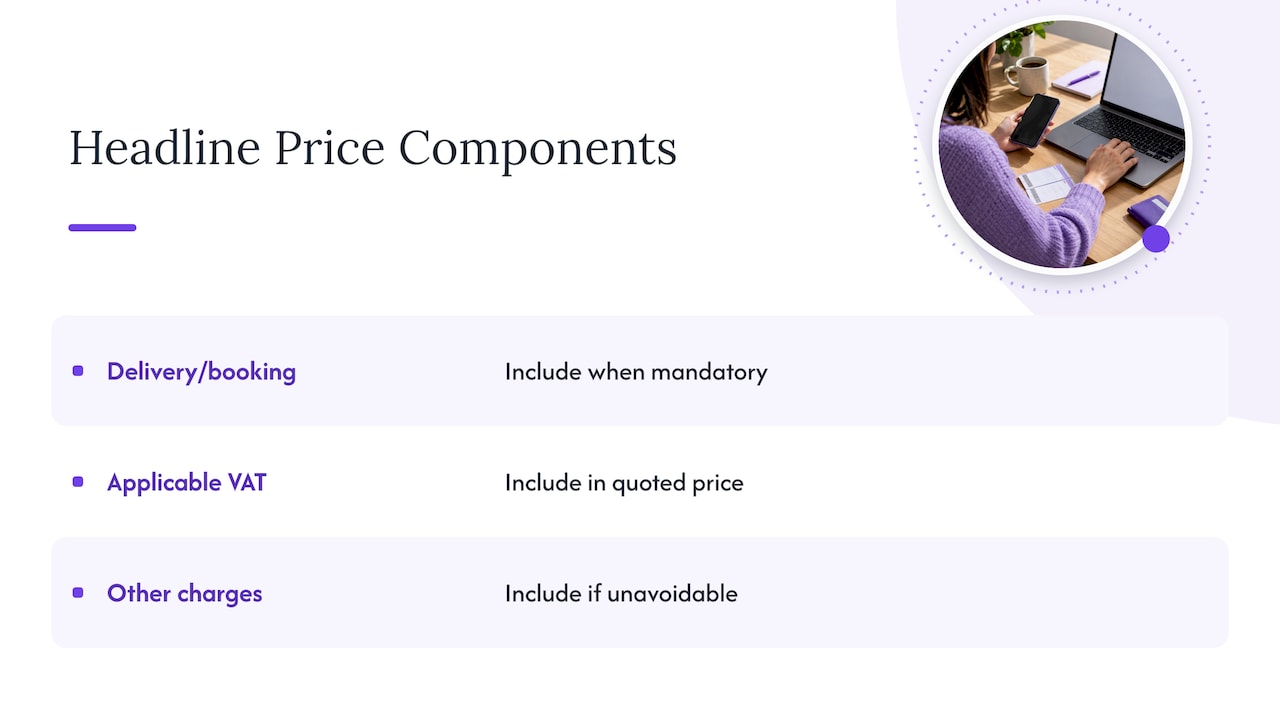
The advertising regulator takes the same line. The ASA’s ticket pricing advice says quoted prices must include non-optional taxes, duties, fees and charges that apply to all or most buyers.
What the CMA’s own examples show
Penningtons Law sets out two CMA examples that map neatly onto live events:
- Concert tickets from £50 to £100 with a £3 booking fee per transaction. The advert should say tickets are “from £53”, and could read: “Tickets from £53 – seats £50-100 each plus £3 per transaction”.
- A coach ticket at £10 with a £2.50 per-transaction booking fee. The advert should say “only £12.50”, because nobody can buy a single ticket for anything else.
The lesson: the headline figure is the lowest price a real buyer could actually pay, fees included.
Fees that depend on basket size
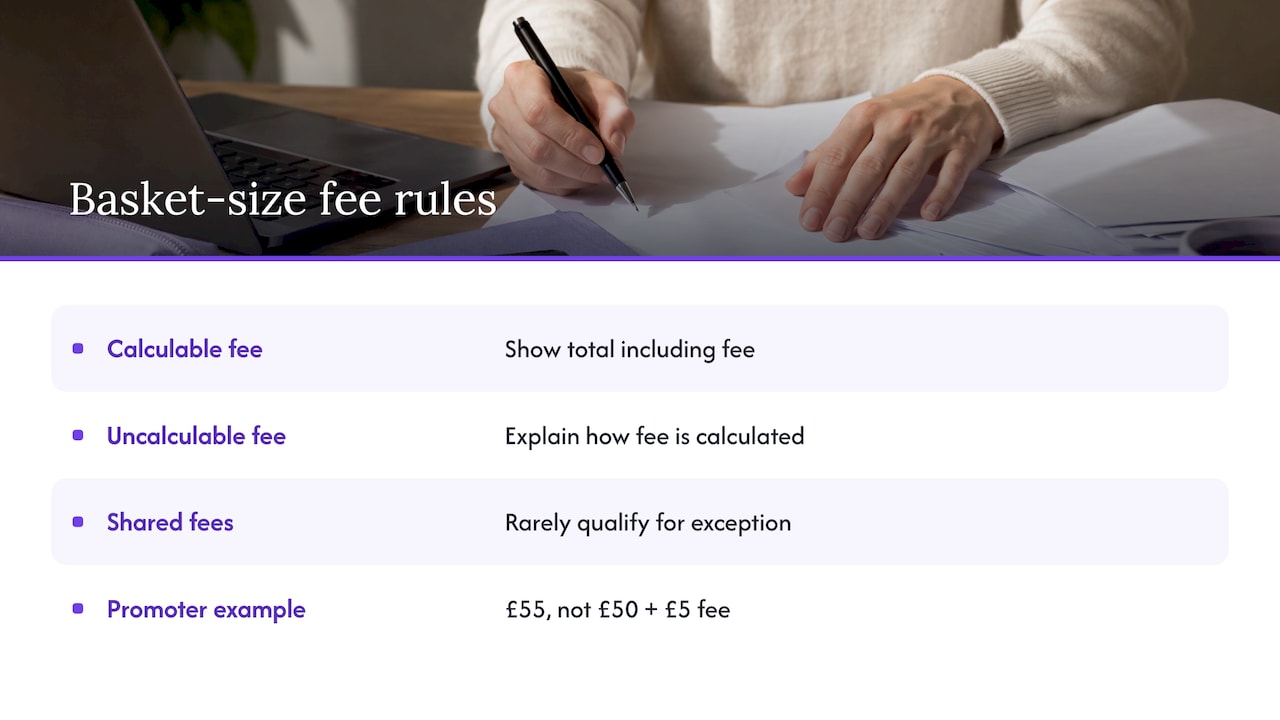
Many promoters charge a per-ticket fee, or a fee that changes with the number of tickets. The ASA’s guidance, drawing on its 2018 ruling against a ticket resale site, says that where the fee per ticket can be calculated in advance, the page should show the total ticket price including the fee. Even where it could not be, the advert would breach the CAP Code unless it explained how the fee was calculated (ASA).
Isadora Werneck of Logan & Partners makes the same point in her December 2025 analysis. Administration, booking or service fees that apply across several products will rarely qualify for the “cannot be calculated in advance” exception. Traders are expected to structure their pricing so the charge can be included, for example advertising a concert ticket at £55 rather than £50 plus a mandatory £5 booking fee.
Optional and variable charges
Not every charge goes into the headline. The same Logan & Partners analysis, reflecting the CMA guidance, separates three cases for delivery charges, and the logic applies to similar fees:
| Type of charge | What you must do |
|---|---|
| Mandatory and fixed | Include it in the total price shown from the start |
| Optional (for example, a paid postal option when free e-tickets are available) | Show it in the invitation to purchase, but it need not form part of the total |
| Mandatory but variable | State clearly that the charge applies and explain how it will be calculated |
Where part of the price cannot reasonably be calculated in advance, the CMA guidance says the buyer must be given what they need to work it out themselves. That information needs as much prominence as the parts of the price you can calculate (GOV.UK).
“From” prices must be realistic
Logan & Partners also highlights that “from” prices must be realistic. In their example, a zoo advertising tickets “from £12” when that price applies only to children under 10, while adults pay £25, is unlikely to be realistic for most consumers. For a gig, a “from” price for a handful of restricted-view seats that sell out in minutes can create the same problem. Make sure the entry price you advertise is one a typical buyer can actually get.
VAT on booking fees
VAT is the part of the “all-in” price promoters most often get wrong, because it is easy to treat the booking fee as a separate financial service.
Three points from the sources:
- The all-in price includes VAT. CAP Code rule 3.18, set out on the ASA’s VAT guidance page, says quoted prices must include non-optional taxes and fees. VAT-exclusive prices are allowed only if everyone the price is addressed to pays no VAT or can recover it, and then a prominent statement of the VAT amount or rate must accompany it. Consumers buying tickets do not fit that exception.
- Booking fees for card payment have been treated as standard-rated. In the National Exhibition Centre case, booking fees of around 10% of the ticket price, charged to people buying concert tickets by card, were found to be payment for a standard-rated supply and not an exempt financial service. Pinsent Masons reported that the Court of Justice of the EU reached a similar conclusion for a venue selling tickets for third-party promoters.
- Admission itself is usually standard-rated. Apex Accountants states that 20% VAT applies to admission to concerts, festivals, theatre shows, sporting events, conferences and trade exhibitions. The exceptions are cultural events supplied by eligible public bodies or non-profit organisations where exemption rules apply.
The ASA has also applied this in practice. In a 2018 ruling noted on its VAT page, it held that because the claims appeared on a UK version of a website, most buyers would pay UK VAT, so the total price should have included UK VAT.
Whether you must charge VAT at all depends on your own VAT registration and the nature of the event. Take that to your accountant or HMRC. What the advertising rules settle is the presentation: if VAT applies, the number the buyer sees first includes it.
For a deeper look at VAT on ticket sales, see our guide on avoiding VAT fines on ticket sales.
What happens if you get it wrong
Enforcement is no longer theoretical. The CMA gained direct consumer enforcement powers in April 2025, and the numbers since are significant:
- In November 2025 the CMA said it had identified compliance concerns in 14 sectors, covering drip pricing and misleading countdown timers, and opened investigations into 8 businesses.
- In April 2026 the CMA issued its first financial penalty under the DMCCA. According to SHMA, AA Driving School and BSM Driving School admitted drip pricing involving a mandatory £3 booking fee left out of the initial price. They were ordered to pay £4.2 million (cut by 40% from £7 million for early settlement) and to refund over £760,000 to more than 80,000 learner drivers. A £3 fee is a small number. The volume made it expensive.
- In June 2026 the CMA fined a ticket resale platform close to £900,000 and ordered refunds of more than £590,000 to over 50,000 fans. Delivery and service fees had been added at the last stage of checkout instead of being in the total price from the start.
Penalties for breaching consumer protection law can reach £300,000 or, if higher, 10% of global turnover (Penningtons Law). Refunds and reputational damage come on top, and fans remember who surprised them at checkout.
A worked example: building an all-in price
The figures below are hypothetical and for illustration only. They are not Lookport results.
Suppose you promote a 500-capacity show with fixed costs of £9,000 (venue hire, artist fee, production, marketing). You want to advertise one general admission ticket.
- Decide the all-in price first. Say £30, including VAT and every mandatory fee. That is the figure on your poster, ad and listing page.
- Work backwards to your net. If VAT at 20% applies, £5 of the £30 is VAT (£30 ÷ 6). That leaves £25.
- Deduct platform costs. With a 6% commission calculated on the £30 price (confirm the basis on the pricing page), that is £1.80 per ticket, leaving £23.20.
- Find break-even. £9,000 ÷ £23.20 is about 388 tickets, or 78% of capacity.
If you were instead tempted to advertise £25 and add a £5 booking fee at checkout, the outcome for you might be the same, but the advert would be misleading. Fix the all-in price at the start and the margin maths takes care of itself.
You can run your own numbers with the tour break-even calculator, which models costs, ticket prices, revenue and break-even. Our guides on ticket sales break-even analysis and tiered ticket pricing go further, including how to handle several price tiers under the “from” rule.
How to show prices and fees clearly: a checklist
The CMA’s clear pricing campaign gives businesses a 3-step checklist, referenced in its June 2026 announcement. In practice, for a promoter, the steps look like this:
- List every charge a buyer cannot avoid. Ticket face value, booking or service fee, delivery fee, VAT, any local levy. If the buyer must pay it, it is mandatory.
- Put the total in every place price appears. Posters with prices, social ads, newsletters, your event page, the ticket selection step and the basket. Check the earliest one first, as that is where drip pricing usually starts.
- Explain what cannot be calculated. If a fee varies and you cannot fix it in advance, say it applies and show how it is calculated, with the same prominence as the price.
A few practical habits help:
- Use a range with a clear structure for mixed prices. The CMA concert example above, “from £53 – seats £50-100 each plus £3 per transaction”, shows how.
- Keep optional extras optional. Merchandise bundles, paid delivery options and similar add-ons should not be pre-selected. The CMA’s November 2025 programme specifically named automatically opting consumers in to optional charges.
- Handle free tickets carefully. The Edinburgh Festival Fringe Society, in an April 2026 update for artists, now includes its £1.50 booking fee in the advertised price of each show, caps the fee at £9 per transaction (first six tickets), and shows free ticketed shows as “£1.50 (£0.00 plus £1.50 booking fee)”.
- Review third-party channels. Check how agents, listing sites and partner venues display your price.
Our UK ticket fee strategy guide and the walkthrough on all-in ticket pricing cover the decision between absorbing a fee and passing it on. Ticketing fees explained shows how to model each option.
Ticketing with a single, simple commission
Clear pricing is easier when your costs are simple. Lookport Ticketing charges a 6% commission, with no other Lookport charges. Ticket proceeds go directly into your own Stripe account, and availability follows Stripe-supported countries.
That gives you one known platform cost to build into your all-in ticket price and your break-even model. You decide the price your fans see, then work backwards. See Lookport Ticketing for the features currently available, or the special events ticketing page if you run one-off shows.
When you are ready to set prices, model them first in the calculator, then set up your event on Ticketing.
FAQ
Is a booking fee allowed on tickets in the UK?
Yes, charging one is allowed. The rule is about presentation. If the buyer must pay the fee, it has to be in the total price shown from the start, not added at the end. Optional fees can be shown separately.
Do I have to include VAT in the advertised ticket price?
If VAT applies to your ticket and fee, consumer prices must include it. CAP Code rule 3.18 requires quoted prices to include non-optional taxes and fees. VAT-exclusive pricing is limited to audiences who pay no VAT or can recover it. Ask your accountant whether you must charge VAT.
Can I still advertise a “from” price?
Yes, if it is realistic. A “from” price should be one most buyers can actually get, and it should include mandatory fees. The CMA’s concert example uses “from £53” for £50 tickets with a £3 per-transaction fee.
What if my booking fee changes with the number of tickets?
Where you can calculate the fee per ticket in advance, show the total including it. If you genuinely cannot, state that the fee applies and explain how it is calculated, with equal prominence. The ASA’s guidance and the CMA’s guidance both say this, and fees that apply across products will rarely qualify for the exception.
What are the penalties for drip pricing?
The CMA can impose fines of up to £300,000 or 10% of global turnover, whichever is higher, and can order refunds. It has already done both in 2026 cases.
Sources
- Providing clear and accurate information about prices: summary (GOV.UK)
- Consumer law and drip pricing: fine margins and big fines (Penningtons Law)
- Ticket pricing (ASA)
- Price transparency under the DMCCA: key takeaways for businesses (Logan & Partners)
- Compulsory costs and charges: VAT (ASA)
- National Exhibition Centre Ltd v Revenue & Customs (BAILII)
- CJEU: third party card handling services cannot be VAT exempt (Pinsent Masons)
- VAT treatment of admission to events in the UK (Apex Accountants)
- CMA launches major consumer protection drive focused on online pricing practices (GOV.UK)
- CMA issues first drip pricing fine under the DMCCA (SHMA)
- CMA orders StubHub UK to refund customers over hidden fees (GOV.UK)
- Info for artists: CMA guidelines and booking fees (Edinburgh Festival Fringe)
Recommended
Ticketing & event budgeting
 2026-11-14
Concert Sales Curve: How UK Tickets Sell and How to Plan for It
Learn what a concert sales curve shows, how UK tickets typically sell from on-sale to show day, and how to check your pace against break-even.
 2026-11-13
Own Your Ticketing Data: A UK Promoter's Guide
What owning your ticketing data means under UK GDPR, which buyer data to keep, and how to set up referral tracking and marketing consent so it works for you.
 2026-11-12
Anti-Bot Ticketing: How UK Promoters Protect an On-Sale
How anti-bot ticketing works, what the UK ban on ticket bots means for promoters, and how to layer defences without blocking genuine fans at your on-sale.
 2026-11-11
GDPR for Event Marketing: A UK Promoter's Guide
How UK GDPR and PECR apply to event marketing: lawful basis, email and SMS consent, ticket-buyer privacy notices, retention and choosing CRM software.
 2026-11-10
Geo-Targeting Concert Ads: A UK Promoter's Guide
How to set up geo-targeted concert ads in the UK: choose radius, split tour dates by city, track ticket sales and stay within PECR consent rules.
 2026-11-08
UTM Tracking for Events: A Practical Guide for UK Promoters
Learn how to tag event links with UTM parameters, name campaigns cleanly and read GA4 reports so you can see which marketing actually sells tickets.