LOOKPORT / TICKETING & EVENT BUDGETING
Reduce No Show Rate for UK Promoters with Evidence and Lookport
Evidence backed tactics UK promoters can use to reduce no show rate: refundable deposits, timed SMS, easy transfers and Lookport ticketing and scanning tools.
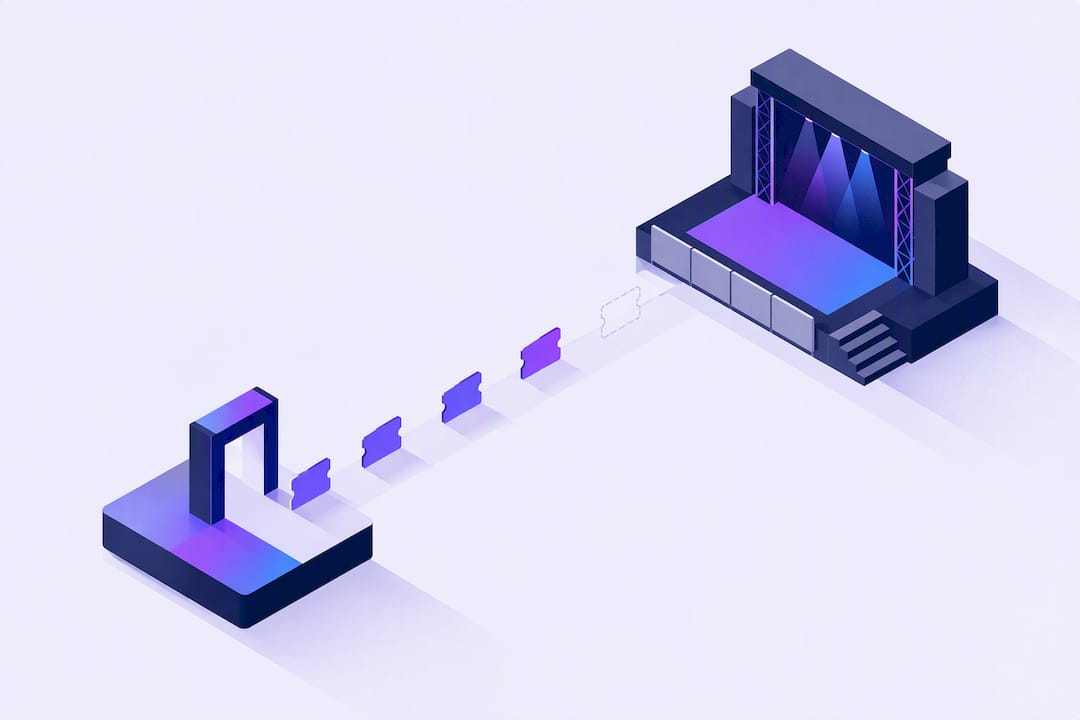
Cut no-shows by combining paid commitment (a ticket price or a refundable deposit), well-timed reminders, easy ticket transfer and tight on-the-day scanning. Each tactic works alone; stacked together, they compound. Test changes against your own show data, measure the resulting show rate, and weigh every fix against the revenue and reach you might lose. There are tools available that can help you run most of this without extra software.
TL;DR:
- Using paid tickets or refundable deposits significantly reduces no-show rates, with deposits set at 10-20% of the ticket price and refunded automatically at check-in.
- Reminder timing and wording are critical; 24-hour SMS reminders using guilt or cost framing can lower no-shows more effectively than neutral messages, especially when sent at a consistent local time.
- Implementing flexible ticket transfers with a clear cutoff window and immediate scan updates can turn potential no-shows into sales and keep attendance high.
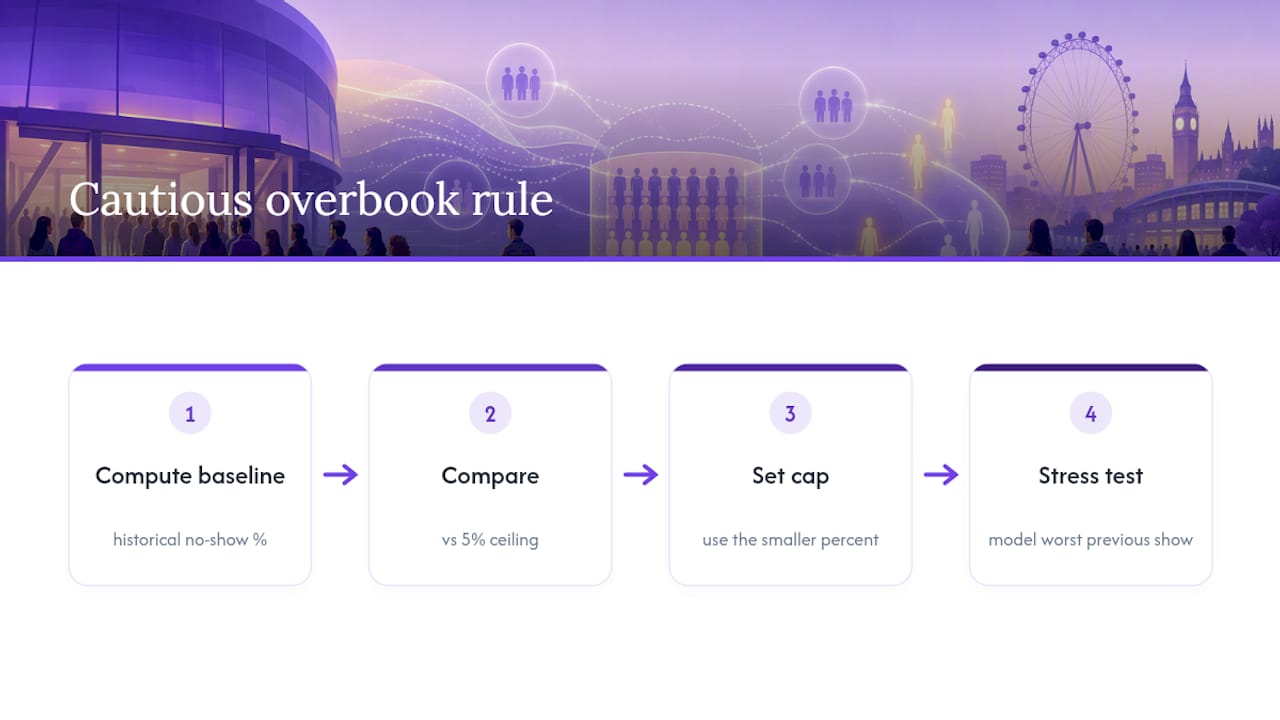
- Overbooking should be limited to the smaller of your historical no-show rate or 5 percent to minimize the risk of turning attendees away and facing refund or reputation issues.
- Combining tactics like staged reminders, deposit policies, and real-time transfer options through platforms like Lookport enhances attendance prediction and reduces empty seats.
Table of Contents
- Choosing between free, paid and deposit ticket models to reduce no show rate
- What reminder timing and wording actually reduce no-shows?
- Do incentives and refundable deposits reduce no-shows?
- How ticket transfers and resale cut empty seats
- How to forecast attendance and use cautious overbooking
- What admission process reduces walkaways on the day?
- How do you test which no-show tactics actually work?
- How Lookport helps you put these tactics into practice
- Selected studies and industry reading
- Sources
- FAQ
Choosing between free, paid and deposit ticket models to reduce no show rate
Free events regularly draw more sign ups but far weaker turnout. Industry data across more than 1,070 live events puts the median no-show rate at roughly 20%, with free events running near 28% against 17% for paid ones, and payment is the strongest single predictor of whether someone actually turns up. Money changes behaviour through simple loss aversion: once someone has paid, walking away feels like losing something, not just missing an option.
A refundable deposit gives you a middle path when you want to keep an event free or low-cost but still filter out casual sign-ups. Guidance worth following when setting one up:
- Set the deposit at a level that stings slightly if forfeited, often 10% to 20% of comparable paid-ticket pricing.
- Refund it automatically on check-in rather than making attendees chase it.
- Offer concession codes or sliding-scale pricing so the deposit doesn’t exclude lower-income fans, a real risk flagged in UK audience research on rising cost sensitivity.
- Keep the deposit clearly separate from any booking fee so attendees understand what they’re getting back.
What reminder timing and wording actually reduce no-shows?
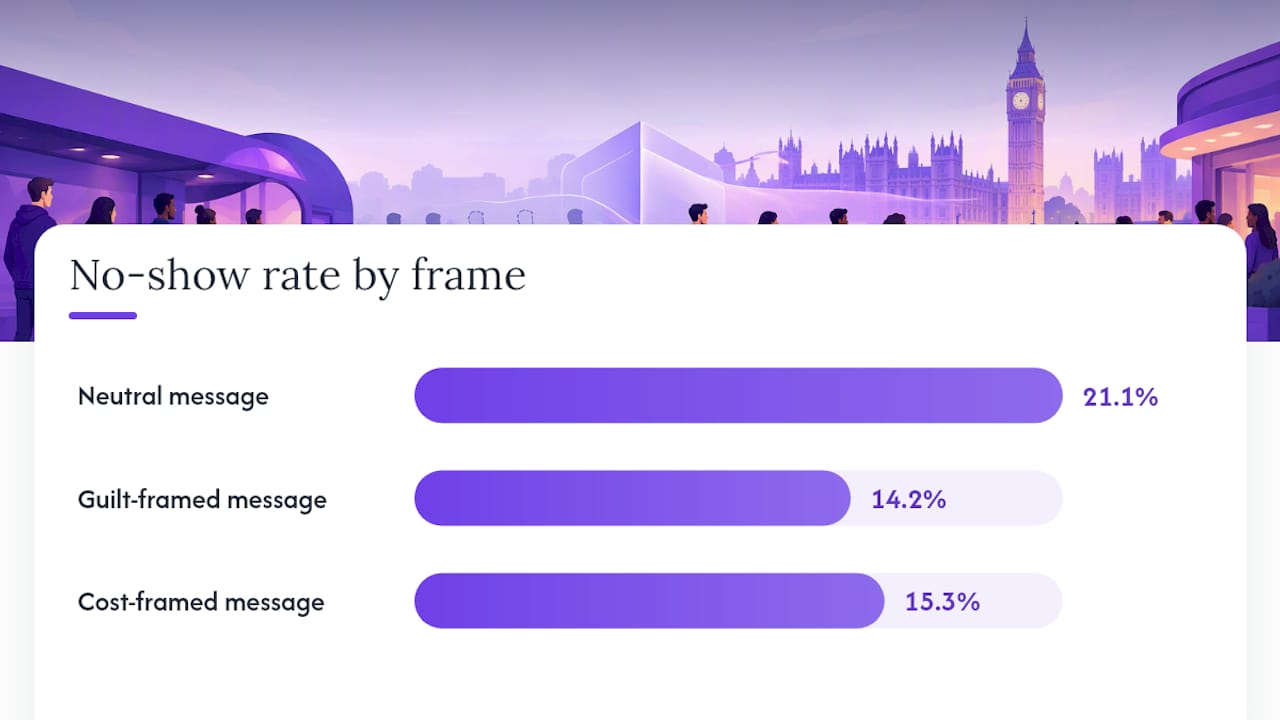
Wording matters more than most promoters assume. A large randomised study of outpatient reminders found that a neutral message left a 21.1% no-show rate, while messages framed around emotional guilt or the cost of a missed slot cut that to 14.2% and 15.3% respectively. The mechanism translates directly to ticketed events: a reminder that says “your seat is waiting” performs worse than one that quietly reminds someone what they’ll lose by not showing.
Run reminders on a three-stage cadence:
- One week out — logistics email covering venue, doors time and transport, low pressure.
- 72 to 96 hours out — a second email or app notification reinforcing the date and offering a transfer link if plans have changed.
- 24 hours out — a short SMS, the channel with the strongest last-minute effect, using cost or guilt framing rather than a generic “see you tomorrow”.
A meta-analysis covering 12 studies confirms the pattern at scale: SMS and telephone reminders both improve attendance compared with no reminder at all, though the size of the effect varies by audience and context, so treat any single figure as a guide, not a guarantee.
Test three frames against each other: a plain logistics reminder, a guilt-framed message (“your seat will go unused”), and a cost-framed message (“you’ve already paid for this, don’t miss it”). Split your list evenly, track show rate as the primary metric, and run the test across at least two events before deciding which frame wins. For SMS specifically, UK rules require clear opt-in consent and a working opt-out on every message.
Pro Tip: Send the 24-hour SMS at a fixed local time, such as 6pm the evening before, rather than a fixed number of hours before doors. Attendees respond better to a reminder that matches their evening routine than one that lands at an odd hour.
Do incentives and refundable deposits reduce no-shows?
Refundable deposits and small rewards both nudge attendance, but each comes with a trade-off worth planning for before you commit to one.
Deposit and refund experiments consistently show higher show rates paired with lower initial registration, so calibrate the deposit against what your specific audience can absorb rather than copying a fixed figure from another promoter. A field experiment covering 13,911 season ticket holders found that reminders paired with small monetary rewards produced a short-term lift in attendance, but this effect was temporary and did not continue in the long term. Treat reward-based reminders as a tactic for a specific show, not a permanent fix, and check whether the cost of the reward is justified by the extra ticket-holders who turn up.
Non-monetary nudges often work just as well without touching your margin:
- Offer a small VIP upgrade or early entry to attendees who confirm ahead of time.
- Use assigned seating rather than general admission, since a named seat increases the perceived personal stake in showing up.
- Share visible proof that the show is close to selling out, a light social-proof push that works well in the final 48 hours.
If you do run refunds or rewards, build a simple operational checklist: who processes the refund, how quickly, and what happens if a reward runs out before demand does.
How ticket transfers and resale cut empty seats
A strict no-transfer policy locks in no-shows that a flexible one would have filled. When someone genuinely can’t attend, giving them a route to pass the ticket on turns a wasted seat into a sale you’d otherwise have refunded or absorbed.
Build the policy around a few clear rules:
- Set a transfer window that closes a fixed period before doors, commonly 24 to 48 hours, so your door team always works from a current list.
- Require the new attendee to register their name against the ticket, which protects you from scalping and keeps your check-in data accurate.
- Cap or waive transfer fees for genuine reassignment, reserving any fee for resale through a marketplace rather than a direct swap between friends.
- Sync every transfer with your scanning system immediately, so the door list reflects the current holder, not the original buyer.
Lookport’s online ticketing features are built around this kind of live transfer and resale flow, so the ticket a fan bought in March and the one scanned at the door in July are always the same verified record.
How to forecast attendance and use cautious overbooking
Build your forecast from what you actually know: sales-to-date by ticket class, day-of-week patterns from past shows at the same venue, and your own historical no-show rate for that type of event. A free acoustic night and a paid arena show do not share a baseline, so keep separate historical rates for each format you run.
Post-pandemic buying patterns have made this harder. Industry reporting on live music notes that fans are buying later and attendance is more variable than it used to be, which means a forecast built on last year’s pacing curve needs a wider margin of error than it once did.
If you overbook to compensate, keep the margin small and never exceed your venue’s licensed capacity. Concerts carry sharper downside than airlines or hotels when overbooking goes wrong: a turned-away paying fan becomes a refund dispute and a reputational problem, not a rebooking on the next flight. Documented overbooking approaches for events flag this as a distinct risk category precisely because secondary markets and fan reaction complicate the maths.
Pro Tip: Cap any overbook at the smallest of your historical no-show percentage or 5%, whichever is lower, and model what happens in your worst previous show, not your average one.
What admission process reduces walkaways on the day?
Getting people through the door quickly protects the turnout your reminders and deposits worked to secure. A slow queue at 500 people deep creates its own no-shows: fans give up and leave before they’ve even been scanned.
- Staff scanning lanes to your expected peak arrival rate, not your average one, since most crowds arrive in the last 30 minutes before doors close.
- Hold back a small block of released seats until 30 to 60 minutes before the show starts, so transfers and walk-ups can fill any gaps left by confirmed no-shows.
- Reconcile your scan data against ticket sales the same night, while the numbers are fresh, to catch discrepancies before they distort next month’s forecast.
- Report check-in rate by ticket type and average time-to-admit after every show, building the historical baseline your next forecast will need.
Lookport’s ticket scanning tools capture this data automatically at the door, which removes the manual reconciliation step most promoters still do by spreadsheet.
How do you test which no-show tactics actually work?
Run every tactic as a proper experiment rather than a permanent policy change made on a hunch. Split your audience randomly into a test and control group, keep show rate as your primary metric, and run the test across at least two comparable events before drawing a conclusion from a single data point.
- Track show rate, refund rate and transfer rate separately for each intervention, since a tactic that lifts one can quietly hurt another.
- Distinguish a short-term lift from a lasting change. The season ticket holder study is the clearest warning here: reward-based reminders moved the needle for one show but the effect didn’t carry into later ones.
- Set a simple decision rule in advance: adopt a tactic if it improves show rate without denting net revenue, pause it if the effect doesn’t survive a second show, and refine the message or deposit size if the result is mixed.
- Review results monthly using a small dashboard with four fields: show rate, transfer rate, refund cost and net revenue per ticket sold.
How Lookport helps you put these tactics into practice
Some ticketing platforms are designed specifically for promoters and venues, offering a flat commission with no additional charges, and provide direct payout of ticket proceeds into the organiser’s own Stripe account, depending on Stripe-supported countries.
Every tactic covered above maps to something already live on the platform. Transfers and resale run through online and hybrid ticketing, so a fan who can’t attend can hand their seat to someone else without you losing the sale. Discount and concession codes let you set deposit-style pricing without excluding lower-income fans. Ticket scanning captures check-in data automatically, giving you the historical no-show rate your next forecast depends on. For the numbers side, the ticket sales pacing calculator tracks how a show is selling against past events, and the concert profit and tour budget calculator lets you model deposit sizes, break-even points and the revenue impact of a lower no-show rate before you commit to a policy.
If you’re ready to test one of these tactics on a real show, set up your event on Lookport Ticketing and run a deposit or reminder A/B on your next on-sale.
Selected studies and industry reading
The PLOS One study on message framing is the strongest evidence behind reminder wording. The CREMA field experiment tested rewards at scale with 13,911 real ticket holders. The JHMHP meta-analysis pools multiple reminder studies for a broader effect estimate. Skift’s summary of PheedLoop data supplies the industry no-show benchmark. For engagement tactics beyond ticketing mechanics, see this audience engagement guide.
Sources
- Effect of different message frames on outpatient appointment no-show rates (PLOS One)
- Using reminders with different reward opportunities to reduce no-show behavior (CREMA / RePEc)
- Meta-analysis of reminder interventions to reduce no-shows (JHMHP / AMEGROUPS)
- The $100 experiment that slashed no-show rates to just 10% (Skift summary of PheedLoop data)
FAQ
What is a good no-show rate for a paid concert?
Industry data puts the median around 20% across live events generally, with paid events sitting closer to 17% and free events nearer 28%, according to PheedLoop’s analysis summarised by Skift. Anything meaningfully above that for a paid show is worth investigating with the tactics covered here.
Do reminder texts actually reduce no-shows?
Yes, but wording matters more than simply sending one. A randomised study found guilt or cost-framed SMS reminders cut no-shows to 14.2% versus 21.1% for a generic message, and a separate meta-analysis confirms SMS and phone reminders both beat no reminder at all across most studies reviewed.
Should I charge a deposit for a free event?
A refundable deposit is a sensible middle ground if you want to stay accessible but still filter genuine attendees from casual sign-ups. Set it low enough not to exclude lower-income fans, offer concession pricing, and refund it automatically at check-in.
Is overbooking concerts a good idea?
Only cautiously, and never beyond your venue’s licensed capacity. Concerts carry more reputational and fan-safety risk than airlines or hotels if overbooking goes wrong, so cap any margin to your smallest historical no-show percentage and document your worst-case scenario in advance.
How much does Lookport charge to sell tickets?
Lookport charges a flat 6% commission with no other Lookport charges, and ticket proceeds go directly into your own Stripe account. There’s no separate fee for enabling transfers, discount codes or scanning.
Recommended
Ticketing & event budgeting
 2026-10-22
Ticketing Analytics for UK Promoters: What to Track and Why
Ticketing analytics for UK concert promoters: the metrics that drive decisions, how to set up tracking, and how to tie sales data back to your show budget.
 2026-10-21
Concert Break-Even Calculator: How Many Tickets You Must Sell
Work out how many tickets a UK concert needs to break even. Costs, PRS, ticket commission, a worked example and a free calculator for promoters and venues.
 2026-10-19
Ticket Sales Break-Even Analysis for UK Shows
Work out how many tickets you must sell to cover a UK show: VAT, PRS, fees, fixed costs and a worked example, plus a free break-even calculator.
 2026-10-18
Refund Policy for Concerts: What UK Promoters Must Offer
What UK law and industry rules require when a concert is cancelled, moved or the buyer changes their mind, plus how to write a clear refund policy.
 2026-10-15
Facebook Ads for UK Promoters: Track Ticket Sales Before Spend
UK promoters can set up Meta pixel and Conversions API tracking, choose audiences, estimate ticket costs, and link Facebook ad spend to ticket revenue.
 2026-10-14
Profit Margins: Test 10 P&L Lines for UK Concert Promoters
See how UK concert promoters can model profit per show with 10 P&L inputs, test sell through and costs, and check break even before committing a deposit.