LOOKPORT / TICKETING & EVENT BUDGETING
Model, Comply, Then Sell: Tiered Ticket Pricing for UK Organisers
A UK implementation guide to tiered ticket pricing: model revenue, meet transparency rules, and validate tiers with calculators and Lookport.

Tiered ticket pricing works for most events with mixed audience demand, and academic research puts the average revenue uplift at around 4 to 5% over single-price ticketing. If you’re starting out, keep it simple: one accessible base tier plus one premium upgrade. Model both before you publish, then check your pricing display meets UK transparency rules.
TL;DR:
- Most demand-variant events benefit from using two to four tiered pricing categories, as additional tiers yield diminishing revenue returns.
- Successful tiered models include quantity-based, time-based, experience-based, and pay-what-you-can structures, each suited to different event contexts.
- Proper design requires audience segmentation, capacity allocation, clear price anchors, and reliable sales estimates, with starting point recommendations favoring simplicity.
- Academic research indicates tiered pricing can increase revenue by around 4 to 5 percent on average compared to single-price models, but accuracy in demand forecasting is critical.
- UK regulations mandate full price disclosure at first display, including fees and variable charges, with transparent descriptions and clear tier naming to avoid legal pitfalls.
Table of Contents
- What is tiered ticket pricing and why use it?
- What are the common tier models organisers use?
- How do you design a tiered pricing structure step by step?
- How do you calculate and model tiered ticket revenue?
- How do you optimise tiers without damaging trust?
- What are the legal requirements for displaying tiered ticket prices?
- Quick checklist and template prompts for tiered ticket descriptions
- Model your tiers before you launch
- Sources
- FAQ
What is tiered ticket pricing and why use it?
Tiered ticket pricing means selling the same event at multiple price points, each tied to a different seat category, access level, or purchase window. It exists because your audience doesn’t share one number in their head for “what this show is worth.” Some fans will pay a premium for a front-row view; others only turn up if the price stays low. Standard event ticket pricing models with a single flat rate ignore that gap entirely and leave money on the table.
The evidence backs this up, but with caveats worth taking seriously. One study of pop concerts found multi-tier pricing added around 4.2% to revenue per show, roughly $20,000 in that sample, with other research showing about 5% higher revenue where multiple seating categories were used. Gains shrink with each additional tier you add, so three or four sensible tiers usually beat ten fiddly ones.
There’s a demand side to this too. LIVE’s 2024 audience research found the average single ticket spend sits at £65.10, yet 31% of fans still feel tickets are too expensive. A low-cost base tier addresses that perception directly while a premium tier captures the fans who want more.
Tiering isn’t free of risk, though:
- Added complexity in seat maps, checkout flow, and customer support
- Backlash if fees or tier differences aren’t disclosed upfront
- Diminishing returns once you pass three or four categories
- Confusion at checkout if tier names or benefits aren’t clear
Smaller venues with uniform audiences often gain little from tiering. Larger shows with varied demand, from casual fans to collectors, are where it earns its keep.
What are the common tier models organisers use?
Most successful structures fall into four recognisable patterns, and none of them need custom software to run.
- Quantity or limited tiers. Sell a fixed batch cheap, then step the price up as it sells out. A club night might sell 100 tickets at £20, then release the next 200 at £30 once the first batch clears. This rewards early buyers and builds urgency without needing real-time algorithms.
- Time-based tiers. Early bird, general admission, and late/door pricing, released in sequence as the date approaches. Use this when you need upfront cash flow to cover deposits, and want a natural incentive for fans to commit early.
- Experience tiers. Standard, premium, and VIP tickets, each unlocking something concrete: better sightlines, a merchandise bundle, or early entry. This model performs best when the add-ons cost you little to deliver but feel valuable to the buyer.
- Sliding-scale or pay-what-you-can tiers. Common at community and grassroots shows, where a suggested band of prices lets buyers self-select based on means. This needs clear governance, usually a minimum floor and an honesty-based ceiling, so it doesn’t collapse into everyone picking the cheapest option.
How do you design a tiered pricing structure step by step?
Building tiers properly takes a sequence, not a guess. Skip a step and you’ll either underprice your best seats or overcomplicate checkout.
- Segment your audience. List the distinct groups attending, casual fans, superfans, corporate buyers, and what each one actually values. Understanding those underlying needs, a discipline also central to audience segmentation in content marketing, is exactly the same exercise applied to ticket buyers rather than readers.
- Set capacity per tier. Allocate seats or quantities to each category before you add more tiers than your venue can sensibly manage. Diminishing returns kick in fast; two or three tiers usually capture most of the available uplift.
- Choose price anchors. Anchor your premium tier first, since buyers judge cheaper tiers against it. Round numbers and small psychological gaps (£25 vs £45 vs £75) read more clearly than awkward figures.
- Estimate uptake per tier. Use past sales data or comparable events to guess how many buyers land in each band, then sanity-check the total against your break-even needs.
- Set up the operational side. Build your seat map, configure inventory triggers so tiers release automatically, and make sure your checkout displays the full total price, not just the base fare, before the buyer commits.
Pro Tip: Start with two tiers on your first tiered event, not five. You’ll learn more from watching how a simple structure sells than from managing a complicated one you can’t yet interpret.
How do you calculate and model tiered ticket revenue?
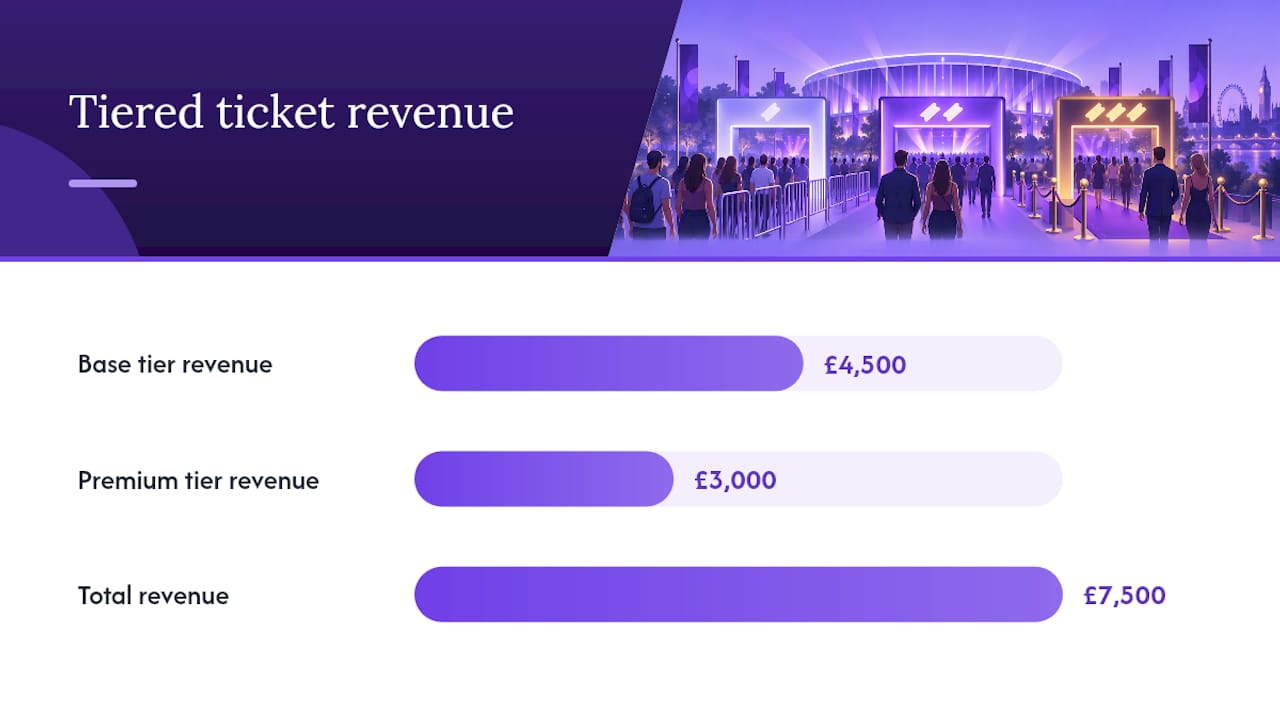
The underlying formula is straightforward: total revenue equals the sum of each tier’s price multiplied by its expected sales volume. If you sell 150 base tickets at £30 and 50 premium tickets at £60, expected revenue is £4,500 plus £3,000, or £7,500 total, before fees and costs.
Academic benchmarks give you a sense of scale, not a promise. Recent modelling research suggests demand-learning approaches, where you update pricing assumptions from early sales, can lift modelled revenue by up to roughly 8% in simulated scenarios, but the same research warns that misspecified demand assumptions can produce small losses instead of gains. Treat any uplift figure as a benchmark, never a guarantee.
Practical steps to test your numbers:
- Check how booking fees affect your net take using a ticketing fee calculator.
- Keep early forecasts conservative and revise them once real sales data comes in.
- Validate with a small live test rather than committing your full allocation to an untested split.
How do you optimise tiers without damaging trust?
Once tiers are live, three numbers tell you almost everything: conversion rate per tier, sales velocity, and average revenue per buyer. Watch these daily in the first week of a sale and weekly after that. A tier converting well but selling slowly might need a small allocation increase; one converting poorly at a high price might need repositioning rather than a straight discount.
Keep experiments small. Avoid sweeping mid-sale changes that surprise buyers who already committed at an earlier price.
Sensible governance rules:
- Set an approval threshold for any price change above a small percentage
- Communicate tier changes publicly rather than adjusting silently
- Limit how often prices can move in a single sale window
- Reserve dynamic ticket pricing tools for genuine demand signals, not guesswork
A ticket sales pacing calculator helps flag when a tier is running hotter or cooler than expected, giving you the data to justify a change before you make it.
Pro Tip: If a tier sells out in the first hour, that’s a pricing signal, not a reason to panic. It usually means your next batch can carry a higher anchor.
What are the legal requirements for displaying tiered ticket prices?
UK guidance under the Digital Markets, Competition and Consumers Act is explicit: the total price a buyer will unavoidably pay must be shown at first display, not revealed piece by piece at checkout. This is the practice regulators call drip pricing, and it’s now a defined problem under Gov.

Where a fee genuinely can’t be calculated upfront, such as a variable delivery charge, you must explain how it’s worked out alongside the displayed price rather than hiding it. Older consumer guidance on entertainment ticket contracts also expects you to give buyers enough seat or access information before they commit to a purchase.
A short compliance checklist:
- Show the full price, including booking fees, at first display
- Explain any genuinely variable charge and how it’s calculated
- Confirm refund terms cover booking charges, not just the face value
- Review contract wording for each tier before launch, not after complaints arrive
Quick checklist and template prompts for tiered ticket descriptions
Before you go live, run through this list: audience segments defined, capacity set per tier, price anchors chosen, total price displayed correctly, refund terms confirmed, and customer messaging drafted for each tier.
Two short templates to adapt:
- Entry tier: “General admission, standing, includes entry from [time]. Total price shown includes all booking fees.”
- Premium tier: “Premium package includes [specific benefit], priority entry, and [specific perk]. Total price shown includes all booking fees.”
Poor labelling, hidden fees, and too many near-identical tiers are the most common reasons a tiered structure underperforms. Keep names plain, keep the count low, and keep the price visible.
Model your tiers before you launch
Getting tiers right is a modelling problem before it’s a ticketing problem, and that’s exactly where Lookport Ticketing fits in. Lookport charges a flat commission, and ticket proceeds go directly into your own Stripe account, so the platform doesn’t sit between you and your money.
The platform’s dynamic pricing feature lets you combine static tiers with limited, rules-based adjustments once a sale is live, rather than guessing your way through mid-sale changes. Before you commit to a tier structure, run your assumptions through the tour break-even calculator to see how different price and volume combinations affect your break-even point, and check your net take with the ticketing fee calculator once fees are in the mix. Availability follows Stripe-supported countries. If your next event needs tiered pricing that’s genuinely modelled rather than guessed, set it up on Lookport Ticketing and validate the numbers before you publish a single price.
Sources
- The Revenue Gains from Multi‐Tier Ticket Pricing: Evidence from Pop Music Concerts
- LIVE 2024 audience research (LIVE annual report)
- Putting fans first: call for evidence on pricing practices in the live events sector
- Recent modelling research on forecasting and price flexibility (arXiv)
FAQ
What does tiered pricing mean?
Tiered pricing means offering the same event at several price points, each linked to a different seat category, access level, or purchase timing. It lets organisers capture different levels of willingness to pay instead of forcing every buyer onto one flat rate.
What do tier 2 and tier 3 tickets mean?
There’s no universal standard: tier numbering is set by each organiser or venue, so tier 2 might mean a mid-range seating block while tier 3 covers the cheapest or furthest-back category. Always check the specific event’s seating chart or ticket description, since the same label can mean different things at different venues.
What is the tiered pricing method?
The tiered pricing method involves segmenting your audience by what they value, setting a fixed price and capacity for each segment, and selling those tiers either simultaneously or in sequence. Academic research on pop concerts found this approach added around 4.2% to average revenue per show compared with single-price ticketing.
How do you calculate tiered pricing?
Total expected revenue is the sum of each tier’s price multiplied by its expected sales volume, so 150 tickets at £30 plus 50 at £60 gives £7,500 before fees. Tools like Lookport’s tour break-even calculator let you test different price and volume combinations against your actual costs before you commit to a structure.
Recommended
Ticketing & event budgeting
 2026-10-22
Ticketing Analytics for UK Promoters: What to Track and Why
Ticketing analytics for UK concert promoters: the metrics that drive decisions, how to set up tracking, and how to tie sales data back to your show budget.
 2026-10-21
Concert Break-Even Calculator: How Many Tickets You Must Sell
Work out how many tickets a UK concert needs to break even. Costs, PRS, ticket commission, a worked example and a free calculator for promoters and venues.
 2026-10-19
Ticket Sales Break-Even Analysis for UK Shows
Work out how many tickets you must sell to cover a UK show: VAT, PRS, fees, fixed costs and a worked example, plus a free break-even calculator.
 2026-10-18
Refund Policy for Concerts: What UK Promoters Must Offer
What UK law and industry rules require when a concert is cancelled, moved or the buyer changes their mind, plus how to write a clear refund policy.
 2026-10-15
Facebook Ads for UK Promoters: Track Ticket Sales Before Spend
UK promoters can set up Meta pixel and Conversions API tracking, choose audiences, estimate ticket costs, and link Facebook ad spend to ticket revenue.
 2026-10-14
Profit Margins: Test 10 P&L Lines for UK Concert Promoters
See how UK concert promoters can model profit per show with 10 P&L inputs, test sell through and costs, and check break even before committing a deposit.