LOOKPORT / TICKETING & EVENT BUDGETING
Multi-Currency Ticketing: A UK Promoter's Guide to Fees and FX
How multi-currency ticketing works for UK promoters: settlement currencies, card and conversion fees, refunds, and a worked example to budget it before you sell.

Multi-currency ticketing means selling tickets to buyers who pay in a currency other than the one you are paid in. For a UK promoter, that is usually euros or dollars in, pounds out. It widens your audience on a tour or festival, but each conversion and each foreign card adds a cost you need in the budget before you set a ticket price. Lookport Ticketing charges 6% commission with no other Lookport charges, and ticket proceeds go straight into your own Stripe account. That keeps the Lookport side of the sum fixed, so the only variable left is the payment and currency cost you can model in advance.
TL;DR
- Multi-currency ticketing has three parts: what the buyer sees and pays, what currency you hold, and what currency you settle in. Each can trigger a fee.
- Foreign-issued cards are classed as international by the card networks, and a second charge applies when the card’s currency differs from your settlement currency.
- Budget the extra cost per ticket, not as a vague percentage. A worked example below shows how a 20% overseas share changes the margin.
- Decide refund and cancellation rules before onsale, because a refund may not return the exact amount you originally received.
- Model the whole thing in the tour break-even calculator before you commit to a price.
Table of Contents
- What multi-currency ticketing means for a promoter
- Why it matters on a tour or festival
- Where the costs come from
- A worked example: 20% of tickets sold in euros
- How buyers see and pay in their own currency
- Refunds and cancellations across currencies
- Checklist before enabling multi-currency sales
- Budgeting it in the calculator
- Where Lookport fits
- FAQ
- Sources
What multi-currency ticketing means for a promoter
Three separate things get called “multi-currency”, and mixing them up is where budgets go wrong.
- Presentment currency. The currency the buyer sees at checkout, for example €35 on a Paris date.
- Card currency. The currency the buyer’s card is issued in. A French card paying in euros is a euro card. A UK card paying in euros is a pound card paying in a foreign currency.
- Settlement currency. The currency your payment provider pays out in, usually pounds for a UK organiser.
Stripe’s guide to multicurrency transactions for UK businesses breaks the flow down the same way: accepting payments, holding foreign balances and settling funds. A payment provider can settle either in pounds or in supported foreign currencies, depending on payout settings.
For a promoter this is a pricing question first and a technical question second. If you sell a Dublin show in euros and pay the venue in euros, you may want to settle in euros too, so you never convert. If you sell a Dublin show in euros and pay your UK production costs in pounds, you will convert at some point, and that point carries a cost.
Why it matters on a tour or festival
Overseas buyers are a real share of the audience for some shows: a festival with international travellers, a London date on a European run, a run of dates on both sides of the Channel. Showing a familiar currency removes one reason to abandon checkout. It also gives you a clear price to put in marketing for each country.
The cost is that the fees stack. Stripe’s UK guide explains that when a customer abroad pays a UK business by card, the card networks treat the payment as international, which triggers a cross-border fee through the processor. If the card’s currency also differs from your settlement currency, a second fee applies for the conversion. The same guide adds that every conversion involves either a fee or a margin built into the exchange rate, and it advises checking the margin, how transparent the rate is and how often conversion happens across the payment flow.
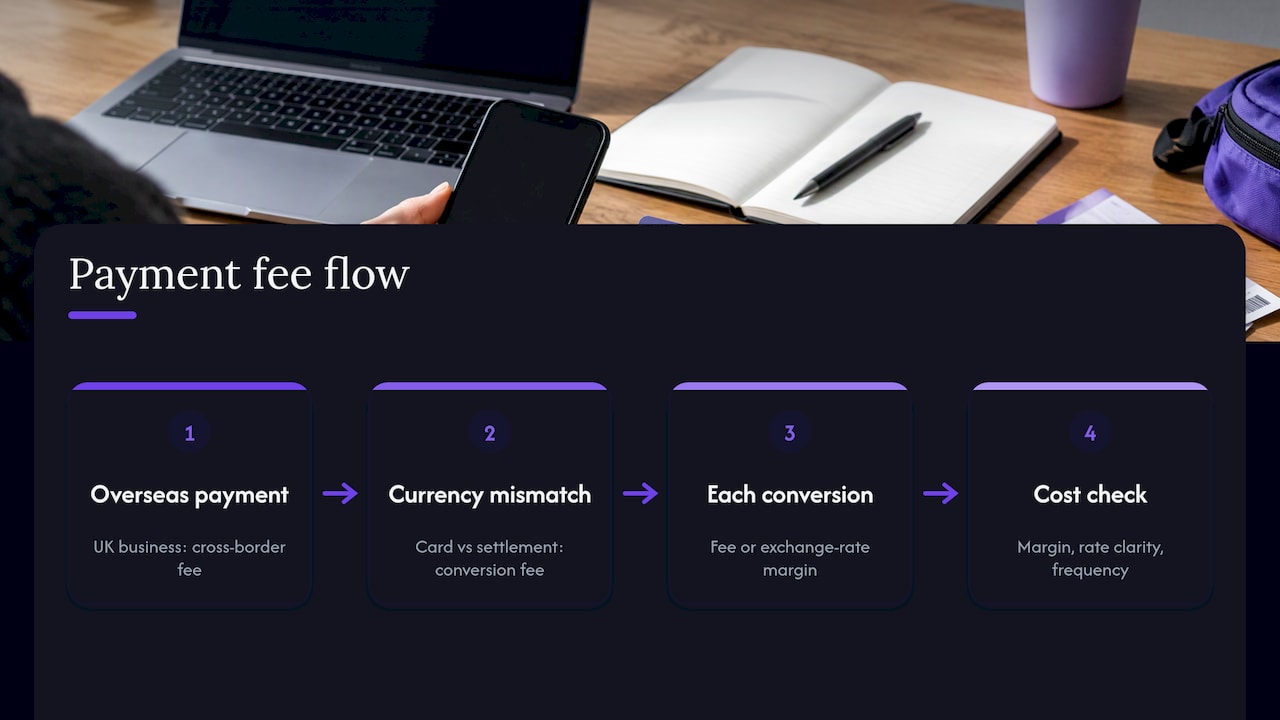
So the budget question is not “what is the exchange rate?” It is “how many times does my money change currency, and what does each step cost?”
Where the costs come from
For a UK organiser selling through Stripe, four layers can apply to a single ticket. Published UK rates are on Stripe’s UK pricing page, and they can change, so read your own account’s rates rather than any figure in an article.
| Layer | What triggers it | Where it shows up |
|---|---|---|
| Lookport commission | Every ticket sold | 6%, with no other Lookport charges |
| Card processing | Every card payment | Lower for UK cards, higher for international cards |
| Currency conversion | Card or presentment currency differs from settlement currency | A percentage on the converted amount |
| Payout conversion | You pay out into a different currency or account | Depends on your payout settings |
Independent UK write-ups of Stripe’s 2026 pricing describe the pattern: a lower rate on UK-issued cards, a higher rate on EEA and international cards, and a currency conversion fee of around 2% when currencies differ. Treat these as a guide to the shape of the costs and confirm the exact figures in your own Stripe dashboard.
The Lookport layer stays fixed
Lookport charges 6% commission and no other Lookport charges, so adding overseas buyers does not add a Lookport fee. Because proceeds are paid directly into your own Stripe account, the currency and payout settings that apply are the ones on your own Stripe account. Availability follows Stripe-supported countries. For the wider fee picture, see our guide to modelling ticketing fees.
A worked example: 20% of tickets sold in euros
This is a hypothetical example to show the method. The rates are assumptions, not quotes. Replace them with the rates on your own account.
Assumptions
- 500 tickets, each worth £30 or the euro equivalent, so £15,000 gross.
- 400 tickets sold to UK buyers with UK cards in pounds.
- 100 tickets sold to buyers paying in euros with euro cards, settled in pounds.
- Lookport commission: 6% of ticket sales.
- Assumed card fees: 1.5% + 20p on UK cards, 2.5% + 20p on international cards.
- Assumed conversion fee: 2% on the converted amount.
Calculation
| Line | Working | Cost |
|---|---|---|
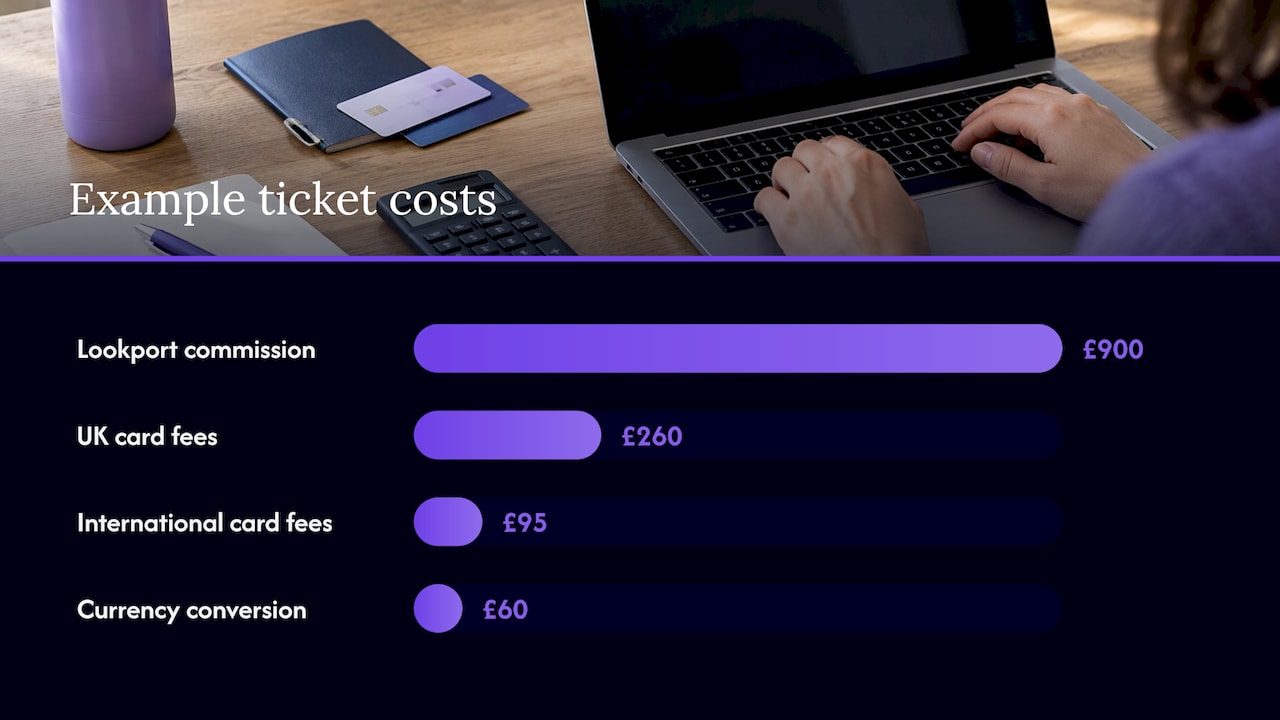
| Lookport commission | 6% × £15,000 | £900 |
| UK card fees | 400 × (1.5% × £30 + 20p) = 400 × £0.65 | £260 |
| International card fees | 100 × (2.5% × £30 + 20p) = 100 × £0.95 | £95 |
| Currency conversion | 2% × £3,000 | £60 |
| Total | £1,315 |
That is 8.77% of gross. If all 500 tickets had been sold to UK buyers, the card fees would be 500 × £0.65 = £325 and the total £1,225, or 8.17%. The overseas share added £90, about 0.6 percentage points of gross.
Two points follow from this. First, the extra cost is modest at a 20% overseas share, so it rarely justifies avoiding overseas buyers. Second, it scales with the share: at 50% overseas, the same assumptions give four times the uplift on a per-ticket basis, which you would want in the price rather than absorb from margin.
Exchange-rate movement is the larger risk
In the example, fees cost £155 on the overseas tickets. A 5% fall in the euro against the pound between onsale and settlement would take £150 off the same £3,000 of euro sales. If you sell months ahead, that movement can exceed the fees. Two ways to handle it in the budget:
- Price in the buyer’s currency with a margin built in, and review the euro price if the rate moves a lot before onsale phases.
- Settle in the currency you need to spend. If a European date has costs in euros, keeping those proceeds in euros removes the conversion on both sides.
How buyers see and pay in their own currency
The buyer-facing side is set at checkout: the price they see and the currency their card is charged in. Stripe documents the account side of this in its multi-currency settlement guide, which covers enabling additional settlement currencies in your account. Because your Lookport proceeds land in your own Stripe account, that account is where you review currency and payout options. For the exact checkout and display options available on Lookport Ticketing, see the Ticketing page and the online and hybrid ticketing feature page.
Whichever way you set it up, keep one rule: the price the buyer sees must be the price they pay. UK rules on drip pricing and fees make this a compliance point, not only a conversion point. Our guide to all-in ticket pricing under CMA rules covers how to show a single total, and a euro price should follow the same principle as the pound one.
Refunds and cancellations across currencies
Decide this before onsale, because it affects both your terms and your cash flow.
- Refund in the original currency. A buyer who paid €35 expects €35 back. If you settled in pounds, you are paying out an amount that was fixed at the exchange rate on the day of sale, so the cost to you changes with the rate.
- Fees on refunds. Processing fees on the original payment are generally not returned automatically, so a refunded ticket can cost you the fee with no revenue. Check how your Stripe account treats this and put it in the cancellation budget.
- Cancelled shows. If a whole date is cancelled, refunding every overseas buyer at a different exchange rate from the sale can leave you short. Hold a contingency on the overseas share of revenue for the weeks before the show.
Write your refund policy in the buyer’s currency terms as well: state that refunds go back to the original payment method in the currency charged.
Checklist before enabling multi-currency sales
- Count the overseas share. Estimate it from the date, the city and any previous sales. If it is under 10%, a single pound price may serve you.
- Pick your settlement currency. Match it to where your costs fall. A date with euro venue fees argues for keeping some euros.
- Read your Stripe rates. Find the card rates and the conversion rate on your own account, and write them down with the date.
- Build the fee into the price. Add the per-ticket overseas cost to the ticket price or the budget. Do not leave it as an unplanned loss.
- Set an exchange-rate buffer. Use a margin on the budget for the gap between onsale and settlement.
- Show one all-in price. Present the total the buyer pays, in their currency, with fees included.
- Write refund terms. State the currency and method of refunds.
- Check tax and fulfilment. VAT and fulfilment errors are common on cross-border sales. Our guide to Stripe ticketing for UK events covers them. If you tour in Europe, take the European tour selling guide alongside it.
For VAT on international sales and your tax position, speak to your accountant. The rules depend on the event location and how you are registered.
Budgeting it in the calculator
The calculator lets you model costs, ticket prices, revenue and break-even for a show or tour. For a multi-currency date, run it twice:
- Baseline: all tickets at the pound price, 6% commission and your standard card cost.
- Overseas scenario: the share of tickets sold abroad, with the extra card and conversion cost added to your per-ticket cost.
Compare the break-even ticket count in each. If the overseas scenario pushes break-even up by more than a handful of tickets, raise the price or the margin buffer. Then add an exchange-rate scenario: reduce the euro revenue by 5% and see whether the show still clears break-even. Label each run with the rates you used and the date, so you can compare with real settlement figures after the show.
Where Lookport fits
Lookport Ticketing is built for concert promoters, event organisers and venues. The commission is 6% with no other Lookport charges, and proceeds go directly to your own Stripe account, so you keep control of settlement and currency choices on your own account. Pair it with the tour break-even calculator to set prices before you go on sale.
You can see the commission on the pricing page and set up your sales on the Ticketing page.
FAQ
Does Lookport charge extra for selling in other currencies?
Lookport charges 6% commission with no other Lookport charges. Card and currency conversion costs come from the payment side, through your own Stripe account, so read the rates on that account when you budget.
What is the cost of selling tickets to overseas buyers?
There can be a higher card rate for international cards and a conversion fee when the card currency differs from your settlement currency. Stripe’s UK guide describes both layers. Model them per ticket, as in the worked example above, using the rates on your own account.
Should I settle in pounds or euros?
Settle in the currency you will spend. If a European date has costs in euros, keeping those proceeds in euros avoids two conversions. If most costs are in pounds, settle in pounds and add a buffer for exchange-rate movement.
Who bears the exchange-rate risk on refunds?
You do, unless your terms say otherwise. A refund goes back in the currency the buyer paid, so a move in the rate between sale and refund changes your cost. Hold a contingency on overseas revenue until the show has taken place.
Sources
- Multicurrency Transactions for UK Businesses: A Guide, Stripe
- Stripe pricing and fees, United Kingdom
- Multi-currency settlement, Stripe documentation
- Stripe vs PayPal vs Wise for UK Founders: Fees and Full Comparison
Recommended
Ticketing & event budgeting
 2026-11-21
Tour Announcement Strategy: A UK Promoter's Plan
Plan a tour announcement from break-even to on-sale: lead times, sequence, channels, first-48-hour measures and budget, with a worked UK example.
 2026-11-20
Last-Minute Ticket Sales Tactics for UK Promoters
A practical plan for the final weeks before a show: diagnose slow sales, work out your break-even gap, target the right audiences and stay within UK pricing rules.
 2026-11-19
Secondary Market Monitoring for UK Promoters
What secondary market monitoring means for UK promoters: which resale signals to watch, what they tell you about demand, and how to act on them within the rules.
 2026-11-18
Marketing Budget Allocation for Concerts: A UK Promoter's Guide
Set a concert marketing budget from gross potential and ticket margin, split it by sales phase and channel, and know when to move money. UK worked example.
 2026-11-17
Ticket On-Sale Timeline: A Planning Schedule for UK Promoters
Plan your ticket on-sale timeline: announcement, presale, general sale and final push, with a week-by-week schedule and a worked example for UK promoters.
 2026-11-16
AI for Event Marketing: A UK Promoter's Practical Guide
How UK promoters can use AI for event marketing: audience segments, demand forecasts, copy, chatbots and measurement, with ICO rules and a worked budget example.