LOOKPORT / TICKETING & EVENT BUDGETING
AI for Event Marketing: A UK Promoter's Practical Guide
How UK promoters can use AI for event marketing: audience segments, demand forecasts, copy, chatbots and measurement, with ICO rules and a worked budget example.
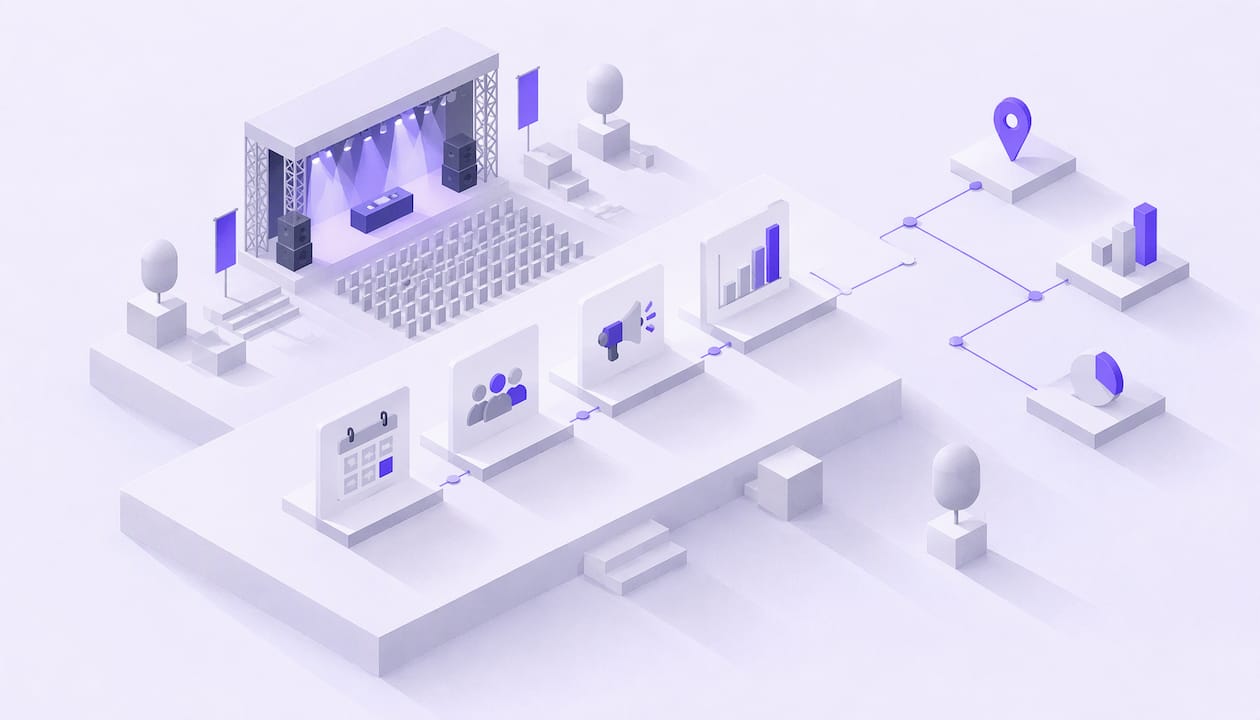
AI helps most in event marketing when it works on your own sales data: it can forecast demand, split your audience into segments, draft copy for you to edit and show which spend sold tickets. It does not replace a marketing plan, and it needs a ticketing record you can trust. If you sell through a platform that pays proceeds straight into your own Stripe account and charges a flat 6% Lookport commission with no other Lookport charges, your marketing budget is easy to model. You can set cost per ticket against what each ticket actually earns you.
This guide covers where AI is useful for a promoter, the inputs each use needs, how to check the output, and what the UK rules require. Each use ends with a question: does it move tickets sold, or only activity?
TL;DR
- AI is most useful in four places: demand forecasting, audience segmentation, content drafting and sales measurement.
- Every output depends on your sales data. Clean ticket records and a clear marketing budget come before any tool.
- Draft with AI, approve as a person. Check facts, tone and consent before anything goes to fans.
- UK email and SMS marketing falls under PECR and UK GDPR. Consent and opt-outs are part of the workflow, not an afterthought.
- Model the spend first. The Concert Profit & Tour Budget Calculator shows how many tickets you need before a campaign pays for itself.
Table of Contents
- What AI can and cannot do for event marketing
- Use 1: forecast demand before you spend
- Use 2: segment your audience by motivation
- Use 3: draft emails, posts and ad copy
- Use 4: answer fan questions with a chatbot
- Use 5: measure what AI marketing actually sold
- Build a marketing budget scenario around the forecast
- UK rules: consent, ICO and responsible AI use
- Where Lookport fits
- FAQ
- Sources
What AI can and cannot do for event marketing
AI in event marketing means software that finds patterns in data and produces a prediction, a grouping or a draft. It does not know your artist, your room or your local market unless you give it that information.
Adoption is already common in the industry. EventTech Live’s 2025 research, based on a survey run in late 2024, found that 45% of event organisers were actively using AI. Data analytics (20%) and personalisation (18%) were the leading applications. Content creation (15%) and customer-service automation (14%) followed. The same survey reported that 65% planned to increase their use over the next two years, and named staff training (30%) and cost (25%) as the main barriers.
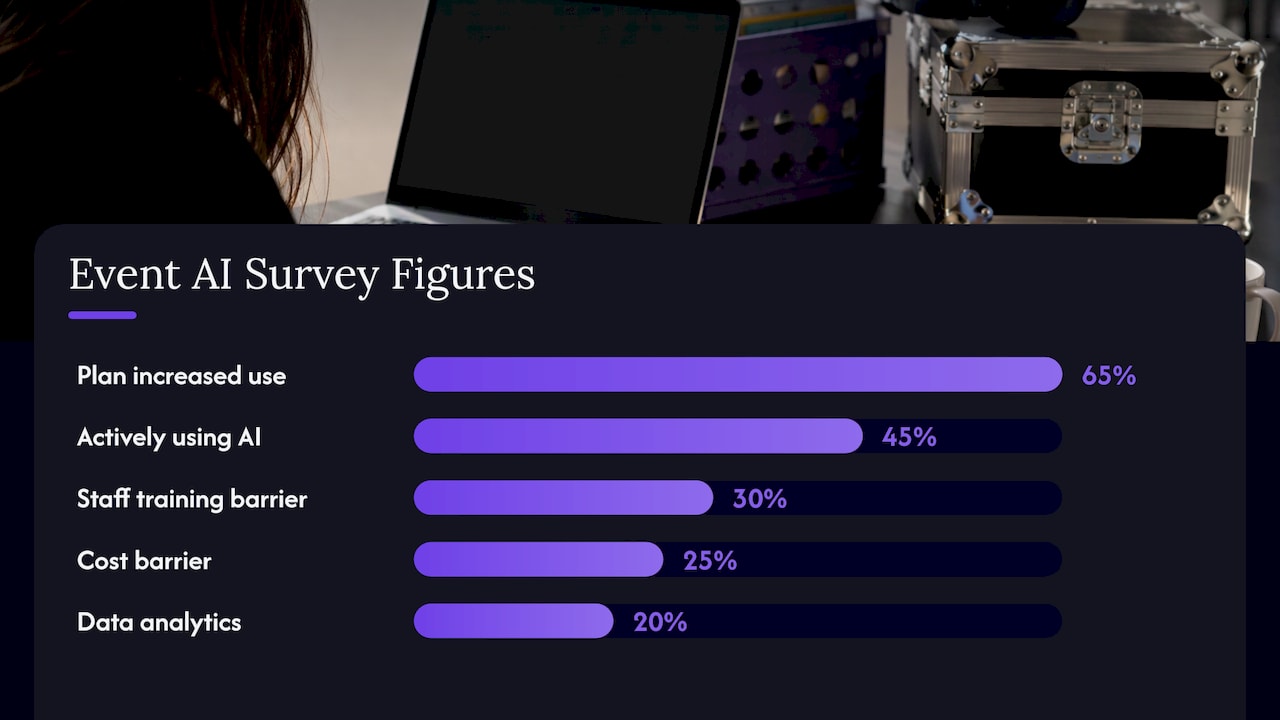
The lesson for a promoter is to start with the uses that touch revenue. Analytics and personalisation lead because they are tied to who buys, when and at what price.
A UK example shows the commercial case. Gotobeat, a live entertainment company working in the UK and Europe, used AI to predict which venues suit emerging artists as their audiences grow. It sold more than 150,000 tickets in 2025. The company’s own tooling is proprietary, so you cannot copy it. The method is what transfers: use past sales to decide where and when to put a show.
Use 1: forecast demand before you spend
A demand forecast estimates how many tickets a show will sell and how fast. For marketing, it answers three questions: how much to spend, when to push and when to release the next ticket tier.
Inputs you need
- Ticket sales by day for comparable past shows: same artist level, venue size, genre and season.
- Ticket price tiers and the dates they were released.
- Marketing spend by channel and by week.
- Calendar factors: school holidays, competing local shows, announcement and on-sale dates.
Workflow
- Export past sales by day from your ticketing records.
- Group shows that are genuinely comparable. A 300-capacity club night and a 2,000-capacity theatre show are not.
- Produce a forecast range, not a single number. A low, expected and high case is more useful than one figure.
- Set a decision point, for example the first 72 hours of sales, where you compare actual sales with the range and decide whether to change spend.
Validation and limits
Run the forecast on shows that have already happened and compare it with what sold. If you cannot reproduce past results, do not trust it on a new show. Our guide on how to test whether an AI ticket-sales forecast is useful walks through that check. For a step-by-step model, see AI ticket sales forecasting for UK concerts and AI ticket forecasts for UK promoters: three budget cases.
Treat accuracy claims with care. Vendors publish figures measured on their own data, and your show may behave differently. A first-time artist in a new city has little history, so any forecast for it is a wide range.
Use 2: segment your audience by motivation
Segmentation splits buyers into groups so each gets a relevant message. AI helps when you have enough records to see patterns that a spreadsheet filter would miss.
Useful splits for a concert promoter:
- Repeat buyers, who have bought for earlier shows with you.
- Early buyers, who purchase in the first days of an on-sale.
- Late buyers, who wait until the week of the show.
- Group buyers, who purchase four or more tickets.
- Enquirers who did not buy, such as people who joined a mailing list or visited the event page.
Marketing consultancy Mustard Media argues that organisers need to own, understand and measure their audience data. In a February 2026 interview, its Sian Bennett said better insight helps them use limited budgets more efficiently and spot unconverted prospects. That applies to a venue with a small marketing line as much as a festival.
The first days of sales carry the most signal. Our guide to AI audience analytics using the first 72 hours of sales shows how to read who bought, from where and after which message, and how to use that for repeat sales.
Validation
A segment is only useful if the groups respond differently. Send two versions of a message to two comparable groups and compare ticket purchases, not opens. If the results match, the segment is not adding anything and you can simplify.
Use 3: draft emails, posts and ad copy
Generative AI drafts quickly. It can produce subject-line options, short social captions, event page copy and ad variants from a brief. The value is speed on the first draft and range in the variants you test.
What to put in the brief
- Artist, date, venue and ticket price tiers, exactly as listed.
- The audience segment and what they already know.
- Your tone and words you never use.
- The single action you want: buy, share or join the waiting list.
What to check before sending
- Every fact: date, doors time, age limit, price and support acts.
- Claims about the artist. Do not let a draft invent quotes, awards or sold-out histories.
- Tone. Fans notice generic copy, and one UK marketer’s 2026 field guide notes that over half of consumers are less likely to engage with content marked as AI-generated. Edit every draft so it sounds like your venue or promotion.
AI drafts are only text. If you promote with video, human-made, ready-to-edit music videos and short social clips give your campaign creative that you can brand and adapt, alongside the copy you draft.
For paid social specifically, Facebook ads for concerts explains how to track ticket sales back to the ad, which is where the draft’s value is decided.
Use 4: answer fan questions with a chatbot
Most pre-show questions repeat: doors time, age restrictions, accessibility, parking, refunds and transfers. A chatbot connected to your event information can answer these at any hour and leave your team free for exceptions.
Set it up in this order:
- Write the answers once, in one place, and keep them current.
- Give the bot only that content to draw from.
- Make it hand over to a person for anything it cannot answer, such as a refund dispute or a safety concern.
- Review a sample of conversations weekly during the on-sale.
The risk is a confident wrong answer about a ticket or an access need. Keep the scope narrow and the handover easy.
Use 5: measure what AI marketing actually sold
Measurement decides whether any of the above was worth it. The usual failure is counting clicks, opens or followers instead of tickets.
A simple set of measures for each campaign:
| Measure | What it tells you | Where it comes from |
|---|---|---|
| Tickets sold per channel | Which spend produced buyers | Ticketing records and tracked links |
| Cost per ticket | Spend divided by tickets sold | Your marketing spend and sales |
| Sales in the first 72 hours | Whether the on-sale launch worked | Daily sales export |
| Repeat-buyer share | Whether your audience is growing or recycling | Buyer records across shows |
| Net revenue per ticket | What a ticket earns after fees | Ticket price less platform commission |
Use tracked links for every channel so each sale carries a source. Without that, AI “insights” are guesses.
A worked example (hypothetical)
This example is illustrative and not a real result. A promoter plans a show in a 1,200-capacity venue with a £28 ticket and a £3,000 marketing budget.
- Full capacity at £28 is £33,600 in ticket revenue.
- Lookport’s 6% commission on that is £2,016, which is £1.68 a ticket.
- If the campaign sells 250 tickets, that is £7,000 in ticket revenue and a marketing cost of £12 a ticket.
- After commission of £420, the 250 tickets leave £6,580 before the other show costs.
The question for the promoter is whether £12 a ticket fits the show’s break-even. Put your own figures into the Concert Profit & Tour Budget Calculator to see how many tickets the show needs to cover its costs, and how much of that your marketing must deliver. For revenue at different price points, the ticket revenue calculator is the quicker check.
Build a marketing budget scenario around the forecast
AI forecasts and budgets work best together. Use the forecast range to build three scenarios and set a trigger for each.
- Low case: sales track the bottom of the range. Cut paid spend to the best-performing channel, or review the show’s costs.
- Expected case: sales track the middle. Keep the plan and shift budget towards channels with the lowest cost per ticket.
- High case: sales track the top. Release the next price tier on time and hold back spend you do not need.
Record the scenario you chose and why. After the show, compare it with the result. Over a few shows, this record becomes your best dataset.
For the wider plan, the festival marketing plan for UK promoters sets the timeline, and audience engagement technology covers tools that keep fans involved between announcement and doors.
UK rules: consent, ICO and responsible AI use
AI does not change your legal duties. Email, SMS and similar direct marketing in the UK are governed by the Privacy and Electronic Communications Regulations (PECR), alongside UK GDPR, which the Information Commissioner’s Office (ICO) enforces.
The ICO’s guidance says consent for electronic mail marketing must be specific and informed, and that simply asking for consent for direct marketing is not enough. The rules also differ for individual and corporate subscribers, so check which applies to each list.
In practice:
- Record when and how each person agreed to hear from you, and for which type of message.
- Put an unsubscribe in every message and apply it to every list straight away.
- Keep a suppression list so an opted-out fan is never re-imported from an old export.
- Check what a tool does with the fan data you upload before you upload it.
- Keep a person in the loop for decisions that affect individuals, such as pricing changes or who receives an offer.
The March 2026 report from 16 UK cultural organisations’ AI experiments recommends people-centred processes, clear but flexible guardrails and small, low-stakes experiments. For a promoter, that means piloting AI on one show before applying it to a tour. The same report flags bias in large language models and ongoing skills needs, which is a further reason to review outputs before they reach fans. For a full eight-to-twelve-week plan, see our guide to ICO-compliant AI concert marketing.
Where Lookport fits
AI marketing is only as good as the sales record behind it. Lookport Ticketing is built for concert promoters, event organisers and venues, and it keeps the money side simple: a 6% Lookport commission with no other Lookport charges, and ticket proceeds paid directly into your own Stripe account. Availability follows Stripe-supported countries. You can see the commission on the pricing page and the AI-related features Lookport documents on the AI for event ticketing page.
A flat commission makes the cost-per-ticket sums above clean: you know what each sale costs before you set the campaign budget.
To put the numbers around your next show, start with the Concert Profit & Tour Budget Calculator. When you are ready to sell, set up your event on Lookport Ticketing.
FAQ
Is AI worth using for a small venue or promoter?
Yes, if you start with one narrow use. Drafting emails and reading your own sales data need no special budget. Run it on one show, measure tickets sold against your usual approach, and expand only if the result holds.
What data do I need before using AI for event marketing?
You need daily ticket sales for past shows, price tiers with release dates, marketing spend by channel and a consented contact list. Without sales history by day, forecasts and segments have little to learn from.
Can I upload my fan list to an AI tool?
Only if you have a lawful basis and the tool’s data handling fits your privacy notice. Check what the tool does with the data first, and keep consent records and a suppression list. If in doubt, ask a data protection adviser or read the ICO’s guidance.
How do I know whether AI marketing increased ticket sales?
Use tracked links per channel and compare tickets sold and cost per ticket with a similar earlier show. Opens and clicks are not enough. Compare the forecast range with actual sales at the 72-hour point.
Sources
- AI in Events: Adoption, Barriers and Forecast, EventTech Live
- Gotobeat’s AI tech helped it sell over 150k tickets in 2025, Music Ally
- Mustard Media’s Sian Bennett on how festivals can thrive through data, Festival Insights
- AI Tools Compared: A 2026 Marketer’s Field Guide
- How do we comply with the PECR electronic mail marketing rules? ICO
- Let’s Get Real AI Report, March 2026
Recommended
Ticketing & event budgeting
 2026-11-22
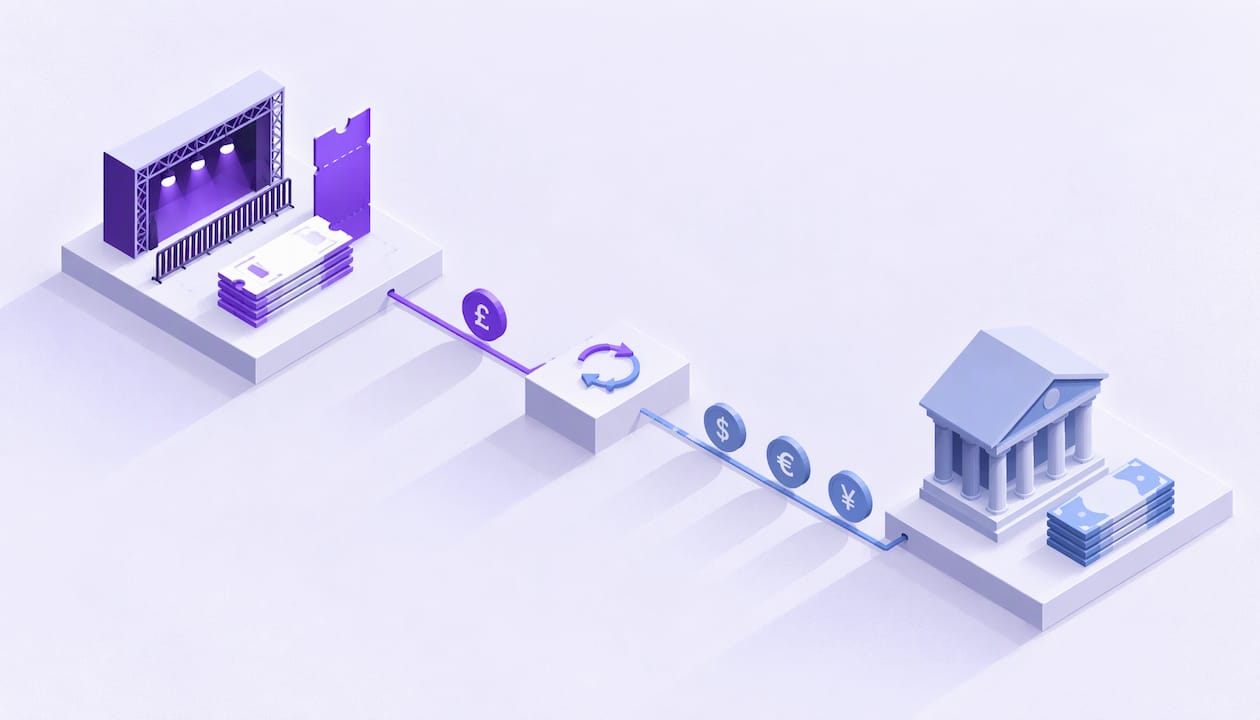
Multi-Currency Ticketing: A UK Promoter's Guide to Fees and FX
How multi-currency ticketing works for UK promoters: settlement currencies, card and conversion fees, refunds, and a worked example to budget it before you sell.
 2026-11-21
Tour Announcement Strategy: A UK Promoter's Plan
Plan a tour announcement from break-even to on-sale: lead times, sequence, channels, first-48-hour measures and budget, with a worked UK example.
 2026-11-20
Last-Minute Ticket Sales Tactics for UK Promoters
A practical plan for the final weeks before a show: diagnose slow sales, work out your break-even gap, target the right audiences and stay within UK pricing rules.
 2026-11-19
Secondary Market Monitoring for UK Promoters
What secondary market monitoring means for UK promoters: which resale signals to watch, what they tell you about demand, and how to act on them within the rules.
 2026-11-18
Marketing Budget Allocation for Concerts: A UK Promoter's Guide
Set a concert marketing budget from gross potential and ticket margin, split it by sales phase and channel, and know when to move money. UK worked example.
 2026-11-17
Ticket On-Sale Timeline: A Planning Schedule for UK Promoters
Plan your ticket on-sale timeline: announcement, presale, general sale and final push, with a week-by-week schedule and a worked example for UK promoters.