LOOKPORT / TICKETING & EVENT BUDGETING
Secondary Market Monitoring for UK Promoters
What secondary market monitoring means for UK promoters: which resale signals to watch, what they tell you about demand, and how to act on them within the rules.

Secondary market monitoring, for a promoter, means tracking how your tickets are listed and priced on resale platforms after they leave your box office. It tells you whether demand outran your pricing and supply, and where tickets are reaching buyers outside your control. The useful part is what you do next: you change primary pricing, release held inventory or add capacity, and you record the evidence in your own sales data and your budget.
This guide covers what to watch, what each signal can and cannot tell you, the UK rules that shape what you can do, and a simple workflow for turning resale observations into a better show budget.
TL;DR
- Secondary market monitoring is the review of resale listings for your events, used to judge demand, pricing and ticket distribution.
- Mark-ups are the main signal: the CMA’s analysis puts typical secondary-market mark-ups above 50%, which suggests face value may have been set below what buyers will pay.
- Resale data is an indicator, not a measure. Check it against your own primary sales pace before you change a price or add a date.
- The UK government announced in November 2025 proposals for a face-value resale cap. Legislation was still at draft stage in May 2026, so check GOV.UK for the current position.
- Test any price or capacity change in the tour break-even calculator before you commit.
Table of Contents
- What secondary market monitoring means for a promoter
- Why the resale market matters to your budget
- The signals worth watching
- What the patterns can tell you
- Check resale signals against your own sales data
- What UK rules say about acting on what you find
- Turn monitoring into primary-side decisions
- A simple monitoring workflow
- Model the decision before you make it
- FAQ
- Sources
What secondary market monitoring means for a promoter
A primary sale is the ticket you sell through your own ticketing. A secondary sale is any later resale of that ticket, on a resale platform, a social media channel or a marketplace. In finance, the same phrase describes trading in existing shares and bonds. In live events, it is a much simpler job: you look at what happens to your tickets once they are out of your hands.
There are two reasons to do it.
- Demand intelligence. Resellers buy because they expect demand to exceed supply and want a profit above face value, as the CMA noted in its response to the government’s resale consultation. A ticket clearing well above face value is therefore a price signal about your event.
- Distribution and compliance. Resale listings show whether your tickets are reaching fans, whether listings carry the information the law requires, and whether touts are buying in bulk at your on-sale.
Most promoters never see this data in a tidy report. It is scattered across listing pages, and the useful skill is knowing which few numbers matter.
Why the resale market matters to your budget
Your break-even point rests on a ticket price and a sell-through assumption. If both are set too low, resale is where the shortfall shows up.
The scale of the gap is documented. GOV.UK’s 19 November 2025 announcement cites CMA analysis that typical secondary-market mark-ups exceed 50%, and Trading Standards investigations that found tickets resold for up to six times their original cost. Those are headline figures for the whole market, not a forecast for your show. Your own event could sit well below that or well above it.
The budget consequence is the point. Every pound of mark-up that goes to a reseller is a pound that did not reach you, the artist or the venue. Monitoring does not recover that money for the show already on sale. It informs the next decision: the price of the next release, the next date, the next tour.
The signals worth watching
You do not need every data point. Focus on a short list and record it on a regular schedule, such as weekly through the on-sale and daily in the final fortnight.
| Signal | What to record | What it can suggest |
|---|---|---|
| Listing count | Number of live listings for each date | Many listings on a weak sell-through may point to speculative buying or fans releasing tickets |
| Asking price against face value | Lowest and typical listing price by tier | A persistent premium suggests demand above your price point |
| Time on market | How long listings stay up | Listings that sell quickly indicate buyers accept the price |
| Tier or section spread | Premium by seat block or ticket type | One tier priced too low relative to others |
| Listing quality | Whether face value, seat location and restrictions are shown | Compliance issues you may need to raise in writing |
| Timing | Listing spikes after on-sale, announcements or added dates | How quickly the market reacts to news |
Treat asking prices with care. A listing price is what a seller hopes for, not what a buyer paid. Completed sales are a stronger signal, but they are harder to see. Record which one you are looking at each time.
What the compliance side looks for
The CMA’s 2016 compliance review of secondary platforms checked whether listings showed entry and view restrictions, whether grouped seats were together, additional charges, face value and a way to contact the buyer. That list is a practical template for what a decent listing should disclose.
Under the Consumer Rights Act guidance for business, five pieces of information must be given where applicable for a ticket on a secondary ticketing facility: location, user restrictions, face value, certain connections between the seller and the platform or organiser, and any unique ticket number you or your primary agent specify. Barcodes should never be disclosed. If you see listings missing this, record the date and a screenshot.
For the full legal picture, see our guide to secondary ticketing law in the UK.
What the patterns can tell you
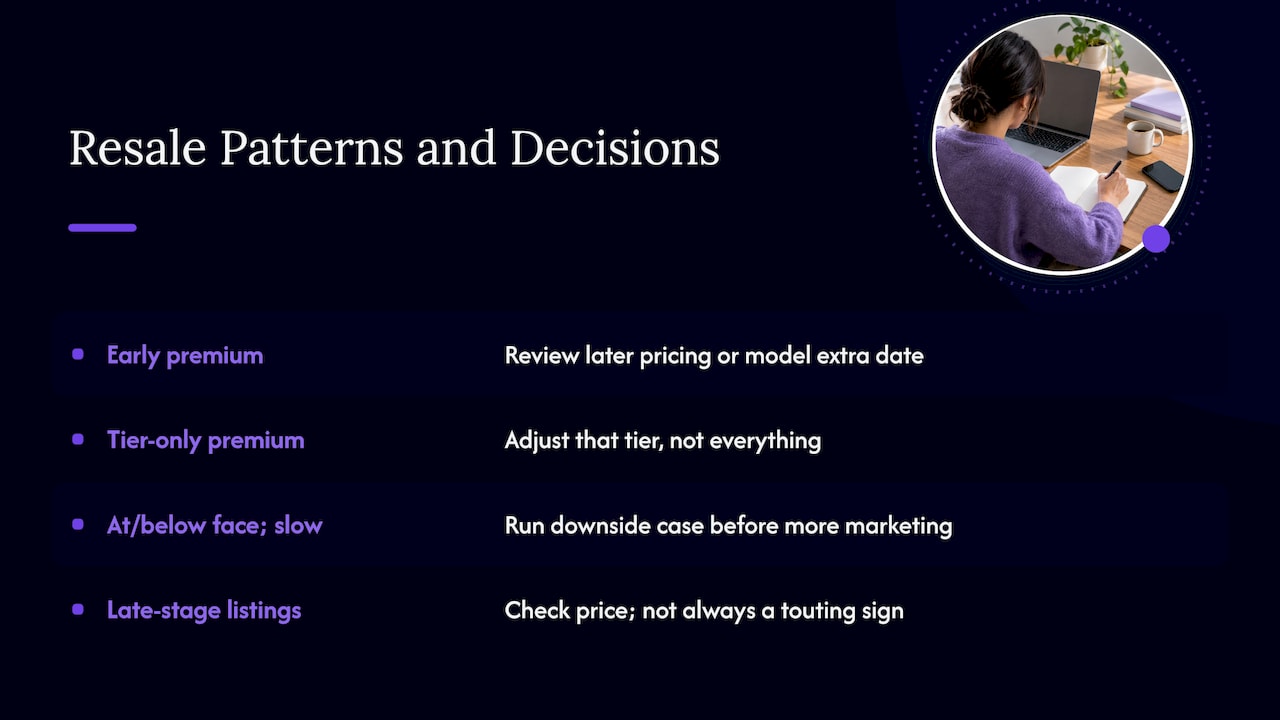
Resale behaviour is not random. A few patterns recur across live events, and each points to a different decision.
A strong early premium. If listings appear within hours of the on-sale at well above face value while your own tickets are selling fast, demand is likely ahead of supply. That is a prompt to look at your pricing for later releases or to model an extra date.
Premiums confined to one tier. If one ticket type carries the premium and the rest trade at or below face value, the problem may be tier pricing rather than the show as a whole. Adjusting that tier is a smaller change than repricing everything.
Listings at or below face value. Many listings at or below face value, with slow primary sales, suggest demand is weaker than planned. Resale here is a warning, not a lost opportunity. Run a downside case before you spend more on marketing.
Late-stage movement. Fans release tickets they can no longer use as the event approaches. STAR, which represents UK ticket agents, told Parliament that good capped resale is essential for consumers who can no longer use their tickets. A rise in late listings is not always a sign of touting. Look at the price before you draw a conclusion.
Treat each pattern as a hypothesis. It becomes a decision only when your own primary data agrees with it.
Check resale signals against your own sales data
Secondary data only describes the part of the market you can see. Your primary data describes every ticket you sold. The comparison is where the value lies.
Before acting on a resale signal, check:
- Sales pace. Is your cumulative sell-through ahead of or behind the plan at the same point in the on-sale?
- Buyer concentration. Are a small number of buyers taking large blocks? Bulk buying can distort both your sales and the resale picture.
- Channel and campaign. Did a marketing push or an announcement coincide with the resale spike?
- Order patterns. Do orders cluster in the first minutes, which can indicate automated buying?
If you own your sales records, these checks take minutes. If the data sits in another system, they take days. Our guide to owning your ticketing data explains why that matters, and ticketing analytics for UK promoters lists the measures to track from day one.
Bot activity deserves its own line. STAR’s evidence to Parliament notes that bot activity can place significant demand on ticketing platforms at the point of sale even where detection measures exist. The ticket bots ban, in force from 5 July 2018, makes it a criminal offence for touts to use automated software to buy more tickets than they are allowed, with an unlimited fine. If your order log suggests bulk automated buying, our guide to anti-bot ticketing covers how promoters protect an on-sale.
What UK rules say about acting on what you find
Monitoring is only useful if you know what you may do about it. The position has several layers.
Notifying platforms
The CMA’s open letter to event organisers explains that organisers can notify secondary platforms in writing about restrictions on use, including resale restrictions, and about seat information, which platforms must display on resale listings. If you notify a platform in writing that tickets do not exist or have not yet been made officially available, that platform must suspend sales until they are. Keep a dated record of every notification.
The same letter says the CMA is less likely to prioritise enforcement against organisers using resale restrictions where there is a legitimate reason, the restrictions are necessary and proportionate, and they are communicated transparently.
Cancelling resold tickets
The Consumer Rights Act guidance states that an organiser cannot cancel a ticket or blacklist a seller merely because it was resold, unless cancellation was clearly set out as a contract term before purchase and that term is not unfair under consumer protection law. Do not cancel tickets on the strength of a listing alone. Take legal advice from a solicitor before you rely on a resale restriction in your terms.
The proposed face-value cap
On 19 November 2025 the government announced proposals to make resale above face value illegal, with face value defined as the original price plus unavoidable fees such as service charges. Resale platform fees would be capped, and platforms would have a legal duty to monitor and enforce the cap. Businesses that broke the rules could face CMA penalties of up to 10% of global turnover under the Digital Markets, Competition and Consumers Act 2024.
Progress has been slower than the announcement suggested. Music Week reported in May 2026 that the King’s Speech included only draft legislation on secondary ticketing, so the cap was not a priority for that parliamentary session and remained subject to further consultation. The rules may change again, so check GOV.UK before you base a policy on them.
Limits of any cap
The CMA’s 2021 secondary ticketing report cautions that restrictions alone are not enough: vigorous enforcement and monitoring would be needed, and evasive resellers would likely move to social media channels that platform measures do not cover. Your monitoring should therefore not stop at the main resale sites. Include the places where fans actually trade tickets.
Turn monitoring into primary-side decisions
Resale evidence is useful in three places: price, capacity and timing.
Price
If resale premiums are large and sustained, face value may have been low for the demand. Before you raise a price, work out what you would gain and what you might risk. A higher price changes the break-even ticket count, the revenue at each sell-through level and the all-in price fans see. UK organisers also need to show prices clearly: our guide to CMA-compliant all-in ticket pricing covers how to present the total up front.
A short worked example, labelled hypothetical. A 1,200-capacity room has a £30 face value. You observe resale listings at £45 to £55 for the first fortnight while your own sell-through is ahead of plan. You model a £35 price for the remaining release and a second date at the same price. You compare three cases: the current plan, the higher price, and the added date. The numbers here are invented to show the method. Your own figures decide the result.
Capacity
Sustained premiums across several tiers, together with fast primary sell-through, can support a case for an additional date. Be careful with the reverse: a premium on a handful of listings is not evidence of a second sell-out. Use your primary sales for the decision and resale for support.
Timing
The pattern of when listings appear helps you plan release windows, marketing pushes and the final-fortnight push. Pair it with a sales pacing forecast. Our guides to running a sales pacing forecast and to AI ticket forecasts before deposits explain the inputs, the workflow and the limits of forecasting from sales data.
A simple monitoring workflow
- Set a baseline. Before the on-sale, record face value by tier, capacity and your planned sell-through by week.
- Choose your sources. List the resale platforms and social channels where your events are likely to appear.
- Log on a schedule. Record listing counts, the lowest and typical asking price by tier, and whether you are seeing asking or completed prices. Use the same time of day.
- Capture evidence. Screenshot listings that break disclosure rules or appear to sell tickets that do not exist, with the date.
- Compare with primary data. Check sell-through, buyer concentration and order timing against your own records.
- Decide and notify. Where listings breach the rules, notify the platform in writing. Where the signal supports a business decision, model it first.
- Review after the event. Note what resale showed and what actually happened, so the next budget starts from evidence.
A consistent log beats a clever one. Three weeks of comparable weekly figures tell you more than one dramatic screenshot.
Model the decision before you make it
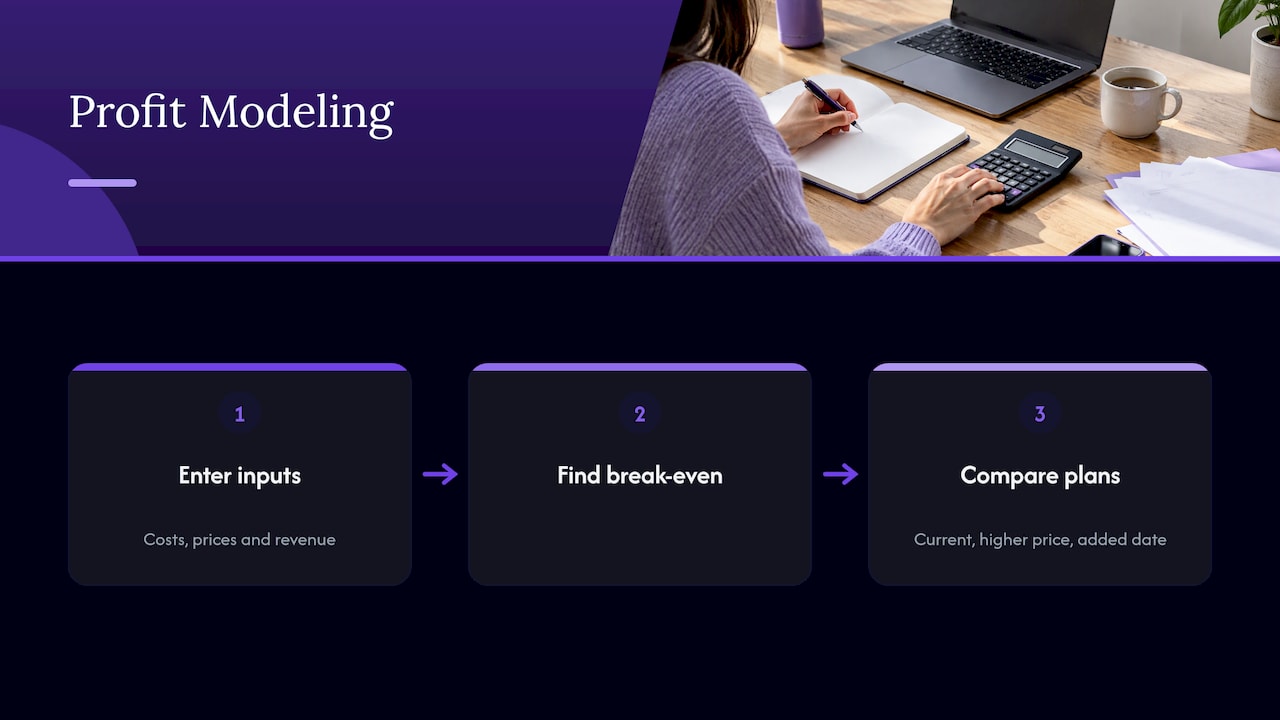
When resale suggests you under-priced or under-supplied a show, you still have to answer a budget question: what happens to profit if you change the price or add a date? The concert profit and tour budget calculator lets you enter costs, ticket prices and revenue to see the break-even point, so you can compare the current plan with a higher price or an extra date before you commit.
If you want to keep those decisions in one place, Lookport Ticketing charges a 6% commission with no other Lookport charges, and ticket proceeds are paid directly into your own Stripe account. Availability follows Stripe-supported countries. The commission is listed on the pricing page.
Our ticketing platform also includes sales and demand forecasting, marketing insights and CRM and campaign tools, so your primary-side picture stays in step with what you see on resale. Features are those currently described on lookport.live.
FAQ
What is secondary market monitoring in ticketing?
It is the regular review of resale listings for your events. You record how many tickets are listed, at what price and with what information. The aim is to read demand, spot ticket distribution problems and gather evidence for pricing and capacity decisions.
Is ticket resale above face value illegal in the UK?
The government announced proposals in November 2025 to make it illegal, but Music Week reported in May 2026 that only draft legislation was committed. Existing rules still require resale platforms to show specified information. Check GOV.UK for the current position before you change your terms.
Can I cancel tickets that have been resold?
Not merely because they were resold. The Consumer Rights Act guidance says cancellation needs to be a clear contract term set out before purchase, and the term must not be unfair. Take advice from a solicitor before you rely on it.
Does a high resale price mean I should raise my ticket price?
It is a signal, not an instruction. Check your own sell-through, buyer concentration and order timing, then model the new price against your break-even point before you act.
Sources
- CMA response to the consultation on the resale of live events tickets
- GOV.UK: Government bans ticket touting to protect fans from rip-off prices
- CMA: Secondary ticket platforms compliance review (2016)
- HM Government: Consumer Rights Act secondary ticketing guidance for business
- STAR written evidence to Parliament (LMI0026)
- GOV.UK: Ticket bots ban comes into force
- CMA: Open letter to event organisers
- Music Week: Live sector disappointed as government only commits to draft legislation on ticket touts
- CMA: Secondary ticketing report, recommendations to government (2021)
Recommended
Ticketing & event budgeting
 2026-11-22
Multi-Currency Ticketing: A UK Promoter's Guide to Fees and FX
How multi-currency ticketing works for UK promoters: settlement currencies, card and conversion fees, refunds, and a worked example to budget it before you sell.
 2026-11-21
Tour Announcement Strategy: A UK Promoter's Plan
Plan a tour announcement from break-even to on-sale: lead times, sequence, channels, first-48-hour measures and budget, with a worked UK example.
 2026-11-20
Last-Minute Ticket Sales Tactics for UK Promoters
A practical plan for the final weeks before a show: diagnose slow sales, work out your break-even gap, target the right audiences and stay within UK pricing rules.
 2026-11-18
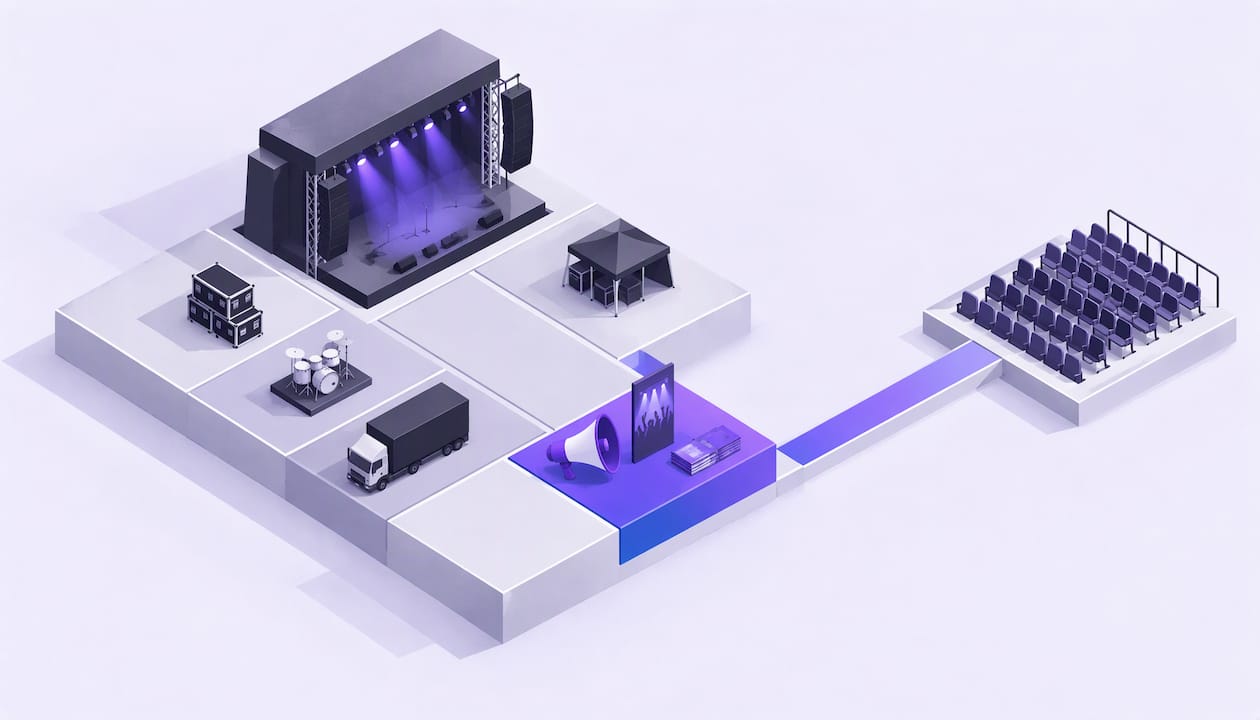
Marketing Budget Allocation for Concerts: A UK Promoter's Guide
Set a concert marketing budget from gross potential and ticket margin, split it by sales phase and channel, and know when to move money. UK worked example.
 2026-11-17
Ticket On-Sale Timeline: A Planning Schedule for UK Promoters
Plan your ticket on-sale timeline: announcement, presale, general sale and final push, with a week-by-week schedule and a worked example for UK promoters.
 2026-11-16
AI for Event Marketing: A UK Promoter's Practical Guide
How UK promoters can use AI for event marketing: audience segments, demand forecasts, copy, chatbots and measurement, with ICO rules and a worked budget example.