LOOKPORT / TICKETING & EVENT BUDGETING
Tour Announcement Strategy: A UK Promoter's Plan
Plan a tour announcement from break-even to on-sale: lead times, sequence, channels, first-48-hour measures and budget, with a worked UK example.

A tour announcement works when it is built backwards from a number: how many tickets each date must sell to break even. Set that number first, then choose the announcement window, the presale, the channels and the weekly checks that show whether you are on course. Lookport Ticketing and the tour break-even calculator are built for that sequence: model the show, then sell it.
This guide is for UK concert promoters, venues and festival organisers. It covers goals, timing, the announce-to-on-sale sequence, coordination, measurement and budget.
TL;DR
- Start with break-even per date, not with the announcement post. The number tells you how hard the campaign has to work.
- Lead times vary by act size: published industry guidance ranges from a few weeks for smaller acts to many months for major tours.
- Run the announcement as a sequence: pre-buzz, announcement, presale, general on-sale, then reminders. Build the calendar back from show night.
- Tag every link, give each channel one number (cost per ticket sold) and review at 24 hours, 72 hours and one week.
- Keep fees and ad spend inside the budget before you commit to prices.
Table of Contents
- Set the goal before the date
- Choose your announcement window
- Build the sequence backwards from show night
- Coordinate artist, venue and promoter
- Choose channels by what they sell
- Measure the first 48 hours, then the first week
- Budget the campaign inside the show
- Sell the tour on Lookport Ticketing
- FAQ
- Sources
Set the goal before the date
Most announcement plans begin with a date and a poster. Start with the maths instead. For each show, you need three figures:
- Fixed costs: artist fee, venue hire, production, crew, insurance, PRS and PPL licensing, marketing, travel.
- Net revenue per ticket: ticket price minus any per-ticket commission and other deductions.
- Capacity you can realistically sell, not the licensed maximum.
Break-even tickets are fixed costs divided by net revenue per ticket, rounded up. Our guide to the concert budget breakdown lists the cost lines, and the break-even calculator guide explains the method.
A worked example (hypothetical)
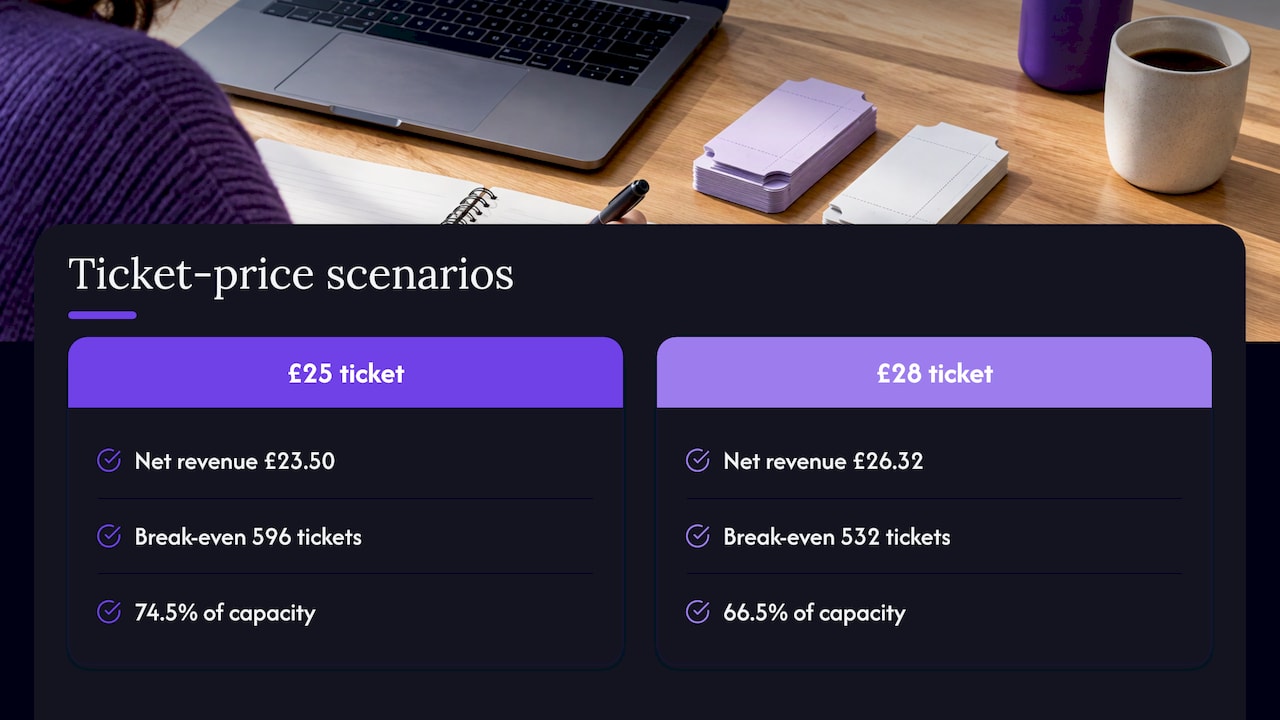
This example is illustrative, not a result from a real show. Take an 800-capacity room with £14,000 of fixed costs and a £25 ticket. Lookport’s commission is 6%, which is £1.50 per ticket, so net revenue is £23.50.
£14,000 ÷ £23.50 = 595.7, so you need 596 tickets. That is 74.5% of the room.
Now raise the ticket to £28. The commission is £1.68, net revenue is £26.32, and break-even falls to 532 tickets, or 66.5% of capacity. The example ignores VAT and any costs not listed, so replace each figure with your own. The point is that a £3 price change moves the target by 64 tickets, and that target decides how much announcement effort the date needs.
Run your own version in the tour break-even calculator, then save the break-even percentage for each date. You will use it again when you read the first 48 hours of sales.
Choose your announcement window
There is no single correct lead time. It depends on the act, the market and how much of the audience already knows the artist.
Published industry guidance gives a useful range. One promoter-focused guide describes six to eight weeks before the earliest date as a common sweet spot, with larger artists announcing up to a year ahead. A separate whitepaper suggests pre-buzz starting three to four months out for community shows, five to six months for established touring artists and six to twelve months for major national tours and festivals.
Treat these as starting points, not rules. Check them against four local facts:
- Competing dates. Look at who else is playing in the same city in the weeks around yours. A strong clash costs more than a late announcement.
- Release cycle. An artist with new music in the market gives you something to talk about. A tour announcement is often described as a coordinated sequence that begins when management, agent and label agree a window with enough lead time.
- Buyer behaviour. Fans of smaller acts commit later. Fans of bigger acts need time to plan travel and budget.
- Your cash position. Long lead times mean deposits sit with the artist and venue for longer. Model that in the budget.
On timing within the week, the same guidance points to Tuesday to Thursday mid-morning for announcements. Test it against your own audience data rather than assuming it holds for every act. Our ticket on-sale timeline turns these windows into a planning schedule for UK promoters.
Build the sequence backwards from show night
A fan who hears about a show once, three days out, rarely buys. One concert promotion playbook argues that the timeline is the strategy, and that promotion starting late and thin is why many shows underperform. Plan the calendar from the show date back.
Phase 1: pre-announcement
Collect demand before you reveal anything. Open a waiting list or mailing sign-up on the artist’s channels and the venue’s. Tag sign-ups by city so that each date can be messaged separately. Keep the content light: a teaser, a countdown, a sign-up link.
Phase 2: announcement
Announce all dates at once, with ticket links live or a clear on-sale date. Everyone involved posts at the same time: artist, promoter, venue and any support acts. Each post links to the same page, so you measure one funnel and not four.
Phase 3: presale
A presale rewards your most engaged fans and gives you an early read on demand. The GLOENTMGMT guide describes the aim of converting attention into tickets within the first 48 hours. Send presale access to your list through unique codes, so you can see which channel produced each sale. Our guides on presale velocity and first-48-hour pricing and promo code strategy cover the mechanics.
Phase 4: general on-sale and the middle weeks
Open general sale and move paid social into the picture. Send a city-specific email to each city’s segment. Do not send every fan every date: it burns goodwill and muddies your numbers.
Phase 5: final weeks
Use retargeting for people who visited the ticket page and did not buy, and exclude those who already bought. Share practical information (doors, set times, access) in show week. Fans reminded across a month buy more often than fans reminded once.
Coordinate artist, venue and promoter
Most announcement problems are coordination problems. Agree these points in writing before the date is set:
- One source of truth. A single ticket link, a single set of dates and venue names, a single price list. Every partner copies from it.
- Posting order and time. Who posts first, at what time, with which image and caption.
- Asset ownership. Who supplies artwork, short video and press copy, and in which sizes. If you need short looping visuals, a Spotify Canvas and lyric video guide gives the current format specs.
- Presale allocations. Which codes go to the artist’s list, the venue’s list and the fan club, and how many tickets each holds.
- Press and listings. Who contacts local press, listings sites and radio in each city.
If you run several venues on one tour, our guide on how to sell tickets for a European tour and the tour management feature show how dates fit under one plan.
Choose channels by what they sell
A channel earns its place by producing tickets, not by producing activity. A workable mix for most UK tours:
| Channel | Job | Watch |
|---|---|---|
| Email to a city segment | Presale and on-sale announcement | Click-to-purchase, not just opens |
| Artist and venue social | Reach existing followers | Link clicks that reach checkout |
| Paid social and search | Reach fans outside your list; retarget visitors | Cost per ticket sold |
| Local press, listings, radio | Credibility in each city | Referral traffic |
| Posters and venue channels | Reach local regulars | Sign-ups, and a question at checkout |
Geography matters. A fan in Leeds does not need the Bristol date. Our guide to geo-targeting concert ads shows how to set the radius around each venue, and the guide to Facebook ads for concerts covers tracking sales from them.
The Ticketing marketing integrations page lists what Lookport connects to for campaign tracking.
Measure the first 48 hours, then the first week
Decide in advance what a good start looks like. Use your break-even percentage from the first section as the anchor.
In the hypothetical 800-capacity example, break-even is 596 tickets. If you want the show to be on track by a certain point, work backwards: what share of those 596 should be sold in the presale, and what share by the end of week one? Write the targets down for each date before you announce. There is no universal benchmark that fits every artist, so use your own past on-sales for similar shows.
Then set a routine:
- Tag every link. Use UTM parameters (tags added to a URL that tell your analytics where a visitor came from) on every post, email and ad.
- Give each channel one number. The playbook cited above uses cost per ticket sold: spend divided by tickets the channel produced. Review it weekly and move budget towards channels that sell.
- Review at 24 hours, 72 hours and one week. Compare tickets sold with your target for each date, not the tour total. One strong city can hide a weak one.
- Read sales, not clicks. Tickets and revenue are the scoreboard. Clicks and opens are signals only.
- Act on the gap. A date behind target gets a city-specific email, a retargeting push or a price or offer review. A date ahead may justify a second show.
Our guides to concert marketing attribution and ad budgets based on ticket margin explain how to connect campaign reports to ticket sales.
Budget the campaign inside the show
Marketing is a cost line, so it moves your break-even. Add it to the model before you set ticket prices.
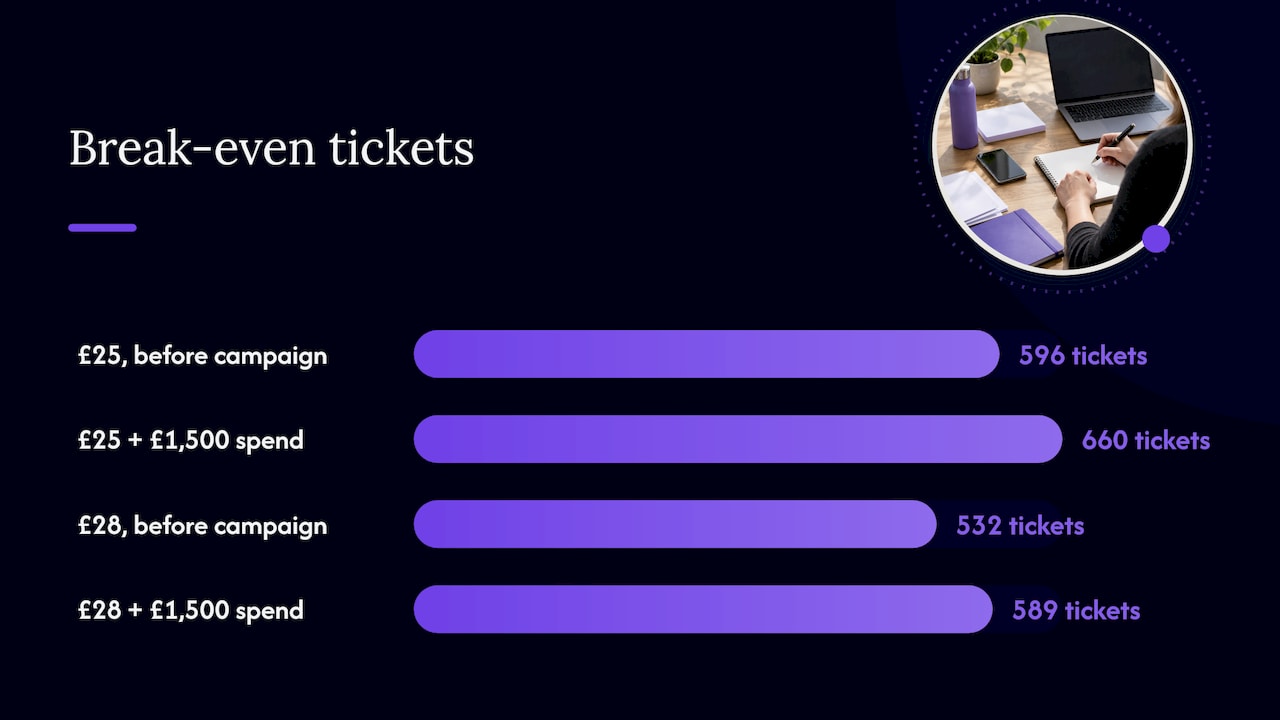
Continuing the hypothetical example: add £1,500 of campaign spend to the £14,000 of fixed costs and the total becomes £15,500. At £25 per ticket and £23.50 net, break-even rises from 596 to 660 tickets, which is 82.5% of the room. At £28, it is 589 tickets, or 73.6%. Marketing spend is only worth it if it brings in more tickets than it adds to the target, so compare cost per ticket sold with your net revenue per ticket.
Two practical rules:
- Cap spend per date at what the date’s margin can carry, and review it at each checkpoint.
- Model three scenarios (cautious, expected, strong) for sell-through, and decide in advance what you will do if a date lands in the cautious case.
AI forecasting tools can help with scenarios in general: they can fit a sales curve to your past on-sales and project where a date will land. Their output depends on the quality of your history and says nothing certain about a new act. Treat a forecast as a prompt to check your numbers, and validate it against the sales you actually see at 24 hours and 72 hours.
Sell the tour on Lookport Ticketing
Lookport Ticketing is a ticketing platform for concert promoters, event organisers and venues. It charges a 6% commission, with no other Lookport charges (see the pricing page), and ticket proceeds go directly into your own Stripe account. Availability follows Stripe-supported countries.
That 6% is the figure to enter in your budget model, so your break-even matches what the platform actually deducts. The platform’s current features are described on the Ticketing page, and the guide on how to choose a ticketing platform sets out the criteria that matter for a tour.
FAQ
How far in advance should a tour be announced?
It depends on the act. Published guidance ranges from around three to six weeks for smaller acts to many months for major tours and festivals. Start from your break-even and your local calendar, then choose the window that gives you enough weeks to run all five phases.
Should I announce all dates at once?
Usually yes, with each city messaged separately. One announcement gives fans a single story and gives you one funnel to measure. If a date is not confirmed, leave it out rather than announce it twice.
What should I do in the first 48 hours?
Watch presale and early on-sale sales against the targets you wrote down for each date. Check which tagged channel is producing tickets, and send city-specific follow-ups where a date is behind.
How much should I spend on marketing a tour?
Set it per date from the margin. Add the spend to your fixed costs, recalculate break-even and compare cost per ticket sold with your net revenue per ticket. Use the tour break-even calculator to see the effect before you commit.
Sources
- Strategic Concert Announcements: Timing for Ticket Success
- Event Marketing Whitepaper | TSE Entertainment
- The anatomy of a tour announcement | GLOENTMGMT
- How to Promote a Concert: The Complete Playbook
- Spotify Canvas & Lyric Video Guide (2026 Specs and Tips)
Recommended
Ticketing & event budgeting
 2026-11-22
Multi-Currency Ticketing: A UK Promoter's Guide to Fees and FX
How multi-currency ticketing works for UK promoters: settlement currencies, card and conversion fees, refunds, and a worked example to budget it before you sell.
 2026-11-20
Last-Minute Ticket Sales Tactics for UK Promoters
A practical plan for the final weeks before a show: diagnose slow sales, work out your break-even gap, target the right audiences and stay within UK pricing rules.
 2026-11-19
Secondary Market Monitoring for UK Promoters
What secondary market monitoring means for UK promoters: which resale signals to watch, what they tell you about demand, and how to act on them within the rules.
 2026-11-18
Marketing Budget Allocation for Concerts: A UK Promoter's Guide
Set a concert marketing budget from gross potential and ticket margin, split it by sales phase and channel, and know when to move money. UK worked example.
 2026-11-17
Ticket On-Sale Timeline: A Planning Schedule for UK Promoters
Plan your ticket on-sale timeline: announcement, presale, general sale and final push, with a week-by-week schedule and a worked example for UK promoters.
 2026-11-16
AI for Event Marketing: A UK Promoter's Practical Guide
How UK promoters can use AI for event marketing: audience segments, demand forecasts, copy, chatbots and measurement, with ICO rules and a worked budget example.