LOOKPORT / TICKETING & EVENT BUDGETING
Ticket On-Sale Timeline: A Planning Schedule for UK Promoters
Plan your ticket on-sale timeline: announcement, presale, general sale and final push, with a week-by-week schedule and a worked example for UK promoters.

A workable on-sale timeline has five stages: announce, presale, general sale, maintain and close. For most UK concerts, work backwards from show night and start selling roughly three months out, then fix every date in your budget before you announce. In a Prestige analysis of five UK stadium boxing fights, general sale opened between 7.5 and 19 weeks before the event, with a median of about 11.5 weeks. Your own range depends on capacity, artist demand and how much marketing you can fund. We built the Lookport ticketing platform and the tour break-even calculator so promoters can test that plan against real costs before a single ticket goes live.
This guide gives you the schedule, the decisions behind each stage, a labelled hypothetical example and the checks that keep the timeline honest.
TL;DR
- Work backwards from show date. Set the announcement, presale, general sale and price-change dates before you publish anything.
- Allow about 10 to 14 weeks of selling for a typical UK concert, and longer for festivals or touring shows with a big marketing build.
- Create dated moments (presale, general sale, price step, final push) because buyers rarely move without a reason.
- Show the total price from the first screen. UK rules now treat compulsory fees as part of the price.
- Test the plan in a break-even model first, so a slow first month shows up as a decision, not a surprise.
Table of Contents
- The five stages of an on-sale timeline
- How far ahead to put tickets on sale
- Why the middle of the timeline needs moments
- Stage by stage: what to decide
- Pricing steps inside the timeline
- A worked example (hypothetical)
- Build the timeline in six steps
- Common timeline mistakes
- Where Lookport fits
- FAQ
- Your next step
- Sources
The five stages of an on-sale timeline
Every ticketed show moves through the same stages. The length of each one changes. The order does not.
- Announcement. You publish the date, venue and artist, and open a way for fans to register interest.
- Presale. A limited group gets early access: a mailing list, a fan club, venue members or a partner audience.
- General sale. Tickets open to everyone at a fixed, published time.
- Maintenance. The long middle, where you keep sales moving with news, support acts, price steps and reminders.
- Closing. The final fortnight: last-chance messaging, capacity checks and the decision on door sales.
A TSE ticketing guide describes the same five-stage cycle and suggests events with a good ticketing strategy usually allow a minimum of three months between the first sale and the event date. Treat that as a planning baseline, not a rule. A 300-capacity club night with a loyal list can sell in far less. A 5,000-capacity show by a developing act usually needs the full runway.
How far ahead to put tickets on sale
Start from two numbers: how many tickets you need to sell and how fast similar shows have sold for you. Then work out the earliest date you can afford to announce and the latest date at which you can still recover a slow start.
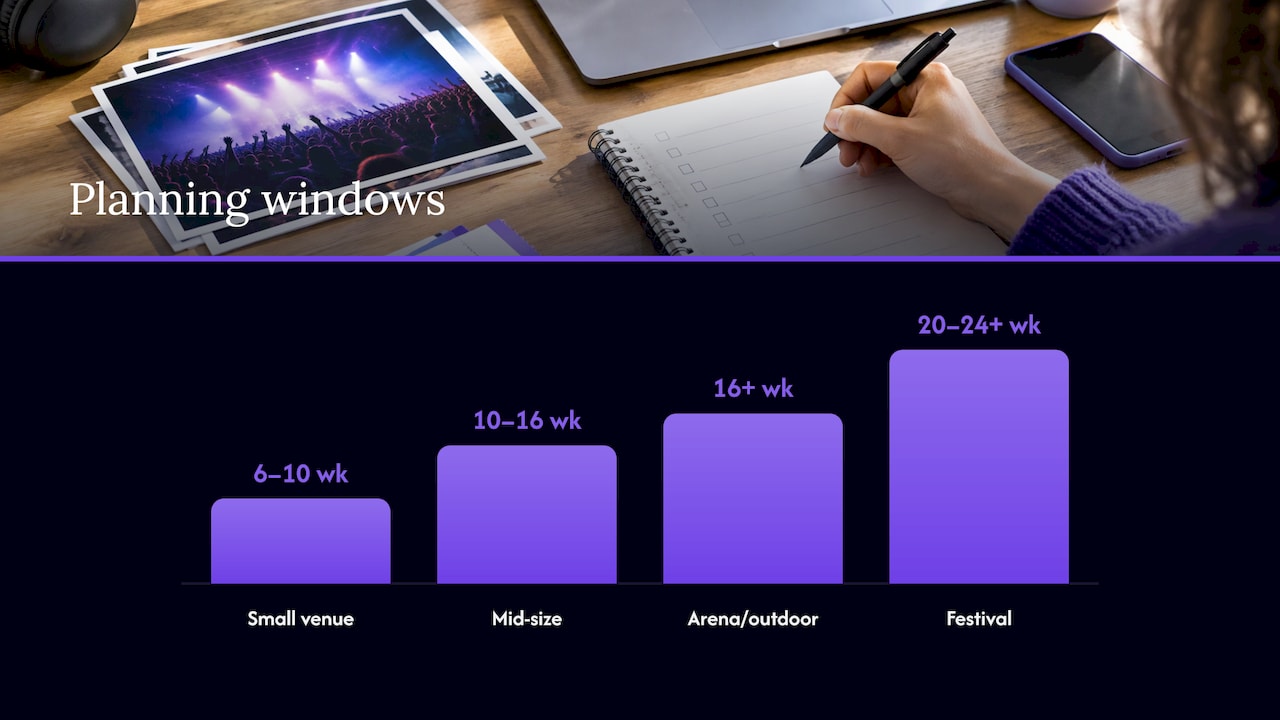
The published ranges are wide. The Prestige analysis above covers stadium boxing, not concerts, so use it as evidence that big events commit to a long window rather than as your target. The same analysis found tickets went on general sale within two to fourteen days of the date and venue being named. That is a useful pattern: the gap between announcement and general sale is short, and the long period is the sales run after it.
For most UK concerts, use this as a starting frame:
| Show size | Typical planning window | Notes |
|---|---|---|
| Small venue, established act | 6 to 10 weeks | Strong mailing list can carry the first week |
| Mid-size venue or theatre | 10 to 16 weeks | Presale plus a press moment |
| Arena or outdoor | 16 weeks or more | Needs staged price steps and repeated news |
| Festival | 20 to 24 weeks or more | Full line-up moments and tiered tickets |
These bands are planning heuristics for budgeting, not published benchmarks. Replace them with your own history as soon as you have it. If you have run the venue before, your previous sales curve is better evidence than any guide. Our article on the concert sales curve shows how UK tickets typically sell over time and how to plan for it.
Why the middle of the timeline needs moments
The sales curve for most live events is lopsided. A burst of sales follows the announcement and general sale, a long quiet period follows, and demand picks up again near the date. A music festival marketing guide from Gupta Media, citing Tally data, reports an average on-sale-to-event cycle of 163 days for festivals and says most buyers feel no urgency unless they think the event will sell out or the price will rise. That is a US-based source about festivals, so use it for the principle rather than the number.
The practical conclusion is to give buyers dated reasons to act. Good ones are real ones:
- A presale with a clear closing time.
- A general sale at a fixed hour.
- A scheduled price step, published in advance.
- A support-act announcement or a new date.
- A final-fortnight reminder with a genuine capacity update.
Place these in the timeline on purpose. If you leave the middle of the run to chance, you will usually discover the slump in week five, when the cost of fixing it is highest.
Stage by stage: what to decide
Announcement
Decide three things before publishing: the general sale time, the presale audiences and the ticket tiers. Announce the show with a way to register interest, so you build a list you own for the presale.
Check that the announcement and the on-sale point to the same page. If fans can see the date but cannot see how or when to buy, you lose the interest the announcement creates.
Presale
Presales reward people who already know your event: a mailing list, a fan club, a venue’s members. Keep the window short, often 24 to 72 hours, and tell each audience exactly when theirs opens and closes.
Presale also tells you something. Early sales show how strong demand is before you commit to marketing spend. Our guide to presale velocity in the first 48 hours explains how to read those first sales and use them when setting prices.
General sale
Fix the time and publish it in the announcement. Morning on-sales are common in the UK, and 10am is the usual convention. Choose a time that your own audience can reach, not one copied from a stadium tour.
Launch day is also the day automated buying causes the most trouble. If your show is likely to draw heavy demand, plan queue and bot protection before the day. See anti-bot ticketing for UK promoters.
Maintenance
This is the stage most plans leave blank. Write a content calendar against the sales calendar: one dated moment every two to three weeks, each with a specific message and a specific audience. Link your marketing activity to ticket sales so you can see what each push produced; our page on marketing integrations describes how Lookport connects with marketing tools.
Closing
Decide in advance when online sales end and whether you will sell at the door. Set a review date at least two weeks before the show to compare sales against the plan, confirm capacity (including any kills or holds) and agree the final marketing push.
Pricing steps inside the timeline
Price steps are among the most effective dated moments, and also the riskiest. A published schedule is simple and defensible: for example, a first release at one price, a second at a higher price once an allocation sells, and a final tier for the last weeks. Dynamic pricing can adjust prices in response to demand, but you should treat it as a policy decision, not a switch.
The UK government has been clear that it expects live events businesses to take the Competition and Markets Authority’s (CMA) dynamic pricing findings seriously. Its response to the call for evidence on pricing practices in the live events sector refers to the CMA’s published guidance and notes concerns about releasing a small tranche at a low advertised price before moving quickly to higher tiers. In practice that means:
- Publish your tiers and the rule for moving between them.
- Do not advertise a headline price that few buyers can actually get.
- Show the total price, including any booking fee that every buyer must pay, from the first screen.
For the fee side, read our guides on UK ticket fee strategy and all-in ticket pricing. For capacity-specific price points, see pricing by venue size. If you want to understand how demand-based pricing works on the platform, see dynamic ticket pricing.
A worked example (hypothetical)
The figures below are invented to show the method. They are not Lookport results and not a forecast for any real show.
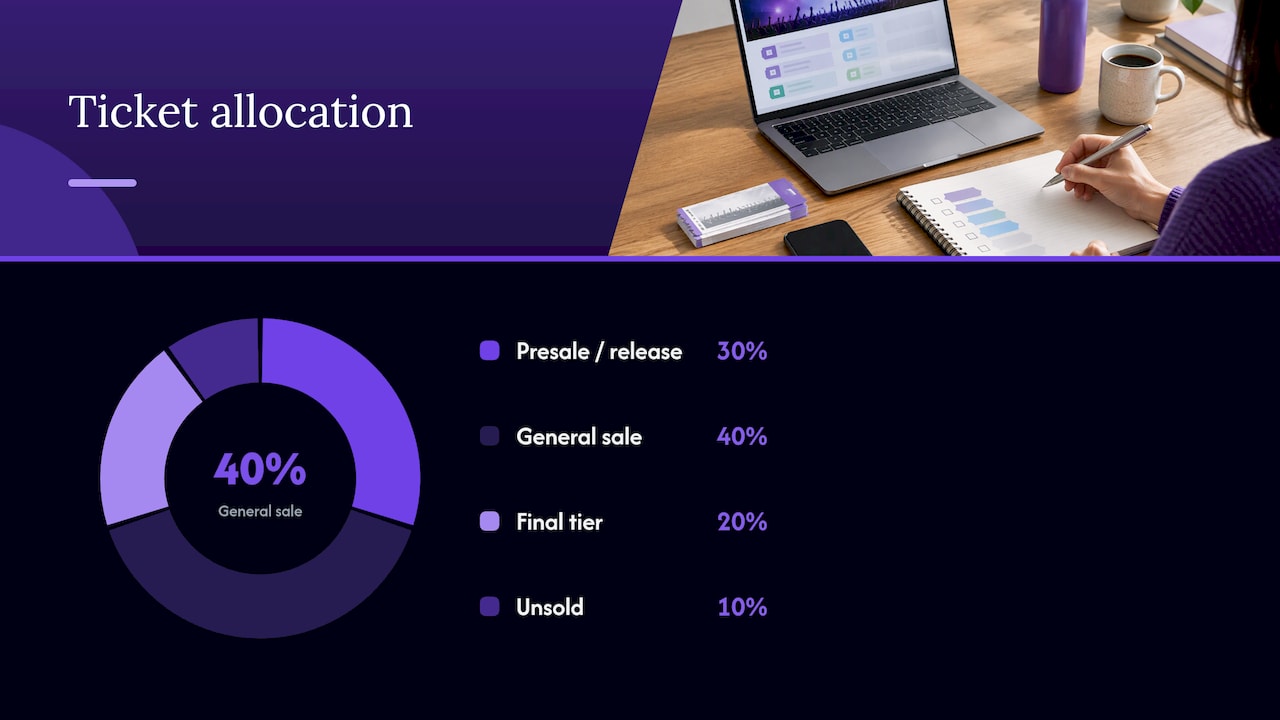
A promoter plans a 1,200-capacity evening show for 20 weeks from today. They set a first-tier price of £28, a second tier of £32 and a final tier of £35. They assume the following split of sales, which they would replace with their own history:
| Phase | Weeks before show | Share of tickets | Tickets | Price | Revenue |
|---|---|---|---|---|---|
| Presale and first release | 14 to 12 | 30% | 360 | £28 | £10,080 |
| General sale, second tier | 12 to 4 | 40% | 480 | £32 | £15,360 |
| Final tier | 4 to 0 | 20% | 240 | £35 | £8,400 |
| Unsold | 10% | 120 | £0 |
Total ticket revenue is £33,840 from 1,080 tickets. At Lookport’s 6% commission, ticketing commission would be £2,030.40. Suppose the show’s costs (artist fee, venue hire, production, marketing, insurance) total £27,500. The result before tax would be about £4,309.60.
Now move the timeline. If the second tier sells slower and only half of the 480 tickets go at £32 before the final tier opens, the remaining sales slide into the final window or go unsold. Run that scenario in advance and you see where the break-even point moves, and you can decide your trigger date for extra marketing spend before you commit to deposits. The AI ticket forecasts for UK promoters article walks through three budget cases of this type.
Build the timeline in six steps
- Set the target. Capacity, ticket tiers and the sell-through you need to break even.
- Fix show night and work backwards. Place the general sale first, then presale, then announcement.
- Assign the sales curve. Split your target across the phases using your own past shows. Label every assumption.
- Schedule the moments. One dated, specific reason to buy per phase, plus the price step dates.
- Set review triggers. Pick the dates and sales figures at which you act: extra marketing, a support act, a revised tier or a cut to costs.
- Check against costs. Put the timeline into your break-even model so that every trigger has a financial meaning.
The weak point is step 3. A promoter with no history tends to copy someone else’s curve, usually from a bigger event. Keep your curve cautious, and update it with real sales each week.
Common timeline mistakes
- Announcing before dates are fixed. Changing the on-sale after you announce it costs trust.
- No presale audience. Without a list, general sale carries the whole launch.
- Opening and closing every ticket type together. You lose the pull of tiers and the signal they give.
- Leaving the middle empty. No scheduled moments between week two and the final fortnight.
- Hiding fees until checkout. This costs conversions and now carries regulatory risk, as the government material above sets out.
- No review date. Waiting until the last two weeks leaves little room to act.
Where Lookport fits
A timeline only works if you can see sales against it and keep what you earn. Lookport charges 6% commission with no other Lookport charges, and ticket proceeds go directly into your own Stripe account. Availability follows the countries Stripe supports. You can set up your event on Lookport Ticketing and see the commission on the pricing page. Our guide on how to choose a ticketing platform lists the questions worth asking before you commit.
If you run tours, tour management brings multi-date planning into one place, and custom branding keeps the buying page consistent with your event.
FAQ
How long before a concert should tickets go on sale?
For most UK concerts, roughly 10 to 16 weeks before the show is a sound planning window, with longer for arenas and festivals. A small show with a strong mailing list can sell in less. Use your own past sales to set the final figure.
What time should general sale start?
10am is the most common convention in the UK, but the right time is the one your audience can reach. Publish it with the announcement, and use the same time for every show in a run so fans learn the pattern.
How long should a presale last?
A presale of 24 to 72 hours works for most promoters. It is long enough for the audience to act and short enough to keep urgency. State the opening and closing time for each presale group.
When should ticket sales close?
Set this before you announce. Many promoters keep online sales open until shortly before doors and decide on door sales based on remaining capacity. Review sales two weeks out and agree the closing rule then.
Should ticket prices change during the on-sale?
They can, if the tiers and the rules for moving between them are published and the total price is clear from the start. The government response linked above refers to CMA guidance on dynamic pricing, so check that before you set a schedule.
Your next step
Put your dates and expected sales into the tour break-even calculator. Model a fast, an expected and a slow sales curve, and fix your review triggers from the results.
Sources
- Prestige: How Big Fight Tickets Go On Sale
- TSE: Strategies to Sell More Tickets for Entertainment Events
- Gupta Media: Music Festival Marketing Guide 2025
- GOV.UK: Government response to the call for evidence on pricing practices in the live events sector
Recommended
Ticketing & event budgeting
 2026-11-22
Multi-Currency Ticketing: A UK Promoter's Guide to Fees and FX
How multi-currency ticketing works for UK promoters: settlement currencies, card and conversion fees, refunds, and a worked example to budget it before you sell.
 2026-11-21
Tour Announcement Strategy: A UK Promoter's Plan
Plan a tour announcement from break-even to on-sale: lead times, sequence, channels, first-48-hour measures and budget, with a worked UK example.
 2026-11-20
Last-Minute Ticket Sales Tactics for UK Promoters
A practical plan for the final weeks before a show: diagnose slow sales, work out your break-even gap, target the right audiences and stay within UK pricing rules.
 2026-11-19
Secondary Market Monitoring for UK Promoters
What secondary market monitoring means for UK promoters: which resale signals to watch, what they tell you about demand, and how to act on them within the rules.
 2026-11-18
Marketing Budget Allocation for Concerts: A UK Promoter's Guide
Set a concert marketing budget from gross potential and ticket margin, split it by sales phase and channel, and know when to move money. UK worked example.
 2026-11-16
AI for Event Marketing: A UK Promoter's Practical Guide
How UK promoters can use AI for event marketing: audience segments, demand forecasts, copy, chatbots and measurement, with ICO rules and a worked budget example.