LOOKPORT / TICKETING & EVENT BUDGETING
VIP Upsell Strategy: 5 Tactics for UK Promoters to Drive Repeat Sales
Turn regular ticket buyers into VIPs with five practical tactics for UK promoters, from presale timing and pricing to loyalty, KPIs, and ticketing tools.
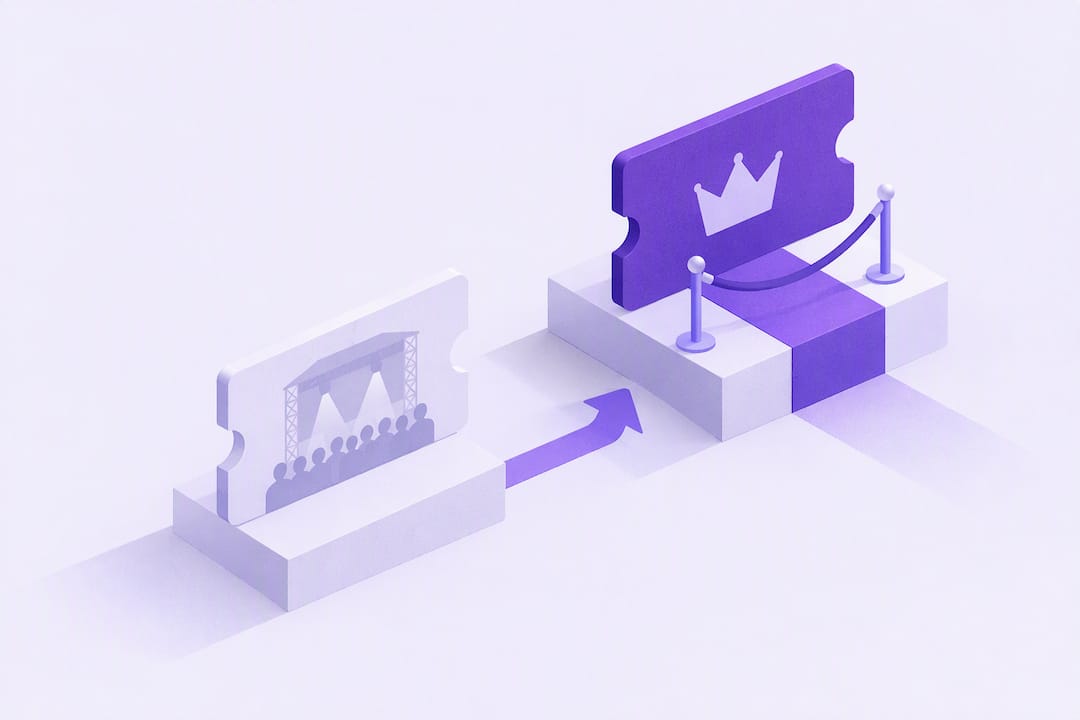
A VIP upsell strategy converts regular buyers into higher value members by packaging exclusive access and meaningful perks that raise repeat purchases and average order value. The approach works best when perks match what a specific audience segment actually wants rather than a generic discount, and when the offer is timed to the moments a buyer is most engaged, such as presale or just after checkout.
TL;DR:
- Start with an entry tier priced near standard tickets, then target upgrade offers using recency, frequency, and spending patterns rather than a blanket promotion.
- Test a post purchase offer before building a presale campaign, and use a comparable holdout group to measure added spending per buyer.
- Confirm promised perks within 24 hours, deliver an early benefit within 14 days, and check fulfillment before the event to support renewals.
- For UK email or text marketing, obtain prior consent unless a qualifying soft opt in applies, record permission, and provide a way to opt out.
- Show the standard ticket price beside the VIP premium, then test fixed, percentage, and bundled pricing against both purchase and perk redemption rates.
Table of Contents
- Why VIP upsells outperform discounts and generic loyalty points
- Key tactics to convert regular customers into VIPs
- Designing VIP packages and pricing that convert
- Turning a VIP purchase into loyal behaviour
- Measuring VIP upsell success: the KPIs that matter
- Practical upsell examples mapped to ticketing tools
- Staying compliant when promoting VIP offers in the UK
- How we help promoters put VIP upsells into practice
- FAQ
- Sources
Why VIP upsells outperform discounts and generic loyalty points
VIP upsells work because they tap into behavioural triggers that discounts rarely touch. Scarcity and fear of missing out push a buyer to act now rather than wait. Reciprocity (the sense of being given something extra) builds goodwill that a straight percentage off does not. Status, the feeling of belonging to a smaller group with better access, keeps people coming back long after the initial purchase.
Research on search and repurchase behaviour backs this distinction up. A study published in Management Science found that price discounts discourage further search in the current buying period, while reward based programmes encourage repeat visits and give a firm more prominence on a customer’s next visit. For promoters, that means a one-off discount might close a single sale, but a VIP tier with ongoing perks is what brings someone back for the next tour date.
- Scarcity and limited access create urgency that a flat discount cannot replicate.
- Reciprocity from unexpected perks builds goodwill that compounds over repeat purchases.
- Status and belonging keep high-value customers engaged between events.
Firms with smaller fan bases often need to offer proportionally higher-value rewards to compete with larger networks for repeat attention, according to the same Management Science research. That is a useful prioritisation rule: spend your upsell budget on the segment most likely to return, not on everyone equally.
Key tactics to convert regular customers into VIPs
The tactics below are ordered roughly by how quickly they tend to pay off, though the right order for you depends on your data maturity and existing fanbase size.
- Build a tiered ladder with an easy entry point. A low-cost first tier (early access only, no extra cost) gets people into the habit of choosing VIP before you ask for a bigger spend.
- Use trigger-based personalisation. Segment by recency, frequency and monetary value (RFM) and send the VIP offer only to people whose purchase pattern suggests they are close to upgrading.
- Lead with scarcity in presale windows. Early-access presale slots paired with a capped hospitality add-on create urgency without needing a price cut. Our presale pricing guide covers how pacing data in the first 48 hours can inform this timing.
- Bundle hospitality and seat upgrades together. A seat upgrade on its own is a transaction; paired with a merchandise bundle or lounge access it becomes an experience worth paying more for. Our cross-sell add-on ideas go into specific pairings that work for ticketed events.
- Place offers at the cart and post-purchase stage, using effective musician email marketing techniques to reach buyers while they are most engaged. A buyer who has already committed to one ticket is a warm audience for a VIP add-on shown immediately after checkout, before they leave the page.
Every tactic that relies on email or SMS needs to respect consent rules. Under PECR regulation 22, electronic direct marketing generally requires prior consent unless a qualifying soft opt-in applies, such as when the buyer purchased a similar product recently and was given a clear opportunity to object.
Pro Tip: Test your VIP offer as a post-purchase upsell before building a full presale campaign. It needs no new audience and tells you quickly whether the perk mix is right.
Designing VIP packages and pricing that convert
Package design starts with data, not guesswork. Look at what past VIP buyers actually used (early entry, meet-and-greet, merchandise bundle) rather than what seems impressive on paper. A perk nobody redeems is wasted margin.
- Anchor the VIP price against a visible standard ticket price so the premium feels proportionate, not arbitrary.
- Offer an entry-level VIP tier priced close to standard tickets to normalise the upgrade decision before introducing a higher tier.
- Run three simple pricing experiments: a fixed premium over face value, a percentage premium, and a bundled flat price, then compare take-rate and redemption rate across each.
- Read results by take-rate first and refund or complaint rate second. A high take-rate with high complaints usually means the perks were oversold.
Transparency matters more than it might seem. Research on hospitality package perception found that many VIP bundles are seen as poor value when the included perks do not match what buyers actually wanted, and that disclosing the face value within a bundle improves trust, according to a 2025 study on VIP hospitality perceptions. Showing the standard ticket price alongside the VIP premium, rather than burying it in a single bundled figure, reduces the chance a buyer feels misled after the event. Our tiered pricing guidance walks through how to structure these tiers while staying compliant with UK pricing transparency expectations.
Turning a VIP purchase into loyal behaviour
The sale is only the start. What happens in the first fortnight after purchase decides whether a VIP buyer renews or quietly churns.
- Send a welcome sequence within 24 hours confirming exactly what the buyer gets and when they will get it.
- Deliver a quick win within the first 14 days, such as early access to a second presale or a small unexpected extra.
- Use a dedicated channel for VIP communications (a separate email segment or SMS list) so updates do not get lost among general announcements.
- Check every perk against a fulfilment list before the event: lounge access confirmed, merchandise allocated, upgraded seats assigned.
- Send a renewal nudge two to three weeks before the next relevant sale, reminding VIPs of what they valued last time.
Pro Tip: A fulfilment checklist matters more than the sales page copy. A VIP who does not receive a promised perk is far less likely to upgrade again.
Measuring VIP upsell success: the KPIs that matter
Track a short set of numbers rather than everything available. The core ones are conversion rate to VIP, VIP retention across events, incremental average order value compared with standard buyers, lifetime value uplift, and redemption rate on included perks.
- Conversion to VIP tells you whether the offer and its timing are working.
- Retention and redemption rate together tell you whether the perks delivered what was promised.
- Incremental AOV and lifetime value uplift tell you whether the upsell is actually profitable, not just popular.
To isolate incremental revenue, run a simple holdout: show the VIP offer to one segment and withhold it from a comparable segment for the same event, then compare spend per buyer. If take-rate is low, test the perk mix before touching price. If churn is high after one cycle, check fulfilment first and messaging second. Tokenised or tradable loyalty structures can widen participation among lower-spending customers but may also encourage buyers to delay purchases strategically, according to research in Manufacturing & Service Operations Management, which found traditional reward structures remain more profitable under many pricing strategies. That is a useful caution against over-engineering a points system when a straightforward tiered VIP offer would convert better.
Practical upsell examples mapped to ticketing tools
Two flows illustrate how the tactics above fit together in a real ticketing funnel. Figures below are illustrative only, not reported results.
- Presale VIP flow: open a 48-hour early-access window to past attendees, cap hospitality add-ons at a small fixed number, and use sales pacing data to decide whether to extend the window. Say a show has 2,000 standard tickets and 100 capped VIP hospitality slots: pacing data showing the VIP slots selling out in six hours signals demand for a second tier next time.
- Post-purchase upgrade flow: immediately after a standard ticket purchase, offer a seat upgrade bundled with a merchandise item at a single bundled price, shown once at checkout and once more by email 48 hours later if unclaimed.
- VIP ticket configuration and fulfilment tracking can run through our VIP ticketing feature, with discount codes and pacing data available in the same dashboard used for standard sales.
Promoters who want to model these flows against real costs can use the tour break-even calculator to see how a given VIP take-rate affects overall event profit before committing to the offer.
Staying compliant when promoting VIP offers in the UK
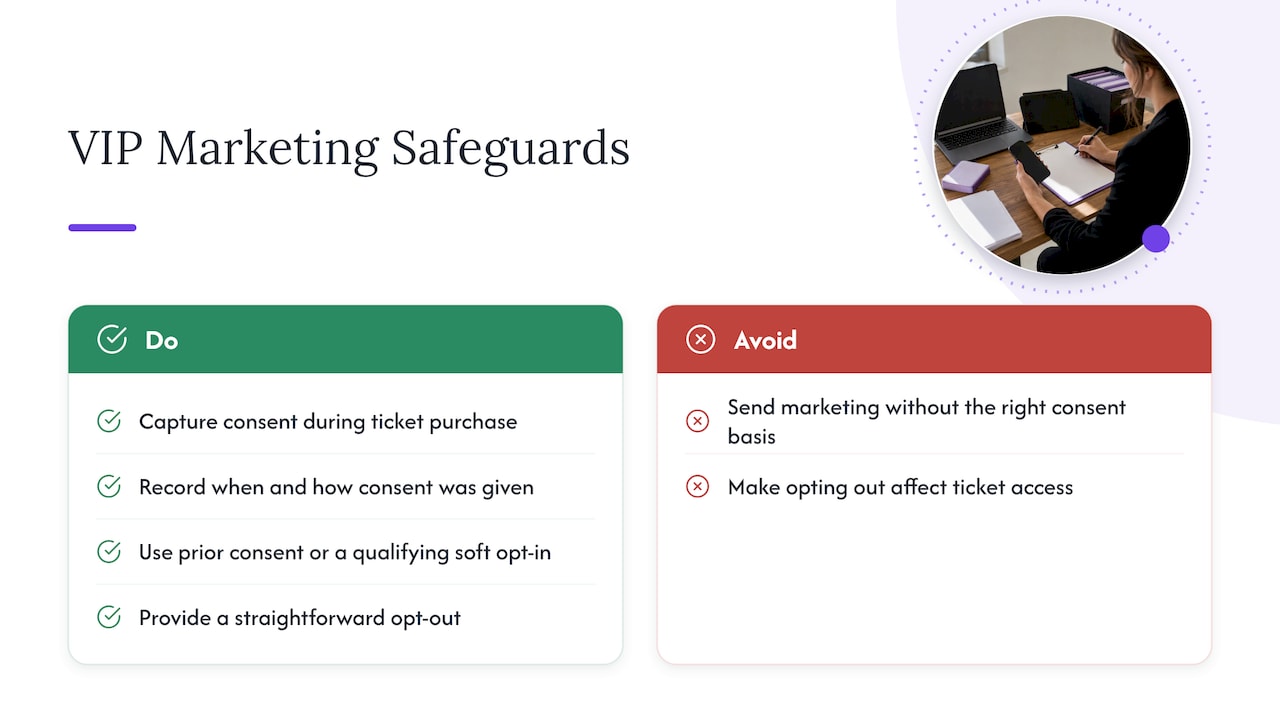
Running VIP upsells through email or SMS puts you squarely inside UK direct marketing rules. PECR regulation 22 restricts unsolicited electronic marketing, and in most cases you need prior consent from the recipient unless a soft opt-in applies, typically where someone bought a similar ticket from you recently and was given a clear chance to opt out at the time.
The Information Commissioner’s Office has been clear that marketing communications and the customer data behind them must be transparent and lawful under the Data Protection Act and PECR together. For a VIP upsell programme, that means keeping a record of how and when each contact consented, offering a straightforward way to opt out of VIP marketing without losing ticket access, and avoiding automated post-purchase messages that stray into marketing without the right consent basis. Practical guidance on structuring these journeys within PECR is set out in direct marketing guidance from Nottingham Trent University, which covers how post-purchase messages can tip into regulated marketing.
None of this stops you running a VIP programme. It means building consent capture into the ticket purchase flow itself, so the upgrade offer and the marketing permission are handled in the same step rather than as an afterthought.
How we help promoters put VIP upsells into practice
Our ticketing platform allows promoters to run VIP tiers alongside standard ticket sales without needing separate systems, with VIP ticket types, discount codes for presale windows, and sales pacing managed in the same dashboard, and ticket proceeds are paid directly into the organiser’s own Stripe account.
There is a flat 6% commission with no other platform charges, making the economics of a VIP tier straightforward to model before launch.
| Feature | What it supports |
|---|---|
| VIP ticketing | Configuring tiers, caps and fulfilment tracking |
| Discount codes | Presale and loyalty-driven VIP offers |
| AI sales pacing | Deciding when to extend or close a VIP window |
| Direct Stripe payouts | Proceeds go straight to your own account |
- Set up a VIP tier alongside standard tickets in the same ticketing flow.
- Model your VIP take-rate against event costs with the tour break-even calculator.
- Commission is charged as a flat percentage, with payouts handled through the organiser’s own Stripe account in supported countries.
If you are weighing up a VIP tier for your next show, start with our ticketing platform to see how the tiers and discount codes fit your lineup, or run a quick scenario through the break-even calculator first.
FAQ
What is the 3-3-3 rule in sales?
The 3-3-3 rule is not a formally defined industry standard, and definitions vary depending on the source. In practice it is sometimes used informally to describe pacing a sales conversation or follow-up sequence across three stages, but there is no single authoritative version worth treating as a rule for VIP upselling.
What are the main marketing strategies for VIP upsells?
The core strategies covered here are tiered packaging, trigger-based personalisation using RFM segmentation, scarcity-led presale offers, and bundled hospitality or upgrade add-ons. Each works best when matched to a specific customer segment rather than applied as a blanket offer.
What does “upselling” mean?
Upselling means offering a customer a higher-value version of what they are already buying, such as a premium seat, a bundle, or a VIP tier, rather than an entirely different product. A VIP upsell specifically packages exclusive access and perks around an existing ticket purchase.
What are effective sales techniques for VIP ticket upgrades?
Effective techniques include presenting the upgrade immediately after checkout while intent is high, using a capped early-access window to create urgency, and bundling a seat upgrade with a tangible extra like merchandise. Personalising the offer to a buyer’s past purchase pattern, rather than showing the same offer to everyone, tends to lift take-rate.
Does Lookport charge extra fees for VIP ticket features?
We charge a flat 6% commission with no other Lookport charges, and that applies the same way whether you are selling standard or VIP tickets. Ticket proceeds, including VIP tiers, go directly into your own Stripe account.
Sources
- Searching for rewards | Management Science
- The Privacy and Electronic Communications (EC Directive) Regulations 2003 — regulation 22
- Information Commissioner’s Office response to Ofgem call for evidence
Recommended
Ticketing & event budgeting
 2026-10-22
Ticketing Analytics for UK Promoters: What to Track and Why
Ticketing analytics for UK concert promoters: the metrics that drive decisions, how to set up tracking, and how to tie sales data back to your show budget.
 2026-10-21
Concert Break-Even Calculator: How Many Tickets You Must Sell
Work out how many tickets a UK concert needs to break even. Costs, PRS, ticket commission, a worked example and a free calculator for promoters and venues.
 2026-10-19
Ticket Sales Break-Even Analysis for UK Shows
Work out how many tickets you must sell to cover a UK show: VAT, PRS, fees, fixed costs and a worked example, plus a free break-even calculator.
 2026-10-18
Refund Policy for Concerts: What UK Promoters Must Offer
What UK law and industry rules require when a concert is cancelled, moved or the buyer changes their mind, plus how to write a clear refund policy.
 2026-10-15
Facebook Ads for UK Promoters: Track Ticket Sales Before Spend
UK promoters can set up Meta pixel and Conversions API tracking, choose audiences, estimate ticket costs, and link Facebook ad spend to ticket revenue.
 2026-10-14
Profit Margins: Test 10 P&L Lines for UK Concert Promoters
See how UK concert promoters can model profit per show with 10 P&L inputs, test sell through and costs, and check break even before committing a deposit.