LOOKPORT / TICKETING & EVENT BUDGETING
Event Postponement Policy in the UK: What Promoters Must Set Out
How to write an event postponement policy that fits UK consumer expectations: ticket validity, refund windows, notice, fees and a checklist for promoters.

A good event postponement policy answers five questions before a date ever moves: do tickets stay valid, can a buyer cancel, by when, what do they get back, and how will you tell them. In the UK, buyers from an official seller can generally claim a refund if the organiser cancels, moves or reschedules a show. Write your terms around that expectation. Then publish them at the point of sale.
This guide is for concert promoters, venues and show organisers. It covers what to put in the policy, how to handle notice and refunds, and how to budget for the cost of a move.
TL;DR
- Tickets normally stay valid for the new date, but buyers who cannot attend should be able to ask for a refund within a stated deadline.
- Under STAR rules, primary-seller buyers are entitled to at least face value back if an event is cancelled, and a face-value refund if they cannot attend a rescheduled date.
- Postponement terms are fairest when they name the circumstances, explain how buyers will be told and let them cancel without penalty.
- Publish your deadline, your fee treatment and your contact route before tickets go on sale. Do not invent them after the announcement.
- Model the cost of a move, including refunds from buyers who cannot attend, before you commit to a new date.
Table of Contents
- Postponement, rescheduling and cancellation: how they differ
- What buyers are entitled to
- What a postponement policy should say
- Fair terms and valid reasons for postponing
- What happens to tickets and refunds after a postponement
- How to notify ticket-holders
- Budgeting for a postponement
- Ticketing set up for the terms you publish
- Postponement policy checklist
- FAQ
- Next step
- Sources
Postponement, rescheduling and cancellation: how they differ
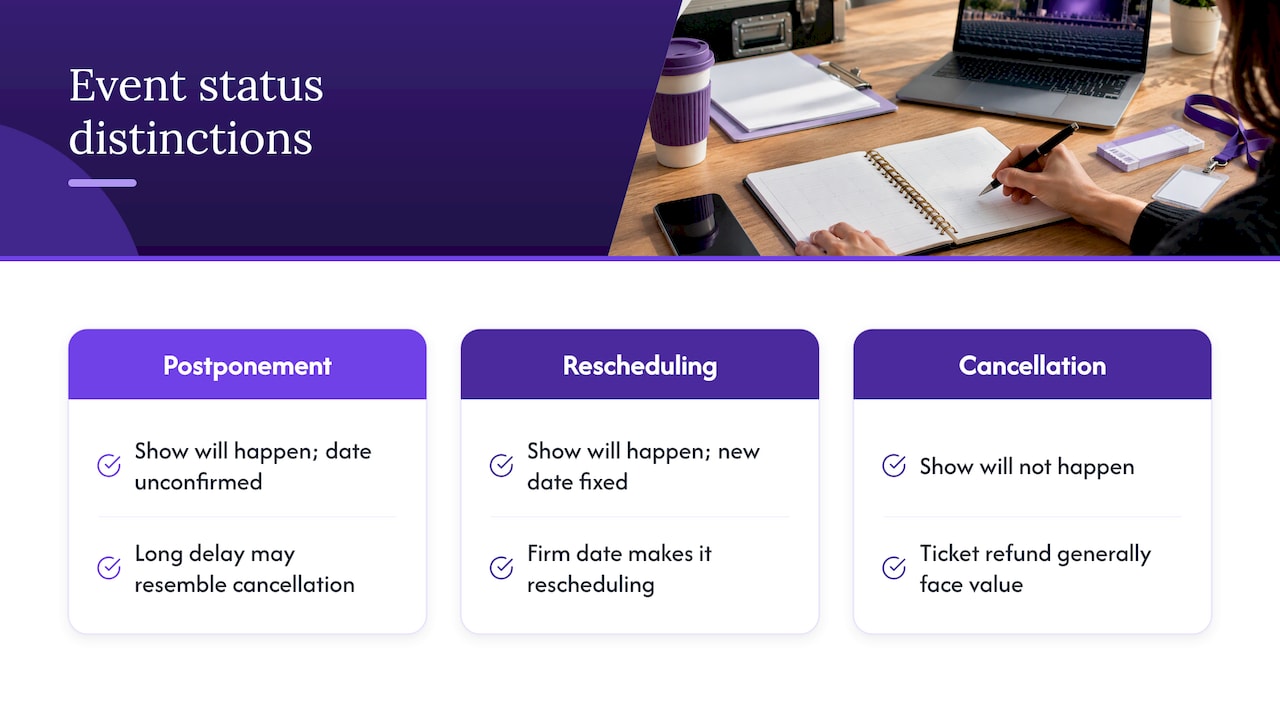
Three words get used loosely, and your policy should not. Postponement means the show will happen, date to be confirmed. Rescheduling means a new date is fixed. Cancellation means the show will not happen.
The distinction matters because buyers’ rights differ. If an event is cancelled, consumers are generally entitled to a refund of the ticket face value, though usually not to independent travel or accommodation costs, according to Citizens Advice. A postponement with no date is the grey area. The longer a buyer waits with no date, the more the arrangement looks like a cancellation in practice. Practitioner commentary on a postponed festival notes that a longer delay raises the risk that the event changes or that the buyer’s circumstances change, and that the buyer is out of pocket meanwhile (Practical Law).
A practical rule for your own policy: say that a postponement becomes a rescheduling as soon as you announce a firm date, and that you will treat an event as cancelled if you cannot announce one. State what you will do in that case. Do not leave it open.
What buyers are entitled to
Your terms sit on top of what UK buyers already expect, so know the baseline.
- Cancelled event: a refund of at least face value from a primary seller under STAR rules, as Which? explains.
- Rescheduled event the buyer cannot attend: a refund of the face value paid, or the discounted face value if the organiser reduced the price (Which?).
- Complaints route: buyers can use STAR’s complaints procedure if the ticket seller is a member (Citizens Advice).
- Change of mind: a buyer who simply no longer wants to go is not entitled to a refund, and that applies to a normal, unchanged event.
STAR’s published model terms for members describe refunds where an event is cancelled or rescheduled by the venue or promoter, or where there is a material change to the programme. They define a material change as one that, in the seller’s reasonable opinion, makes the event materially different from what buyers could reasonably expect (STAR model terms). That wording is a useful template for your own definition.
For the wider refund picture, including cancellations, see our guide to refund policy for concerts.
What a postponement policy should say
Write the policy as a short numbered list of commitments. Each one should be something a buyer can act on.
1. Ticket validity
State that tickets remain valid for the new date. This is common practice. De Montfort Hall’s FAQs say tickets for rescheduled or postponed performances stay valid for the new date unless the promoter specifies otherwise, and should be kept (De Montfort Hall). Liverpool FC’s major events terms say much the same, that tickets will usually be valid for the new date (Liverpool FC).
2. The refund request window
Give buyers a clear deadline to cancel and claim a refund. De Montfort Hall asks customers who cannot attend a revised date to request a refund at least 30 calendar days before it (De Montfort Hall). Liverpool FC’s terms leave the deadline to be specified in the postponement notice and treat no response within it as reconfirmation of the order (Liverpool FC).
These are two venues’ own terms, not a legal rule. Choose a window that suits your show, then publish it. A deadline that closes before the buyer has even had the notice will not hold up well, so start the clock from the date you notify, not from the date you decide.
3. Circumstances that trigger a postponement
Name them: artist illness, venue unavailability, severe weather, safety or licensing issues, travel disruption. A UK law firm advises that a postponement term is more likely to be fair if it is limited to clearly explained circumstances and customers are told when and how they are likely to be affected (Fladgate). A vague clause that lets you move the date for any reason is the one most likely to be challenged.
4. Notice and the right to cancel
The same advice says organisers should give notice and allow buyers to cancel before they are affected, without financial penalty (Fladgate). Build that into the policy: say how quickly you will notify buyers, through which channel, and what they can do next.
5. Fees and what is refunded
Decide how you treat booking fees and say so plainly. Practice varies. Liverpool FC’s terms say booking admin fees are non-refundable on a postponement cancellation (Liverpool FC). Fladgate’s view is that the safest and most compliant option is a full refund of all amounts paid, while retaining booking fees and postage may be justifiable (Fladgate). If you plan to keep any fee, show it before purchase, not after the announcement. Our ticket fee strategy guide covers how to present fees to UK buyers.
6. Credit and alternatives
You can offer credit notes or free entry to a later event as an option. Fladgate notes that these may help to retain loyalty and reduce complaints, but the safest route remains a full refund (Fladgate). Present credit as a choice alongside the refund. Never present it as a replacement for it.
Fair terms and valid reasons for postponing
Your contract with the buyer is the ticket terms. Write them so a buyer reading them at checkout understands what happens if the date moves. Three checks help.
- Is the trigger specific? “Artist illness or an issue outside our control” is clearer than “any reason”.
- Can the buyer exit? If the new date does not suit them, there is a route out with no penalty.
- Is the notice process stated? Buyers should know where the announcement will appear and how you will contact them.
Force majeure wording in your supplier and venue contracts is a separate matter. It governs what you owe artists, venues and suppliers, not what you owe ticket buyers. Ask your solicitor to check both sets of terms against each other, because a venue contract that lets the venue move a date can leave you facing refund requests you cannot pass on.
This is general guidance, not legal advice. For wording that fits your contracts, speak to a solicitor who works with live events.
What happens to tickets and refunds after a postponement
The flow after an announcement is the same for most shows: tickets roll to the new date, buyers who cannot attend are told how to claim, and you process refunds back to the original payment method. Small and amateur productions face this too. A youth theatre run such as The Addams Family production sells to audiences who plan around one date, so a clear rescheduling term matters as much there as it does for a large concert.
Keep a simple record for every postponement:
- the original date, the new date and the date of the notice;
- the refund deadline you gave;
- how many tickets were refunded and how many carried over;
- the fees you refunded or retained, and why.
If resale is part of your sales, also check how a date change interacts with the rules on reselling. Our secondary ticketing law guide covers the UK position.
How to notify ticket-holders
Speed and clarity count more than polish. Follow this order.
- Email every buyer first. Use the address on the order. State whether the event is postponed or cancelled, the new date if you have one, and the refund deadline.
- Update the event page and social channels within the same hour, so buyers who check there see the same message.
- Tell the venue and box office so staff give the same answer by phone.
- Send one reminder before the refund deadline closes, and a second message when the new date is confirmed.
- Give one contact route for refund questions and keep it staffed.
There is no single fixed number of days for announcing a postponement that we can point you to, so do not rely on one. The better measure is your own published policy: tell buyers as soon as you know, and let them cancel before they are affected.
Budgeting for a postponement
A postponement has a cost even when no refund is paid. You may carry deposits for a venue, artist and crew twice, extend marketing and lose some buyers who cannot make the new date. Plan for it before it happens.
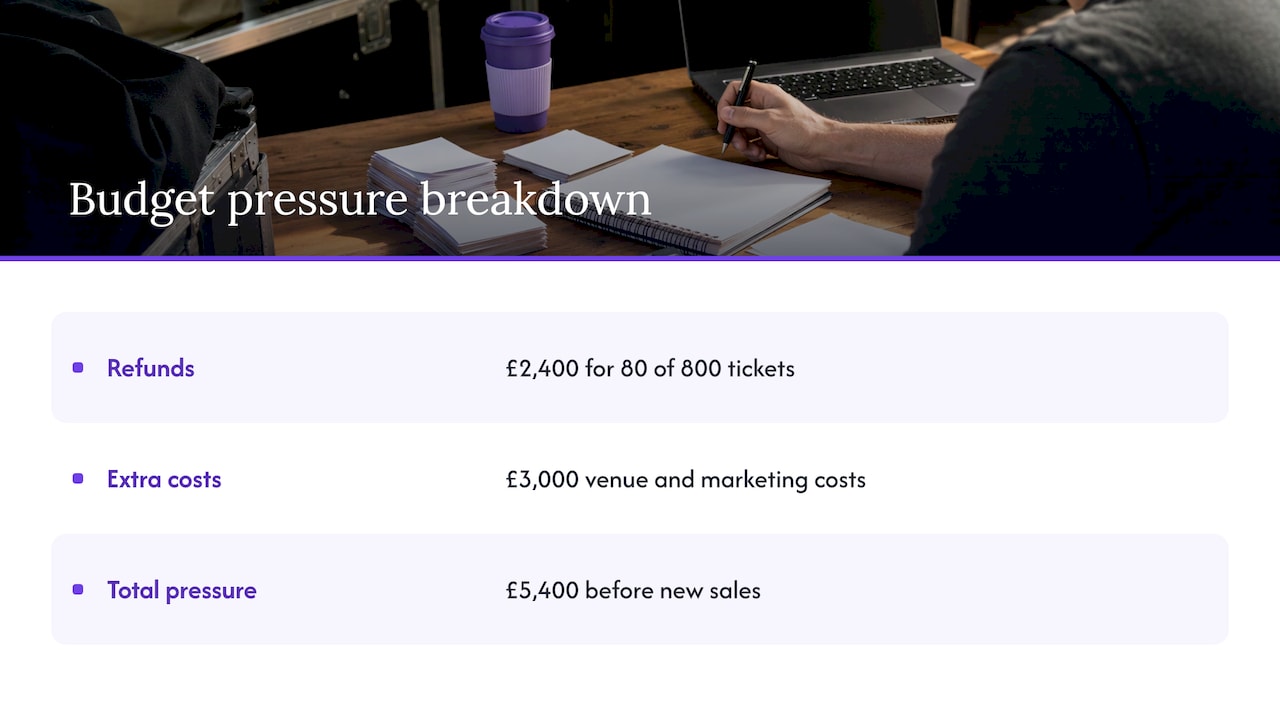
Here is a hypothetical example, for illustration only. Say a promoter sells 800 tickets at £30 and expects 10% of buyers to be unable to attend a new date. That is 80 tickets, or £2,400 of face value to refund. If the new date also adds £3,000 in extra venue and marketing costs, the total pressure on the budget is £5,400 before any new sales. Replace these numbers with your own.
To see how a lower sell-through changes your break-even point, use the tour break-even calculator. Enter your costs, ticket price and expected attendance, then change the attendance and refund assumptions. Our guide to ticket sales break-even analysis walks through the inputs. If you charge VAT on tickets, check the effect of refunds on your returns in our VAT on ticket sales guide.
Ticketing set up for the terms you publish
A postponement policy only works if buyers see it before they pay and you can act on it quickly. Lookport Ticketing is built for concert promoters, event organisers and venues. We charge a 6% commission with no other Lookport charges, and ticket proceeds go directly into your own Stripe account. Availability follows Stripe-supported countries.

If you sell online and in hybrid formats, see how online and hybrid ticketing works, and use the ticketing fee calculator to see what the commission means for your ticket price.
Postponement policy checklist
- Definitions of postponement, rescheduling and cancellation.
- The named circumstances that can trigger a move.
- Ticket validity for the new date.
- A refund request deadline, counted from the date of your notice.
- Treatment of booking fees, shown before purchase.
- Any credit or free-entry option, offered alongside the refund.
- How and where you will announce changes.
- One contact route for refund questions.
- A budget scenario for refunds and extra costs.
FAQ
Do tickets stay valid if an event is postponed?
Usually yes. Venues such as De Montfort Hall and Liverpool FC state in their terms that tickets carry over to the new date, unless the promoter says otherwise. Say it in your own terms so buyers do not have to guess.
Can a buyer get a refund if they cannot attend the new date?
With a primary seller covered by STAR rules, a buyer who cannot attend a rescheduled event is entitled to a refund of the face value paid. Set a clear deadline for requests and publish it in the postponement notice.
Can I keep the booking fee on a postponed event?
Some organisers do, and Fladgate considers it may be justifiable, but a full refund is the safest route. If you intend to retain fees, state that in your terms before purchase.
Can I offer a credit note instead of a refund?
You can offer it as an option, and some buyers will prefer it. It should sit alongside the refund, not replace it. Speak to a solicitor if you plan to make credit the only route.
Is there a fixed deadline for announcing a postponement?
We cannot point to a single fixed period. Publish your own commitment, tell buyers as soon as you know, and let them cancel before they are affected.
Next step
Before your next on-sale, put your postponement terms in writing and test the cost of a move in the tour break-even calculator. When you are ready to sell, set up your shows on Lookport Ticketing.
Sources
- Getting a refund on an event ticket, Citizens Advice
- How do I get a refund from a ticket seller?, Which?
- Covid-19 and sporting events, Fladgate
- FAQs, De Montfort Hall
- Major Events terms, Liverpool FC
- Consumer’s rights for a postponed event, Practical Law
- Model terms and conditions for STAR members
Recommended
Ticketing & event budgeting
 2026-11-04
Accessible Tickets Policy for UK Events: What to Include
How to write an accessible tickets policy for UK shows: legal duties, companion tickets, pricing, evidence checks and booking information, with sources.
 2026-11-03
Abandoned Cart Recovery for Events: A UK Promoter's Guide
How UK promoters can cut ticket checkout drop-off and win back buyers: fixing fees, timing reminders, staying within PECR and measuring recovered revenue.
 2026-11-02
AI Ticket Sales Forecasting for UK Concerts: A Practical Guide
How UK promoters can forecast concert ticket sales with AI: the data to gather, a simple workflow, how to check the forecast and how to turn it into a budget.
 2026-11-01
Pricing by Venue Size: How to Set Ticket Prices for Any Capacity
Set ticket prices by venue size: break-even price per capacity, tier splits, a price floor and UK all-in pricing rules, with worked examples in pounds.
 2026-10-31
Group Ticket Strategy: Offers and Waitlists That Fill Seats
How UK promoters can design group ticket offers and run an event waitlist that fills seats without cutting full-price sales, with worked numbers and legal checks.
 2026-10-29
Stripe Payouts in the UK: Timing, Instant Payouts and Cash Flow for Promoters
How Stripe payouts work for UK event organisers: first payout wait, schedules, Instant Payout fees and limits, and how to plan show cash flow around them.