LOOKPORT / TICKETING & EVENT BUDGETING
Post-Event Marketing for Promoters: A 30-Day Plan
A practical post-event marketing plan for UK concert promoters: what to send in the first 48 hours, which KPIs to track and how to link follow-up to sales.
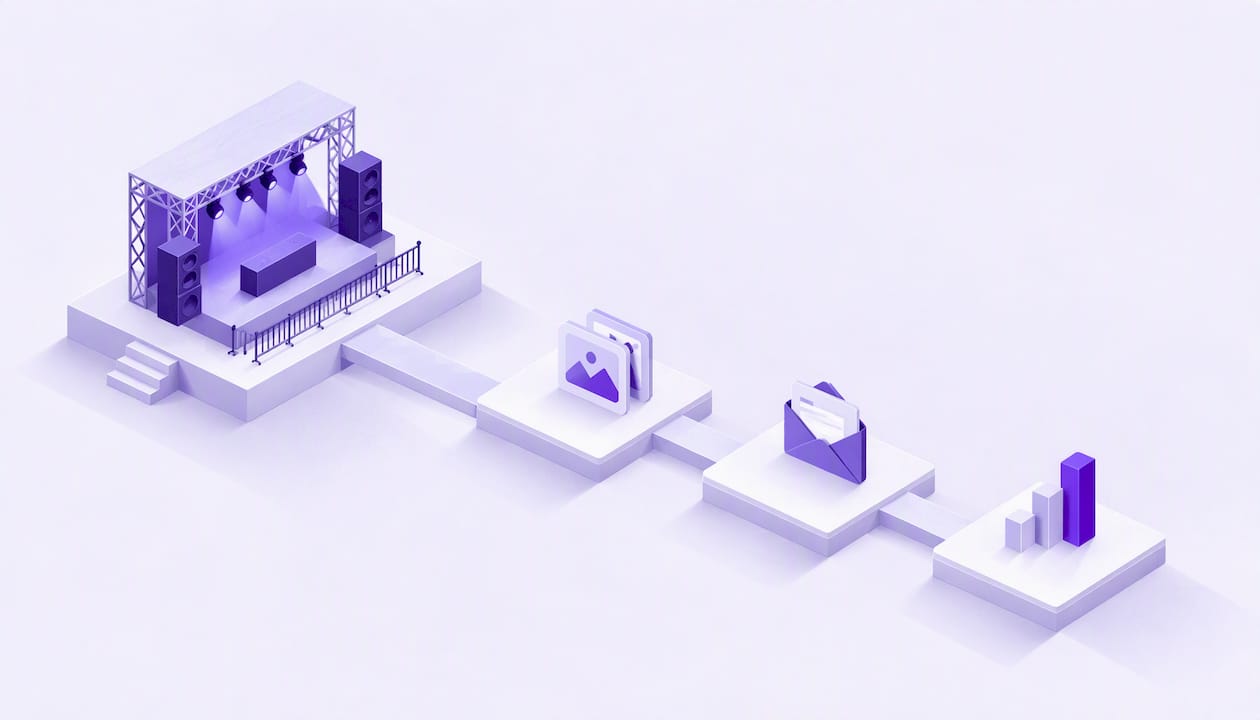
Post-event marketing is everything you do after the last act leaves the stage to keep the audience you have just earned. For a concert promoter, that means a prompt thank-you, separate follow-up for people who came and people who did not, reuse of your content, a short survey, and a clear read of what sold the next show. This guide gives you a 30-day plan, the KPIs worth tracking and a method for testing whether follow-up produced ticket sales.
TL;DR
- Send a thank-you within 48 hours, then a recap and survey in days 3 to 5, and hold your internal debrief around day 5.
- Split your list: ticket holders who attended, ticket holders who did not, and people who showed interest but never bought.
- Track tickets purchased, clicks and conversions, revenue, social reach and engagement, and survey feedback, and count takings by source.
- To prove follow-up led to sales, tag every link, give each segment its own tracking, and compare against a group you did not email.
- Feed the results into your next budget. Our tour break-even calculator helps you test the numbers.
Table of Contents
- What post-event marketing covers
- The first 48 hours
- Segment your follow-up
- Reuse your event content
- Collect feedback that you will use
- Which KPIs to track after the event
- Did post-event marketing lead to ticket sales?
- Turn results into your next budget
- Keep your data records usable
- How Lookport Ticketing supports the follow-up
- A 30-day post-event timeline
- Common mistakes
- FAQ
- Next step
- Sources
What post-event marketing covers
Post-event marketing is the set of campaigns and tactics that run after an event ends. Kampfire’s glossary lists follow-up communication, content repurposing, segmentation and nurturing, re-engagement and feedback collection as its parts. The same source separates it from post-event engagement, which is the two-way side: giving attendees a reason to respond, return and act.
For a promoter the practical goal is narrower than for a conference organiser. You are not closing deals. You want three outcomes:
- Attendees who feel looked after and buy again.
- Ticket holders who missed the night and still feel connected to the artist or venue.
- Evidence you can use to price, budget and market the next date.
The third outcome is the one most teams skip. A show that is over still holds your best data: who bought, when, from which channel and what they said afterwards.
The first 48 hours
Speed matters because the memory of the night is at its strongest straight afterwards. One 30-day post-event plan puts segmented follow-up inside 48 hours, the recap and survey in days 3 to 5, and the internal debrief on day 5. Treat that as a sensible working rhythm, not a rule, and adjust it to your own audience.
In the first two days, do these things:
- Send a thank-you email. Keep it short. Thank people, name the venue and artist, and add one link to a photo gallery or highlights page.
- Send a “sorry we missed you” note to ticket holders who did not attend. Check your scan data first so you do not thank someone who was not there.
- Publish a post-event page. Photos, a short recap and a link to your next on-sale or mailing list sign-up give every message somewhere to land. Our event landing page checklist covers what that page needs.
- Post on social media the same night or next morning. Tag the artist, support acts and venue.
- Confirm tracking is live. Every link you send should carry campaign tags so you can see what it produced.
If you promoted the show with paid social, check that your conversion events are firing before you build a follow-up campaign on them. Our guide to Meta Pixel events lists three checks to run first.
Segment your follow-up
One message to everyone wastes the data you hold. The same 30-day plan recommends different follow-up for different groups: session-relevant content for attendees and recordings or recaps with a reason to re-engage for registrants who did not attend. For concerts, translate that into three audiences.
| Segment | What they did | What to send | Goal |
|---|---|---|---|
| Attended | Bought and scanned in | Thank-you, photos, short survey, early access to the next date | Repeat purchase and feedback |
| Ticket holder, did not attend | Bought, no scan | Apology-free recap, highlights, next date alert | Keep the relationship warm |
| Interested, did not buy | Visited the page, joined a list or clicked an ad | Highlights, a reason to buy next time, mailing list invite | Convert on the next on-sale |
Keep each message to one job and one link. A thank-you that also pushes a ticket sale, a survey and a merchandise offer gets none of them done.
What to say to people who missed the night
Do not make them feel they missed out through fault of their own. Share what happened, point to the next date and offer the simplest way to hear first, such as a mailing list or an on-sale alert. If the artist is touring, link to other dates.
What to say to people who came
Thank them, show them the night they attended, and ask one question. Then, once the survey window has closed, send them an early notice of the next show. Our guide to audience analytics from the first 72 hours of sales shows how early buyer behaviour can help you decide who to contact first.
Reuse your event content
Content made for one night can work for weeks. Naylor’s guidance for associations suggests turning live experiences into short social clips, feature articles, on-demand sessions and infographics. It also notes that contributions from speakers, such as guest posts and follow-up interviews, can extend partnerships. For a concert, the equivalents are:
- Short vertical clips of the best moments, posted over the following fortnight rather than all at once.
- A photo gallery on your post-event page, credited to the photographer.
- A short interview or backstage piece with the artist or a support act, if they agree.
- A one-page “night in numbers” graphic, using only figures you can stand behind.
If you do not have footage to cut, ready-made assets can fill the gap. A marketplace of ready-to-edit music videos lets artists and teams generate short social clips and run campaigns around a release, which suits the weeks after a show when the next single or tour announcement is due.
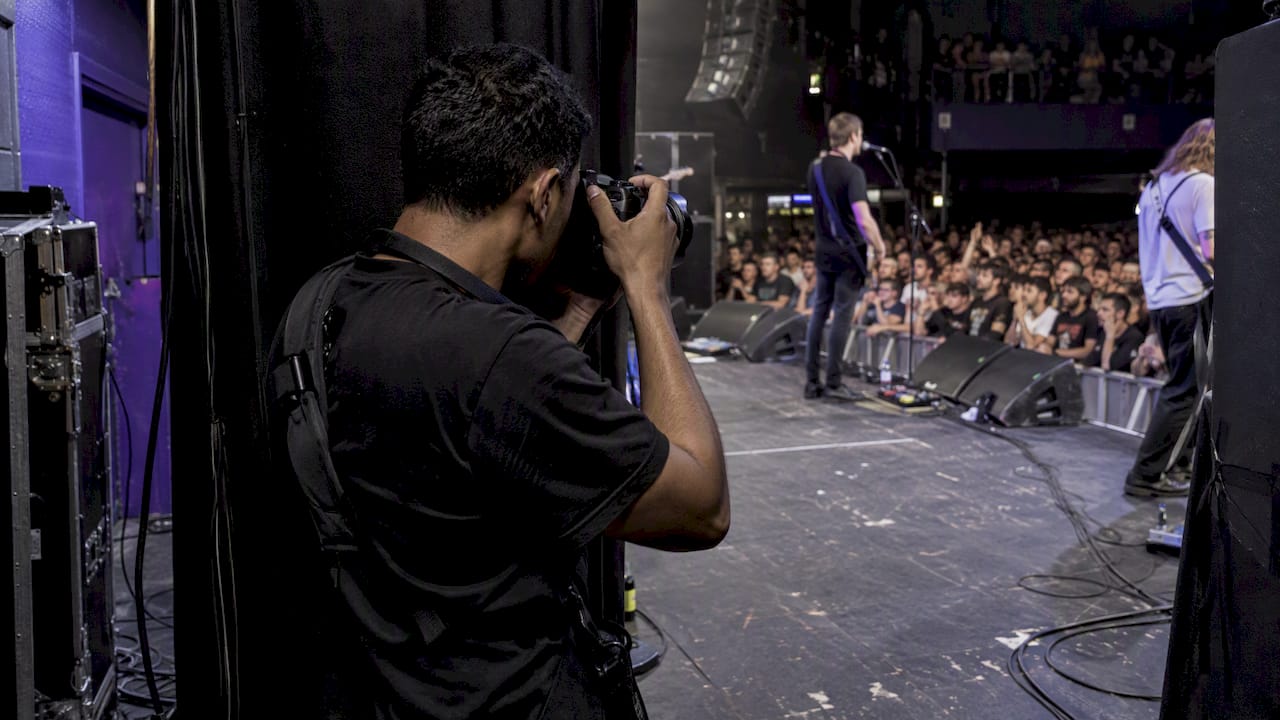
Photography deserves its own thought. Brief your photographer before the show on what you need afterwards: crowd shots, stage shots, detail shots, and clear usage rights for social media and print.
Collect feedback that you will use
Surveys are the most common post-event tactic and the most often wasted. Gala PR’s guide to post-event engagement treats thank-you messages, surveys and social posts as the core of staying visible and building loyalty, and recommends using survey feedback to spot strengths and weaknesses and refine future events.
For a better response and more useful answers:
- Ask five questions or fewer.
- Include one rating (the overall night) and one open question (what one thing would you change?).
- Ask about specifics you can act on: entry queues, sound, bar waits, sightlines, transport home.
- Add a question on how they heard about the show. It feeds your attribution work.
- Close the survey after about a week and tell people what you changed.
Read the open answers yourself, and tally them by theme. Twenty people mentioning the same queue is a finding. One person mentioning the lighting is an opinion.
Which KPIs to track after the event
Start with the numbers that map to money and reach. VisitScotland’s advice for event organisers recommends tracking tickets purchased, clicks or conversions from ads or posts, total revenue, social reach and engagement, and post-event survey feedback. That list is a solid base for a UK promoter, wherever the show takes place.
For attendance, the Audit Bureau of Circulations’ event attendance standard defines metrics including registrants, visitor attendance and repeat visits. Even if you never seek an audit, using clear definitions stops you comparing unlike figures between shows. Decide what “attended” means (scanned entry, for example) and keep it fixed.
A practical KPI set looks like this:
| KPI | Where it comes from | What it tells you |
|---|---|---|
| Tickets sold by channel | Ticketing reports | Which channels produced buyers |
| Attendance rate | Scans divided by tickets sold | How many ticket holders turned up |
| Email click-through rate | Email platform | Whether the follow-up content interested people |
| Conversions from follow-up | Tagged links and ticketing data | Whether follow-up led to purchases |
| Repeat buyers | Customer records across shows | Loyalty and the value of your list |
| Survey score and themes | Survey tool | What to fix before the next show |
| Revenue and cost per sale | Ticketing and spend records | Whether the campaign paid for itself |
For a deeper look at what to watch inside ticketing data, see our guide to ticketing analytics for UK promoters.
Did post-event marketing lead to ticket sales?
This is the question most promoters cannot answer, and no single source gives a standard method. What follows is a practical approach built on ordinary testing principles, not a published benchmark. Treat results as indicative, particularly with small audiences.
Step 1: Tag everything
Give every link in every follow-up message its own campaign tags: source, medium and campaign name, plus the segment. Without this, a ticket bought after an email looks like a direct visit.
Step 2: Use a holdout group
Before you send, set aside a random slice of one segment, for example 10%, and do not email them. After the on-sale for your next show, compare purchase rates between the group that received follow-up and the group that did not. The gap is a better estimate of what your emails achieved than counting clicks, because some of those people would have bought anyway.
Step 3: Compare cohorts across shows
Count the share of buyers for your next show who had bought for the previous one. Do it by segment: attended, ticket holder who did not attend, and interested but never bought. This is the repeat-attendance figure, and it needs customer records that match across events.
Step 4: Ask buyers
Add a “how did you hear about this show?” question at checkout or in the survey. It will not be perfect, but it catches influence that tags miss, such as a friend forwarding a clip.
Step 5: Wait long enough
A concert audience may not buy until an on-sale opens. Decide the measurement window before you start, for example 30 days after the first on-sale announcement, and stick to it.
A hypothetical example
The numbers below are invented to show the arithmetic. They are not results from any promoter.
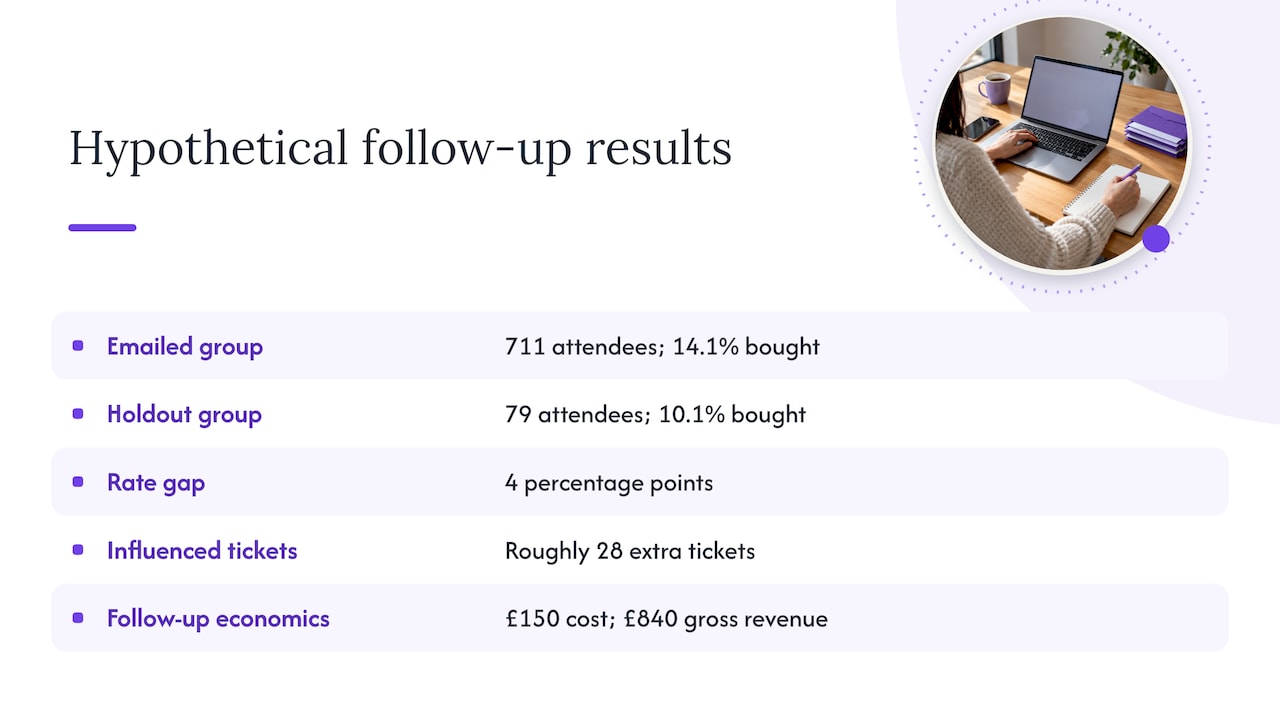
A promoter sells 860 tickets for a 1,000-capacity show. Scans show 790 people attended and 70 did not. The promoter emails the 790 attendees but holds back 79 (10%) at random. Three weeks later, the next show goes on sale. Suppose 100 of the 711 emailed attendees buy (14.1%), against 8 of the 79 held back (10.1%).
The difference is four percentage points. Applied to 711 emailed people, that is roughly 28 extra tickets that the follow-up may have influenced. With only 79 people in the holdout, chance could explain a lot of that gap, so the promoter would repeat the test across several shows before relying on it. If the follow-up cost £150 in time and tools and each ticket averages £30, those 28 tickets would be worth £840 in gross revenue. Your own figures will differ.
To see how extra sales change your margin, enter your ticket price, costs and capacity into the tour break-even calculator and compare scenarios with and without the follow-up spend.
Turn results into your next budget
The debrief is where post-event marketing earns its keep. Hold it around day 5, once the first numbers are in, and cover four things: what sold, through which channel, at what cost, and what the audience said.
The GOV.UK guide for organisers of voluntary events gives advice that applies to any organiser: count takings from different sources separately afterwards, so you can see which activities performed well and plan the next budget more accurately. In concert terms, keep ticket revenue, bar, merchandise and sponsorship apart, and record marketing spend by channel.
Then update your assumptions:
- Replace estimated sell-through with actual sell-through.
- Replace guessed cost per ticket sold by channel with the real figure.
- Add the follow-up cost and any extra sales it can reasonably be credited with.
- Re-run break-even for the next date at several ticket prices.
If you want to forecast demand for the next date from early sales, our guides to forecasting ticket sales after the first week and testing whether a forecast is useful explain the inputs and the limits.
Keep your data records usable
Follow-up depends on clean customer records. Before you send anything, check that you have a lawful basis for contacting each person and that your messages carry a working unsubscribe. Our guide to ICO-compliant AI concert marketing covers the UK data protection side in more depth.
Also check how your ticket data reaches your marketing tools. If sales sit in one system and email lists in another, matching attendees to scans becomes a manual job after every show, which is when segmentation tends to get skipped.
How Lookport Ticketing supports the follow-up
We built Lookport Ticketing for concert promoters and venues. Our commission is 6%, with no other Lookport charges, and ticket proceeds go directly into your own Stripe account. Availability follows Stripe-supported countries. You can see the full detail on our pricing page.
For post-event work, the features to look at are audience CRM, customer data and campaigns and ticketing marketing integrations. See Lookport Ticketing for what is currently live.
Whatever platform you use, make sure it can export buyer and scan data by show, so you can build the segments in this guide.
A 30-day post-event timeline
Use this as a template and adjust the days to your own audience.
- Day 0 to 1: Post highlights on social media. Publish the post-event page. Check tracking.
- Day 1 to 2: Send the thank-you to attendees and the “missed you” note to ticket holders who did not attend. Set up the holdout group first.
- Day 3 to 5: Send the recap and survey. Hold the internal debrief on day 5 with first sales and cost figures.
- Week 2: Release short clips and a photo gallery. Share two or three survey findings and one change you will make.
- Week 3: Send next-date news or a mailing list invitation to the “interested, did not buy” segment.
- Week 4: Close the survey, analyse themes, compare holdout and emailed groups, and update the budget model.
- Day 30: Write a one-page summary: KPIs, what worked, what to change, and the next show’s revised break-even.
Common mistakes
- Sending nothing for a week. The thank-you loses its force and the audience moves on.
- Mixing attendees and no-shows in one message. The wording fits neither group.
- Counting opens as success. Opens say little about sales. Track purchases.
- Posting all the content on day one. Spread it, so the show stays visible for weeks.
- Asking too many survey questions. Response and quality both fall.
- Not recording the result. If the debrief does not change a number in your next budget, it was a conversation, not a debrief.
Qualitative signals count too. A comment from a promoter or booker who saw your clip may matter more than a thousand views. Record those as well as the figures.
FAQ
What is post-event marketing?
It is the set of activities that follow an event: follow-up messages, content reuse, segmentation, re-engagement and feedback collection. The aim is to extend the event’s value and set up the next one. For a concert promoter, that mostly means repeat ticket sales and better planning.
How soon should I email attendees after a show?
Within 48 hours is a sensible target, while the night is fresh. Follow with a recap and survey in days 3 to 5. Use your own open and click data over several shows to find the timing that suits your audience.
Which KPIs matter most?
Start with tickets purchased, conversions from follow-up links, revenue, social reach and engagement, and survey feedback. Add attendance rate and repeat buyers if your records allow. Define each metric before the show so you can compare results between events.
How do I know whether follow-up caused ticket sales?
Tag every link, hold back a random group from each send, and compare purchase rates after your next on-sale. Add a “how did you hear about us?” question for extra evidence. Small audiences give noisy results, so repeat the test across several shows.
What should I send to people who bought but did not attend?
Send a short recap with highlights and a way to hear about the next date first. Do not send a generic thank-you. Check your scan data before sending so the message matches what they did.
Next step
Take the figures from your last show, enter your costs, ticket price and capacity, and see how follow-up spend changes your break-even in the tour break-even calculator. When you are ready to sell the next date, look at Lookport Ticketing.
Sources
- What Is Post-Event Marketing? Definition and Guide, Kampfire
- Post-Event Marketing: The 30-Day Plan After Your Event, Attendir
- Maximizing Event Content Year-Round, Naylor
- A Complete Guide to Post Event Engagement, Gala PR
- Marketing and communications for events, VisitScotland
- Event Attendance Reporting Standards, ABC
- The can do guide to organising and running voluntary and community events, GOV.UK
- Ready-made music videos for social clips
Recommended
Ticketing & event budgeting
 2026-11-04
Accessible Tickets Policy for UK Events: What to Include
How to write an accessible tickets policy for UK shows: legal duties, companion tickets, pricing, evidence checks and booking information, with sources.
 2026-11-03
Abandoned Cart Recovery for Events: A UK Promoter's Guide
How UK promoters can cut ticket checkout drop-off and win back buyers: fixing fees, timing reminders, staying within PECR and measuring recovered revenue.
 2026-11-02
AI Ticket Sales Forecasting for UK Concerts: A Practical Guide
How UK promoters can forecast concert ticket sales with AI: the data to gather, a simple workflow, how to check the forecast and how to turn it into a budget.
 2026-11-01
Pricing by Venue Size: How to Set Ticket Prices for Any Capacity
Set ticket prices by venue size: break-even price per capacity, tier splits, a price floor and UK all-in pricing rules, with worked examples in pounds.
 2026-10-31
Group Ticket Strategy: Offers and Waitlists That Fill Seats
How UK promoters can design group ticket offers and run an event waitlist that fills seats without cutting full-price sales, with worked numbers and legal checks.
 2026-10-29
Stripe Payouts in the UK: Timing, Instant Payouts and Cash Flow for Promoters
How Stripe payouts work for UK event organisers: first payout wait, schedules, Instant Payout fees and limits, and how to plan show cash flow around them.