LOOKPORT / TICKETING & EVENT BUDGETING
Festival Marketing Plan: A UK Promoter's Guide for 2026
Build a festival marketing plan for UK audiences: goals, segments, channel mix, launch timeline, tracking and a budget check that shows your break-even.

A festival marketing plan is a dated document that links one number, tickets sold, to the audiences you target, the channels you pay for and the budget you can afford. It starts from your break-even point and works backwards. This guide shows you how to build one for a UK festival, in the order you would do the work.
TL;DR
- Start with break-even: work out how many tickets you must sell, then set marketing goals as a share of that figure.
- Split your audience into segments (super fans, casual attendees, people who have never been) and give each its own message and channel.
- Plan the lineup announcement as a sales event, with an email or sign-up list ready before it goes live.
- Mix paid, earned, shared and owned media. A mailing list alone will not grow the audience.
- Review sales against your forecast every week and move budget to the channels that produce tickets.
Table of Contents
- Start with the number the plan must deliver
- Know who you are selling to
- Understand when your audience buys
- Build the channel mix
- Treat the lineup announcement as a sales event
- A launch timeline you can adapt
- Set up tracking before you spend
- Review weekly and change the plan
- Where Lookport Ticketing fits
- FAQ
- Next step
- Sources
Start with the number the plan must deliver
Most templates open with “set your goals”. For a ticketed festival, the goal is already fixed by your costs. Artist fees, site, production, staffing, insurance, licensing and marketing all have to be covered by ticket revenue, plus any bar, sponsorship or vendor income you can rely on.
Do this first:
- List every cost, including the marketing budget itself.
- Set ticket prices by tier (early, general, VIP).
- Calculate the number of tickets at which revenue equals cost.
- Set a target above that number, so a weak last month does not turn into a loss.
The tour break-even calculator lets you model costs, ticket prices, revenue and break-even in one place. Change the ticket price or the marketing budget and you see the effect on the number of tickets you need. Our guide to the concert budget breakdown covers the UK cost lines in more detail.
Once you have that number, every later section of the plan answers one question: where will those tickets come from?
Know who you are selling to
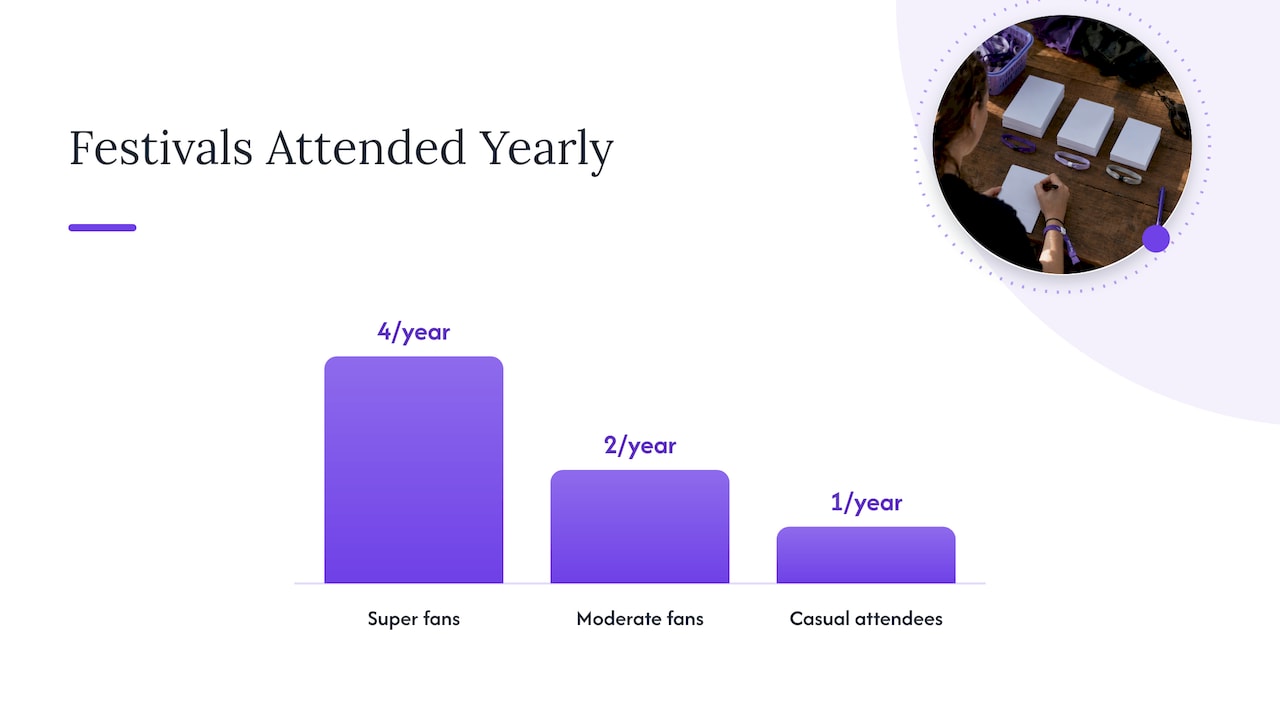
The UK festival audience is not one group. Research on UK festival-goers describes “super fans” as 28% of the audience. They attend about four festivals a year, against two for moderate fans and one for casual attendees. They spend more on VIP tickets and influence the people around them.
That gives you three practical segments to plan for:
| Segment | What they need from you | Typical channels |
|---|---|---|
| Super fans | Early access, VIP options, clear reasons to pick you over other festivals | Email, artist and community channels, retargeting |
| Previous attendees | A reason to return and a good price | Email, direct traffic, social |
| New audiences | Awareness of what the festival is and who it is for | Paid social, search, partner and artist content |
Write one sentence of message for each. A super fan wants to know what is exclusive. Someone who has never attended wants to know what a day there looks like. Mixing the two in a single advert usually serves neither.
Cost is part of the picture too. Mintel’s 2026 UK concerts and festivals report says attendees judge events on the whole experience, not only the music. Convenience, food and drink, and flexibility all count. Your messaging should cover those things, not just the lineup.
Understand when your audience buys
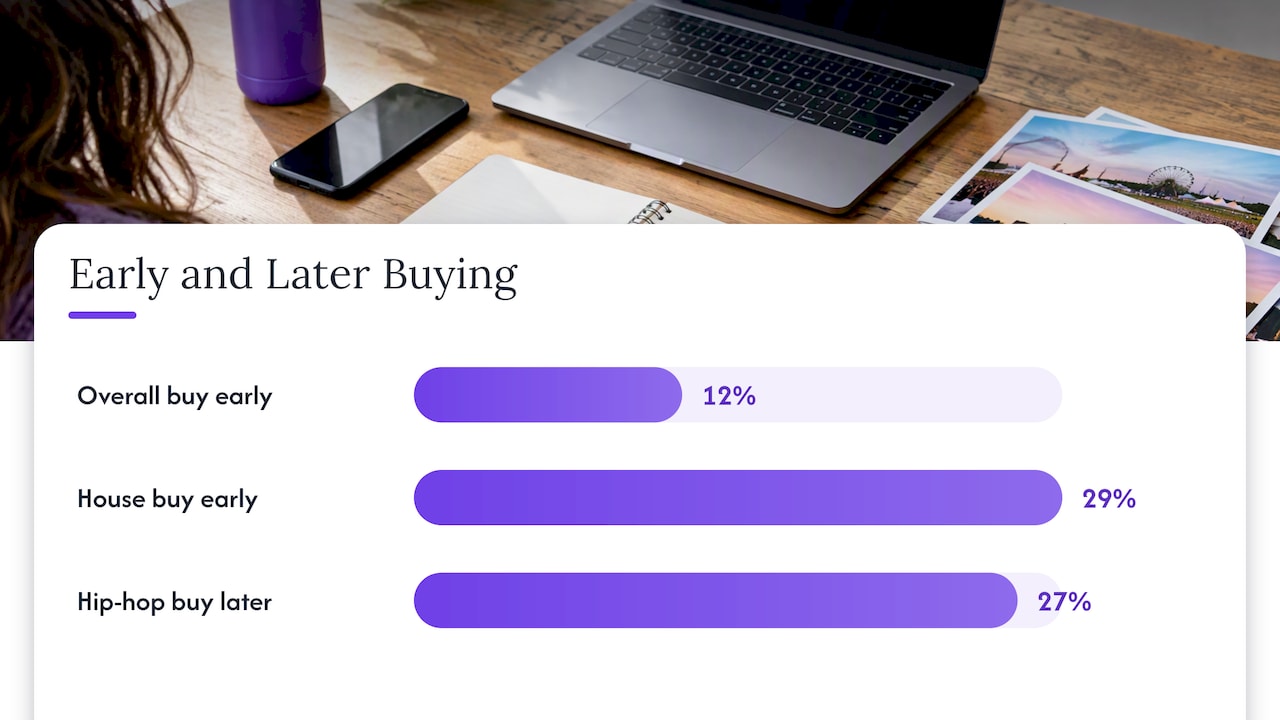
Timing drives your launch plan. The LIVE Audience Research (wave 6) found that 12% of people now buy early to be sure of attending. That was the strongest figure since lockdown. Most of the market still buys later. Some groups behave differently: the same research shows 29% of house music fans buy early to guarantee their place, while 27% of hip-hop fans say they buy later to afford the ticket.
Two things follow for your plan:
- Your genre changes your curve. A dance festival can reward early-bird tiers. A festival with a price-sensitive audience may need payment flexibility.
- Urgency has to be structured. Pushing “last chance” messages too early rarely moves people who are waiting to see what happens. Tiered releases and limited-access offers give a reason to act now without false pressure. Any urgency claim must also be true: do not say tickets are nearly gone when they are not.
If your audience skews younger and cost-sensitive, consider offering instalments or a deposit scheme and say so in your adverts. Mintel’s analyst commentary points to flexible payment options as a way to reach under-30s who feel financially squeezed.
Build the channel mix
A plan that relies on your existing mailing list will plateau. The list is valuable, but it is people who already know you. Growth comes from reaching people who do not.
Use the four-part PESO model to check balance:
- Paid: social ads, search, display, sponsored placements.
- Earned: press, playlists, reviews, artist interviews.
- Shared: artist and partner posts, fan content, creator coverage.
- Owned: email, website, social accounts, the ticket page itself.
For each channel, write down:
- The segment it targets.
- The action you want (sign-up, ticket purchase, share).
- The budget.
- The metric you will check weekly.
To avoid a channel list that is just a wish list, tie each channel to tickets. If you cannot say how many tickets a channel should produce, treat its budget as a test and cap it.
A hypothetical budget split
This is an illustration, not a benchmark. Suppose a 5,000-capacity festival sets a marketing budget of £40,000 and assigns it like this:
| Line | Share | Amount |
|---|---|---|
| Paid social and search, launch and general sale | 45% | £18,000 |
| Creative and content production | 20% | £8,000 |
| Email, CRM and sign-up campaign | 10% | £4,000 |
| Partner, artist and creator activity | 10% | £4,000 |
| Reserve for weeks when sales fall behind forecast | 15% | £6,000 |
The reserve matters. It lets you respond to the numbers rather than spend the full budget to a fixed calendar. Put your own figures into the calculator and see how many extra tickets the spend has to sell to pay for itself.
Treat the lineup announcement as a sales event
The lineup reveal is often the biggest single moment of demand in the campaign. Do not treat it only as an awareness post. Prepare for it:
- Open a sign-up list before the reveal. Offer early access to a presale. Segment sign-ups by interest if you can.
- Prepare the ticket page. Test checkout on mobile before launch. Check that the price tiers and fees are shown clearly.
- Sequence your messages. Teaser, reveal, presale access, general sale, each with a different message and audience.
- Have the budget ready. Paid media is most useful when there is something to buy straight away.
- Watch the first 48 hours. Early sales speed tells you whether your forecast is realistic. Our guides on presale velocity and forecasting sales after the first week explain how to read it.
The general sale is also a commercial test. Strong presale numbers can hide weak demand beyond your core fans, so judge the plan on general sale performance too.
A launch timeline you can adapt
Timings depend on festival size and genre, so treat these as a starting structure rather than a rule. Larger festivals plan further ahead.
| Phase | What happens |
|---|---|
| Planning | Break-even model, segments, budget, tracking set-up |
| Pre-launch | Brand assets, sign-up page, first artist and partner conversations |
| Launch | Lineup reveal, presale, first paid campaigns |
| Sustain | General sale, retargeting, content from artists and the site, VIP and upgrade offers |
| Final push | Last-chance messages (only where true), travel and practical information, remaining inventory |
| After the event | Survey, sales and channel review, lists for next year |
The After the event line is the one most often skipped. Next year’s early demand starts with this year’s email list and the data about where your buyers came from.
Set up tracking before you spend
You cannot move budget towards what works if you cannot see what works. Before launch:
- Make sure your ad pixel fires on the right events. Our Meta Pixel checks cover three tests to run first.
- Use consistent campaign tags on every link.
- Decide which report is the source of truth for sales. Ad platforms and ticketing reports often disagree.
- Read our guide to connecting campaign reports to ticket sales so you can compare channels fairly.
If you use email or other electronic marketing, follow the rules. The ICO explains how to comply with PECR’s electronic mail marketing rules, including consent. Check what permission you hold before you email a list from a previous year or from a partner.
Review weekly and change the plan
A plan is a set of forecasts. Each week, compare:
- Tickets sold against the forecast curve.
- Cost per ticket by channel.
- Share of buyers who are new and share who are returning.
- Sales by tier, including VIP.
If sales are behind, decide from evidence. Is the problem awareness (few visits), conversion (many visits, few purchases) or price? Each has a different fix. More spend is not the answer to a checkout problem.
AI forecasting can help here, but it is a method, not a guarantee. It needs clean sales history and tracked sources, and its output should be checked against what you see. Our guides on AI ticket forecasts for concert budgets and ICO-compliant AI concert marketing explain the inputs, validation and limits.
If you sell VIP, plan the upsell as part of the marketing, not an afterthought. See our VIP upsell tactics.
Where Lookport Ticketing fits
Marketing only pays off if the ticket journey is clear and the economics are known. Lookport Ticketing charges a 6% commission with no other Lookport charges, listed on our pricing page. Ticket proceeds go directly into your own Stripe account. Availability follows Stripe-supported countries. Our marketing integrations page describes what connects to the ticketing platform. For fee modelling, see ticketing fees explained.
Add the 6% commission to your cost model before you set ticket prices, so your break-even number is accurate.
FAQ
What should a festival marketing plan include?
It should include a break-even target, audience segments, messages, a channel mix with budgets, a launch timeline, tracking and a weekly review routine. Add a reserve budget for weeks that fall behind forecast.
How far ahead should I start marketing a festival?
It depends on the size and the genre, so work back from your lineup announcement and general sale dates. Larger festivals need longer to build a sign-up list and test creative. Build the sequence around your own sales curve and adjust it once presale figures arrive.
How much should I spend on marketing?
There is no single correct share. Set the budget from your break-even model: marketing is a cost line that the extra tickets must cover. Keep part of it in reserve and cap channels that cannot show tickets sold.
Is an email list enough to sell out a festival?
Rarely. Your list reaches people who already know you, so it limits growth. Combine owned channels with paid, earned and shared media aimed at new audiences, and check your consent for any email under PECR.
Next step
Before you write another channel plan, model your costs and break-even in the calculator. Then, when the numbers work, set up ticketing with Lookport.
Sources
- Attract Your Music Festival’s Most Valuable Fans (UK)
- UK Music Concerts and Festivals Market Report 2026, Mintel
- LIVE Audience Research Wave 6
- ICO: How do we comply with the PECR electronic mail marketing rules?
Recommended
Ticketing & event budgeting
 2026-10-22
Ticketing Analytics for UK Promoters: What to Track and Why
Ticketing analytics for UK concert promoters: the metrics that drive decisions, how to set up tracking, and how to tie sales data back to your show budget.
 2026-10-21
Concert Break-Even Calculator: How Many Tickets You Must Sell
Work out how many tickets a UK concert needs to break even. Costs, PRS, ticket commission, a worked example and a free calculator for promoters and venues.
 2026-10-19
Ticket Sales Break-Even Analysis for UK Shows
Work out how many tickets you must sell to cover a UK show: VAT, PRS, fees, fixed costs and a worked example, plus a free break-even calculator.
 2026-10-18
Refund Policy for Concerts: What UK Promoters Must Offer
What UK law and industry rules require when a concert is cancelled, moved or the buyer changes their mind, plus how to write a clear refund policy.
 2026-10-15
Facebook Ads for UK Promoters: Track Ticket Sales Before Spend
UK promoters can set up Meta pixel and Conversions API tracking, choose audiences, estimate ticket costs, and link Facebook ad spend to ticket revenue.
 2026-10-14
Profit Margins: Test 10 P&L Lines for UK Concert Promoters
See how UK concert promoters can model profit per show with 10 P&L inputs, test sell through and costs, and check break even before committing a deposit.