LOOKPORT / TICKETING & EVENT BUDGETING
Promo Code Strategy for Ticket Sales: A UK Promoter's Guide
Plan a ticket promo code strategy that sells seats without eroding full-price sales: code types, limits, UK pricing rules and how to measure profit.

A good promo code strategy gives one defined group of buyers a reason to buy now, caps the cost of the discount in advance and is judged on profit, not on codes redeemed. Start from your break-even point, decide how many seats a code must add, and set the limits (audience, quantity, expiry) before the code goes live. If a code mostly discounts people who would have paid full price, it lowers profit.
This guide is for UK concert promoters, festival organisers and venue operators. It covers the goal of a code, the types you can use, how to set terms, how to distribute codes, the UK pricing rules that apply, and how to measure the result. If you want to test a discount against your costs, the tour break-even calculator models ticket price, costs, revenue and break-even in one place.
TL;DR
- Set the goal first: fill a specific gap (a slow first week, a weak midweek date, an unsold block), not “drive sales” in general.
- Choose the code type that matches the goal: time-limited early bird, single-use, group, audience-specific or last-minute.
- Write the terms before launch: eligibility, ticket limit per code, expiry and what happens if the show sells out.
- Check every offer against UK price transparency rules, so the price shown includes mandatory fees.
- Judge the campaign on net revenue against break-even, comparing sales with and without the code.
Table of Contents
- What a promo code strategy is for
- Which promo code types work for concerts and festivals
- How to set eligibility, limits and expiry
- How to distribute codes without weakening full-price sales
- UK price rules that affect promo codes
- Where Lookport fits
- How to measure whether a code worked
- A simple workflow for your next show
- FAQ
- Sources
What a promo code strategy is for
A promo code is a price reduction you control. Unlike a public price cut, you decide who receives it, how many can use it and when it stops. That control is the whole point. A code that anyone can find and use is a price cut with extra steps.
For a promoter, a code should do one of four jobs:
- Pull sales forward. Early demand tells you whether the show will work and brings cash in sooner.
- Reach a new audience. A code for students, a partner venue’s mailing list or a local community group puts the show in front of people who would not otherwise see it.
- Fill a specific gap. A weak date on a tour, a block of upper-tier seats, a midweek night.
- Reward existing fans. A presale code for previous attendees builds repeat attendance.
Pick one job per code. A code that tries to do all four usually ends up as a general discount.
Start from break-even, not from the discount
Before you pick a percentage, know how many tickets you must sell to cover costs. Your break-even depends on fixed costs (artist fee, venue hire, production, marketing, insurance), variable costs per head and what you net per ticket after fees.
Here is a hypothetical example, for illustration only. Assume a 1,000-capacity show, £15,000 of fixed costs and a £25 ticket. We ignore VAT and other variable costs to keep the sums clear.
| Scenario | Net per full-price ticket | Net per discounted ticket | Tickets needed to break even |
|---|---|---|---|
| No discount | £23.50 | n/a | 639 |
| 200 early-bird tickets at 15% off (£21.25) | £23.50 | £19.98 | 669 |
The net figures assume Lookport’s 6% commission, which is £1.50 on a £25 ticket and £1.28 on a £21.25 ticket. Under the 15% early-bird offer, break-even rises by 30 tickets. So the code must bring in more than 30 extra sales that would not have happened otherwise, or bring them earlier in a way that reduces your risk, to be worth running.
That is the test for every code in this guide. Put your own figures into the tour break-even calculator before you set the discount.
Which promo code types work for concerts and festivals
The retail guides that rank for this topic focus on first-purchase discounts, free shipping and cart recovery. Some of that transfers to events. Much does not: a ticket is perishable, capacity is fixed and nobody comes back next week for the same seat. These are the types that fit live events.
Time-limited early bird
A discount that ends on a date gives fans a reason to buy today. Ben Curthoys, a UK ticketing practitioner, argues from box-office experience that deadline-based discounts work better than “first 50 tickets cheap” offers, because a quantity cap lets buyers wait and can leave discounted tickets on sale at the door if the show underperforms. This is one practitioner’s view, but the logic is easy to test against your own sales curve.
Use a fixed end date that suits your sales pattern, and make sure it falls well before the show.
Single-use codes
A single-use code works once and then expires. It suits one-to-one situations: an apology to a customer, a guest-list swap, a prize or a sponsor giveaway. Because a code cannot be forwarded and reused, you know exactly how many discounted tickets exist. The cost of the discount is the number of codes issued multiplied by the discount, which you can set in advance.
Multi-use codes with a cap
A shared code (for a partner, a newsletter or a radio promotion) can be used by many people. Always cap total redemptions and set an expiry. Without a cap, a shared code posted to a voucher site can be used by people you never intended to reach.
Presale and loyalty codes
Give previous buyers early access, or a modest discount, before general sale. This rewards your most reliable audience and gives you an early read on demand. It pairs well with a presale pacing approach. Our guide to using presale velocity to set prices explains how to read the first 48 hours of sales.
Group codes
A code for four or more tickets lifts the average order and brings friends who would not otherwise attend. It works best on seated or standing events where one buyer can organise the party. See our group ticket strategy guide for offers and waitlists that fill seats.
Last-minute codes
If a show is behind target close to the date, a short code sent to your mailing list can fill remaining seats. Keep it narrow and short. Used regularly, it teaches fans to wait for a discount.
Partner and community codes
A code for a university society, a local business or a charity partner gives that partner a reason to promote the show. Agree the quantity, the expiry and what the partner may do with the code. The Wembley example below shows why that last point matters.
How to set eligibility, limits and expiry
Terms are what keep a code from turning into an uncontrolled discount. Write them before the code exists, and publish them where the buyer can see them.
The FA’s Wembley match ticket terms show how a large UK promoter structures code conditions. They state that:
- offers are subject to availability;
- a code is specific to one match and expires on match day;
- codes cannot be exchanged or transferred, and cannot be redeemed for cash;
- there is a maximum of eight tickets per match per code;
- only codes issued by authorised third parties are valid;
- the organiser may cancel or withdraw any code at any time.
You do not need the same wording, but each point answers a question you should settle for your own events.
The terms checklist
| Term | Question to answer | Example approach (hypothetical) |
|---|---|---|
| Eligibility | Who may use it? | Previous attendees, a named partner’s members |
| Quantity per order | How many tickets per code? | Up to four per order |
| Total redemptions | How many uses overall? | A set number agreed against your break-even |
| Expiry | When does it stop? | A fixed date weeks before the show |
| Applies to | Which shows and tiers? | One date, general admission only |
| Transfer | Can the ticket be passed on? | Follow your normal ticket terms |
| Withdrawal | Can you cancel the code? | Reserve the right in the terms |
| Stacking | Can it combine with other offers? | One code per order |
Two practical points. First, keep the quantity cap per order low enough that a reseller cannot buy a block at a discount. Our guide to secondary ticketing law in the UK explains what promoters need to know about resale. Second, put the expiry in the code’s name or the email that carries it, so fans do not have to hunt for it.
How to distribute codes without weakening full-price sales
The risk with any discount is that it moves buyers from full price to a lower price. You limit that by controlling who sees the code and when.
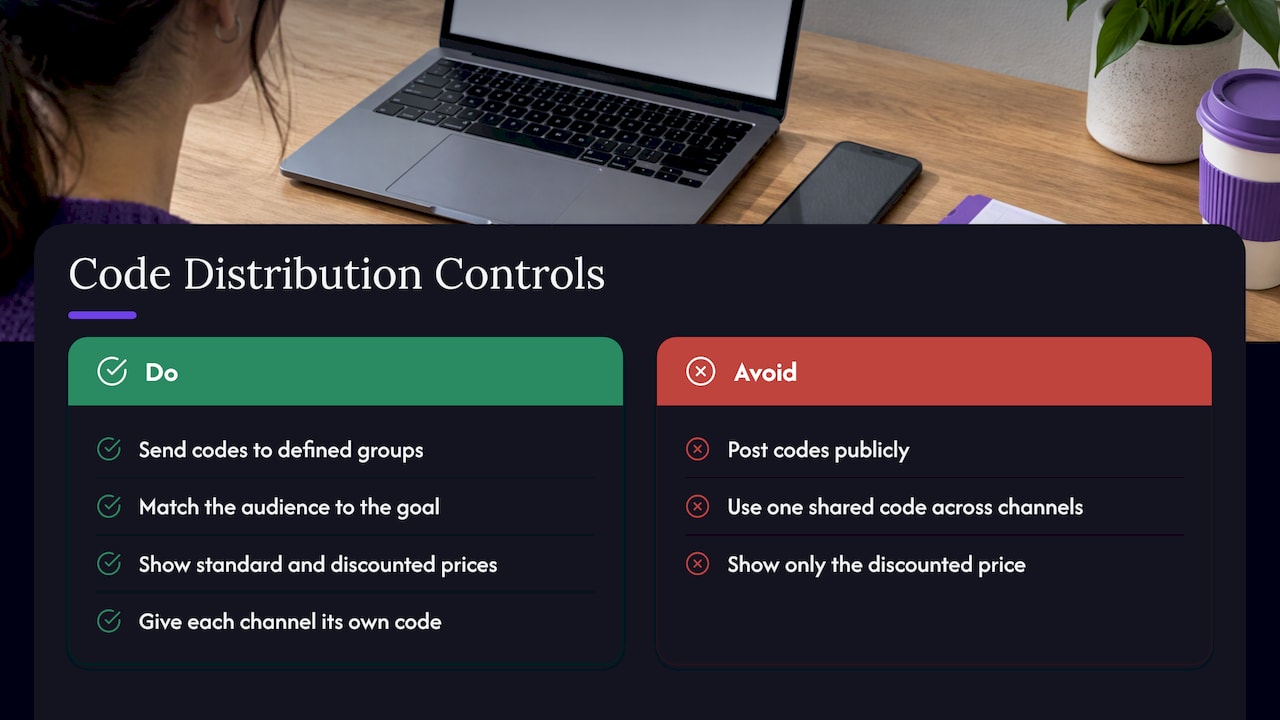
Keep codes out of public view. A code in a social post or on a voucher site is visible to everyone, including fans who would have paid full price. Send codes to defined groups: a mailing list segment, a partner’s members, previous buyers.
Match the audience to the goal. If the goal is new fans, send the code through a channel your existing buyers do not use. If the goal is loyalty, send it only to people who have bought before.
Hold the full price visible. Show the standard price alongside the discounted one. The code should look like a benefit for a group, not a new price for everyone.
Use a different mechanism where a code is not needed. If demand is strong, a price rise by tier can protect revenue better than a discount. If demand moves quickly, dynamic ticket pricing is a different tool, and you should read how it works before combining it with codes.
Track the source of each code. Give every partner or channel its own code. A shared code cannot tell you which channel worked. If you run paid social, check that purchase events are reaching your ad account correctly. Our Meta Pixel events checklist gives three checks to make before you promote a concert.
UK price rules that affect promo codes
A discount only helps if the price you show is the price the buyer pays. UK rules on drip pricing, where mandatory charges appear late in the purchase, apply to ticket sales. Reed Smith’s summary of the CMA’s final price transparency guidance explains that under the Digital Markets, Competition and Consumers Act (DMCC), the full price must be given upfront, and that the CMA can fine firms up to 10% of global turnover for the most serious breaches.
For a promoter, three points follow:
- Show the total price. If a booking fee is mandatory, include it in the price you advertise. A discount of 15% on a base price that then gains a fee at checkout can look misleading.
- Make the saving real. Do not show a crossed-out “was” price that was never charged.
- State conditions clearly. Limits, expiry and eligibility belong on the offer page and in the email, not only in small print.
Our guide on UK ticket fee strategy covers this in more depth. This is general information, not legal advice. For a specific offer or a pricing structure you are unsure about, ask a solicitor who works with consumer law.
Where Lookport fits
Lookport Ticketing charges a 6% commission with no other Lookport charges, and ticket proceeds go directly into your own Stripe account. That makes the arithmetic of a discount simple: every ticket sold, at any price, carries the same percentage, so you can model the net per ticket as in the table above. Availability follows Stripe-supported countries.
You can see how the platform works on the Ticketing page and read the commission terms on the pricing page.
If you are still comparing platforms, our guide on how to choose a ticketing platform lists what to check.
How to measure whether a code worked
Redemptions are not results. A code redeemed 300 times may have added 300 sales or none. Measure it with five steps.

1. Set the baseline before launch
Record how many tickets you expect to sell in the code period without the code. Use sales from comparable past shows, the pace of your presale and your mailing list size. For a structured approach, see our guide to running a sales pacing forecast. A forecast is an estimate, not a promise, and it is only as good as the past data you feed it.
2. Track each code separately
Record redemptions, tickets per order, revenue and the date of each redemption by code. This shows which channel or group responded.
3. Estimate incremental sales
Compare actual sales with the baseline. Where possible, hold back a comparable group: send the code to half of a mailing list and not the other half, then compare conversion. This is the cleanest way to see how many buyers the code created rather than discounted.
4. Calculate net profit effect
Use a simple formula for the discount period:
Net effect = (extra tickets × net discounted price) − (tickets that would have sold anyway × discount per ticket)
A hypothetical example, for illustration only. A 15% code on a £25 ticket is used 200 times. Your comparison suggests 150 of those sales were extra, and 50 would have happened at full price. Net per discounted ticket is £19.98 and net per full-price ticket is £23.50, so the difference is £3.53 (rounded). The 150 extra sales add about £2,996. The 50 discounted sales that would have happened anyway cost about £176. The code adds roughly £2,820 net of that loss. If only 20 of the 200 had been extra, the same code would lose money.
5. Check against break-even
Re-run your break-even with the actual numbers. Did the code move you closer to covering costs, or reduce the margin you need once you pass break-even? The calculator lets you change ticket price and costs and see the effect.
Common mistakes
- Quantity-based codes with no deadline. Curthoys notes that a “first 50 tickets” style offer can leave buyers waiting and can still apply at the door if the show flops. Prefer a deadline.
- No cap on redemptions. A shared code needs a total limit.
- Discounting a show that is already selling. If your presale is ahead of forecast, you do not need the code.
- Judging on redemptions. Track incremental sales and net profit.
- Using one code for every channel. You will not know what worked.
- Hiding fees until checkout. This conflicts with UK price transparency rules and undermines the offer.
A simple workflow for your next show
- Calculate break-even at full price.
- Identify the gap the code must fill, and how many tickets.
- Choose the code type and the audience.
- Set the discount so the maximum cost is known in advance.
- Write the terms: eligibility, limits, expiry.
- Check that the advertised price is the total price.
- Send the code to the defined audience only.
- Track by code, compare with the baseline and re-run break-even.
When you have decided on pricing and are ready to sell, set up Ticketing with Lookport and keep the proceeds in your own Stripe account.
FAQ
What is a good discount percentage for a concert promo code?
There is no standard figure. Work backwards from break-even: the discount must be small enough that the extra sales it brings outweigh the revenue lost on buyers who would have paid full price. Model two or three percentages in the calculator and choose the one that moves break-even least for the sales you need.
Should I use a time limit or a ticket limit?
A time limit is usually the safer choice. A deadline gives fans a reason to buy now, while a ticket limit can let buyers wait and can leave discounted tickets on sale late if sales are slow. You can combine a deadline with a total redemption cap to control cost.
How do I stop codes being shared or resold?
Use single-use codes where you can, keep the number of tickets per order low, and send multi-use codes only to defined groups. Set an expiry and reserve the right to withdraw a code in your terms, as large UK promoters do in their published conditions.
How do I know if a promo code increased sales?
Compare actual sales in the code period with a baseline from similar past shows, or send the code to half of a list and compare. Then calculate net revenue after the discount and check it against break-even. Redemption counts alone do not show whether sales were extra.
Do UK pricing rules apply to ticket discounts?
Yes. The DMCC Act requires the full price, including mandatory fees, to be shown upfront, so a discount must be applied to a price that is not later increased by mandatory charges. For a specific offer, take advice from a solicitor who works with consumer law.
Sources
- FA Match Tickets: Terms and Conditions of Sale and Issue (Wembley Stadium)
- Full price, no surprises: CMA’s final price transparency guidance arrives (Reed Smith)
- Ben on Ticketing: 2017
Recommended
Ticketing & event budgeting
 2026-11-22
Multi-Currency Ticketing: A UK Promoter's Guide to Fees and FX
How multi-currency ticketing works for UK promoters: settlement currencies, card and conversion fees, refunds, and a worked example to budget it before you sell.
 2026-11-21
Tour Announcement Strategy: A UK Promoter's Plan
Plan a tour announcement from break-even to on-sale: lead times, sequence, channels, first-48-hour measures and budget, with a worked UK example.
 2026-11-20
Last-Minute Ticket Sales Tactics for UK Promoters
A practical plan for the final weeks before a show: diagnose slow sales, work out your break-even gap, target the right audiences and stay within UK pricing rules.
 2026-11-19
Secondary Market Monitoring for UK Promoters
What secondary market monitoring means for UK promoters: which resale signals to watch, what they tell you about demand, and how to act on them within the rules.
 2026-11-18
Marketing Budget Allocation for Concerts: A UK Promoter's Guide
Set a concert marketing budget from gross potential and ticket margin, split it by sales phase and channel, and know when to move money. UK worked example.
 2026-11-17
Ticket On-Sale Timeline: A Planning Schedule for UK Promoters
Plan your ticket on-sale timeline: announcement, presale, general sale and final push, with a week-by-week schedule and a worked example for UK promoters.